
Penny Dreadfuls, 1849 · page 300 of 394
The Mysteries of the Court of London — page 300: what you’re looking at
A restored page from Penny Dreadfuls, 1849. Page through the whole issue in the reader above.
📄 Transcribed text from this page (OCR, searchable)
Machine-transcribed from the original scan — historical spelling and the odd misread are preserved.
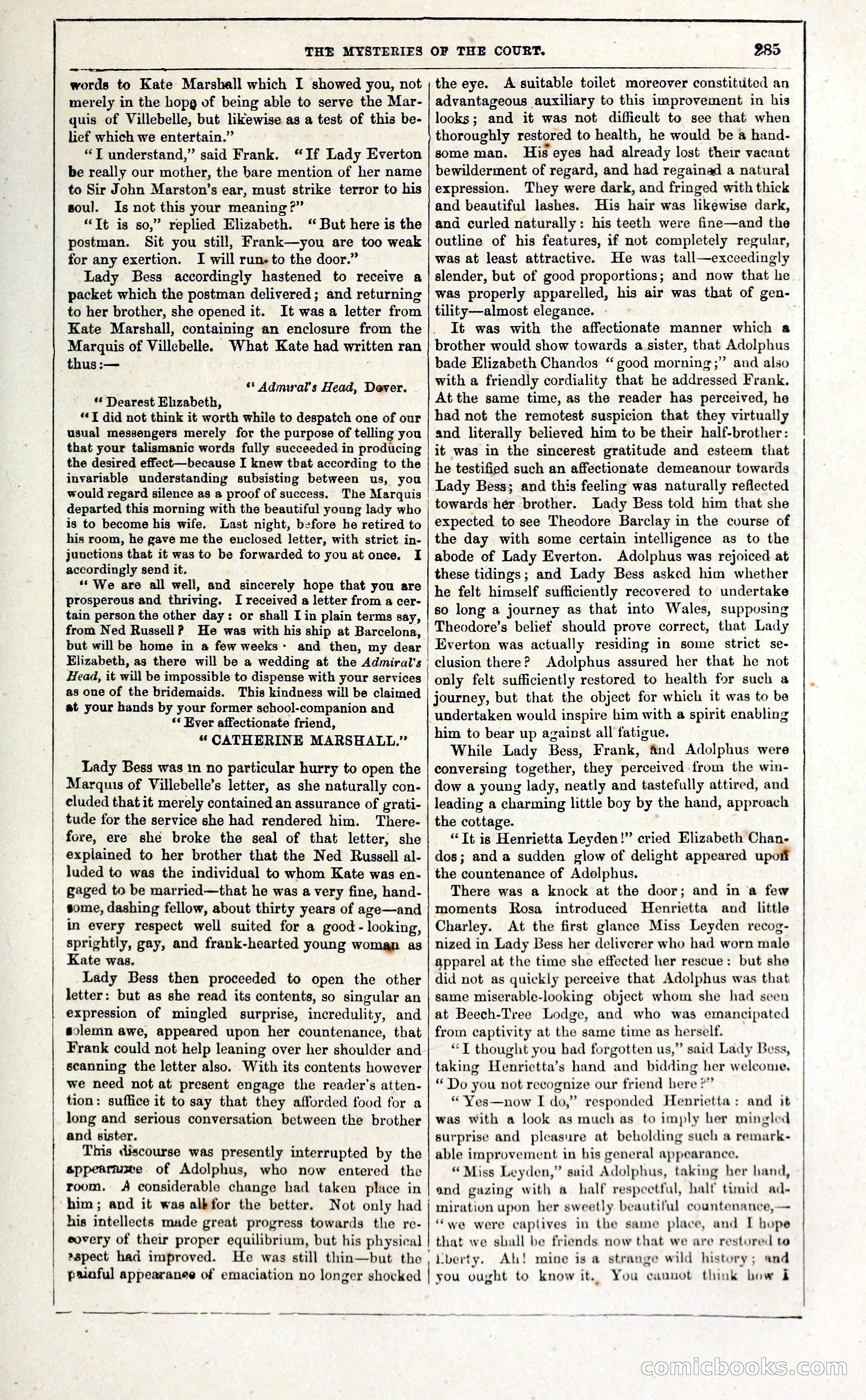
THE MYSTERIES OF THE COURT. words to Kate Marshall which I showed you, not merely in the hopg of being able to serve the Mar- quis of Villebelle, but likewise as a test of this be- lief which we entertain.” “T understand,” said Frank. be really our mother, the bare mention of her name to Sir John Marston’s ear, must strike terror to his soul. Is not this your meaning?” “It is so,” replied Elizabeth. postman. Sit you still, Frank—you are too weak for any exertion. I will run. to the door.” Lady Bess accordingly hastened to receive a “Tf Lady Everton “ But here is the packet which the postman delivered; and returning to her brother, she opened it. It was a letter from Kate Marshall, containing an enclosure from the Marquis of Villebelle. What Kate had written ran thus :— * Admiral’s Head, Dever. ‘* Dearest Elizabeth, “TI did not think it worth while to despatch one of our usual messengers merely for the purpose of telling you that your talismanic words fully succeeded in producing the desired effect—because I knew tbat according to the invariable understanding subsisting between us, you would regard silence as a proof of success. The Marquis departed this morning with the beautiful young lady who is to become his wife. Last night, before he retired to his room, he gave me the euclosed letter, with strict in- junctions that it was to be forwarded to you at onee. I accordingly send it. ‘* We are all well, and sincerely hope that you are prosperous and thriving. I received a letter from a cer- tain person the other day: or shall I in plain terms say, from Ned Russell? He was with his ship at Barcelona, but will be home in a few weeks- and then, my dear Elizabeth, as there will be a wedding at the Admiral's Head, it will be impossible to dispense with your services as one of the bridemaids. This kindnegs will be claimed at your hands by your former school-companion and ‘« Ever affectionate friend, “ CATHERINE MARSHALL.” Lady Bess was in no particular hurry to open the Marquis of Villebelle’s letter, as she naturally con- cluded that it mer rely contained an assurance of grati- tude for the service she had rendered him. There- fore, ere she broke the seal of that letter; she explained to her brother that the Ned Russell al- luded to was the individual to whom Kate was en- gaged to be married—that he was a very fine, hand- some, dashing fellow, about thirty years of age—and in every respect well suited for a good - looking, sprightly, gay, and frank-hearted young woman as Kate was. Lady Bess then proceeded to open the other letter: but as she read its contents, so singular an expression of mingled surprise, incredulity, and solemn awe, appeared upon her countenance, that Frank could not help leaning over her shoulder and scanning the letter also. With its contents however we need not at present engage the reader’s atten- tion: suffice it to say that they afforded food for a long and serious conversation between the brother and sister. Tims discourse was presently interrupted by the sppearmme of Adolphus, who now entered the room. A considerable change had taken place in him; and it was alkfor the better. 2895 the eye. A suitable toilet moreover constituted an advantageous auxiliary to this improvement in his looks; and it was not difficult to see that when thoroughly restored to health, he would be a hand- some man. His eyes had already lost their vacant bewilderment of regard, and had regainad a natural expression. They were dark, and fringed with thick and beautiful lashes. His hair was likewise dark, and curled naturally: his teeth were fine—and the outline of his features, if not completely regular, was at least attractive. He was tall—exceedingly slender, but of good proportions; and now that he tility—almost elegance. - It was with the affectionate manner which a brother would show towards a sister, that Adolphus bade Elizabeth Chandos “ good morning;” and also with a friendly cordiality that he addressed Frank. At the same time, as the reader has perceived, he had not the remotest suspicion that they virtually and literally believed him to be their half-brother: it was in the sincerest gratitude and esteem that he testified such an affectionate demeanour towards Lady Bess; and this feeling was naturally reflected towards her brother. Lady Bess told him that she expected to see Theodore Barclay in the course of the day with some certain intelligence as to the abode of Lady Everton. Adolphus was rejoiced at these tidings; and Lady Bess asked him whether he felt himself sufficiently recovered to undertake so long a journey as that into Wales, supposing Theodore’s belief should prove correct, that Lady Everton was actually residing in some strict se- clusion there? Adolphus assured her that he not only felt sufficiently restored to health for such a journey, but that the object for which it was to be undertaken would inspire him with a spirit enabling him to bear up against all fatigue. While Lady Bess, Frank, &nd Adolphus were conversing together, they perceived from the win- dow a young lady, neatly and tastefully attired, and leading a charming little boy by the hand, approach the cottage. “It is Henrietta Leyden!” cried Elizabeth Chan- dos; and a sudden glow of delight appeared upoff the countenance of Adolphus. There was a knock at the door; and in a few moments Rosa introduced Henrietta and little Charley. At the first glance Miss Leyden recog- nized in Lady Bess her deliverer who had worn male apparel at the time she effected her rescue: but she did not as quickly perceive that Adolphus was that same miserable-looking object whom she had seen at Beech-Tree Lodge, and who was emancipated from captivity at the same time as herself. “T thought you bad forgotten us,” said Lady Bess, taking Henrictta’s hand and bidding her welcome. | Do you not recognize our friend here ?” Not only had | ”) “ Yes—now I do,” responded Henrietta: and it was with a look as much as to imply her mingled surprise and pleasure at beholding such a remark- able improvement in his general appearance. * Miss Leyden,” said Adolphus, taking her hand, and gazing with a half respectful, half timid ad- miration upon her sweetly beautiful countenance,— his intellects made great progress towards the re- | ‘‘we were captives in the same place, and I bope eovery of their proper equilibrium, but his physical | that we shall be friends now that we are restored to »spect had improved. He was still thin—but the , L:verty. Ah! mine is a strange wild history; and puaful appearanee of emaciation no longer shocked | you ought to know it. —_—_—_— ei a lh —_— Oe You cannot think bow i was properly apparelled, his air was that of gen- —— — Go JOO (Cc S (CO)