
Penny Dreadfuls, 1849 · page 302 of 394
The Mysteries of the Court of London — page 302: what you’re looking at
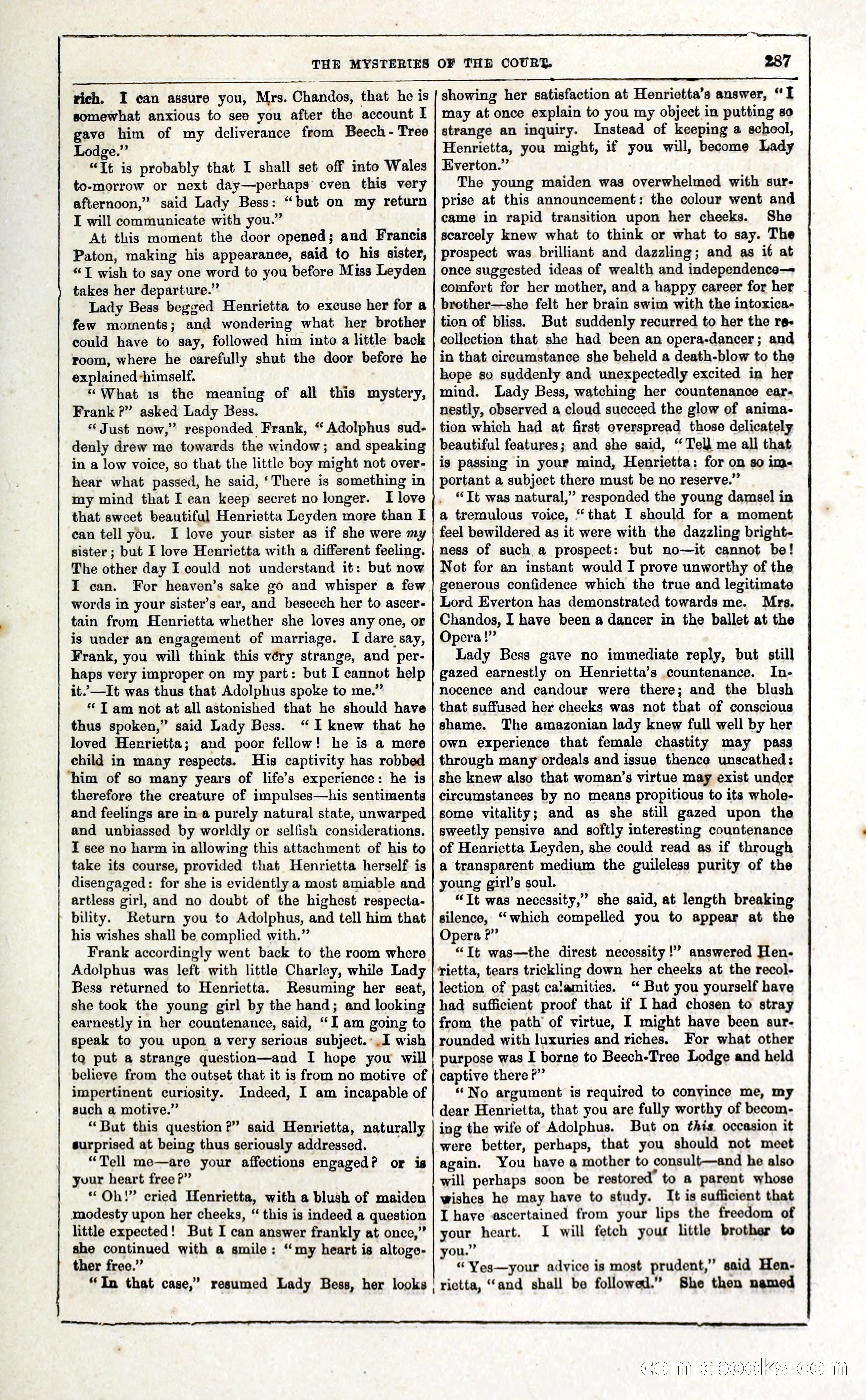
A restored page from Penny Dreadfuls, 1849. Page through the whole issue in the reader above.
📄 Transcribed text from this page (OCR, searchable)
Machine-transcribed from the original scan — historical spelling and the odd misread are preserved.
Pe THE MYSTERIES rich. I can assure you, Mrs. Chandos, that he is somewhat anxious to seo you after the account I gave him of my deliverance from Beech - Tree Lodge.” “It is probably that I shall set off into Wales to-morrow or next day—perhaps even this very afternoon,” said Lady Bess: “but on my return I will communicate with you.” At this moment the door opened; and Francis Paton, making his appearance, said to his sister, “‘T wish to say one word to you before Miss Leyden takes her departure.”’ Lady Bess begged Henrietta to excuse her for a few moments; and wondering what her brother could have to say, followed him into a little back room, where he carefully shut the door before he explained himself. ‘What is the meaning of all this mystery, Frank ?” asked Lady Bess. “Just now,” responded Frank, “ Adolphus sud- denly drew me towards the window; and speaking in a low voice, so that the little boy might not over- hear what passed, he said, ‘There is something in my mind that I ean keep secret no longer. I love that sweet beautiful Henrietta Leyden more than I can tell you. I love your sister as if she were my sister ; but I love Henrietta with a different feeling. The other day I.could not understand it: but now I can. For heaven’s sake go and whisper a few words in your sister’s ear, and beseech her to ascer- tain from Henrietta whether she loves any one, or is under an engagement of marriage. I dare say, Frank, you will think this véry strange, and per- haps very improper on my part: but I cannot help it. —It was thus that Adolphus spoke to me.” * T am not at all astonished that he should have thus spoken,” said Lady Bess. “I knew that he loved Henrietta; and poor fellow! he is a mere child in many respects. His captivity has robbed ‘him of so many years of life’s experience: he is therefore the creature of impulses—his sentiments and feelings are in a purely natural state, unwarped and unbiassed by worldly or selfish considerations. I see no harm in allowing this attachment of his to take its course, provided that Henrietta herself is disengaged: for she is evidently a most amiable and artless girl, and no doubt of the highest respecta- bility. Return you to Adolphus, and tell him that his wishes shall be complied with.” Frank accordingly went back to the room where Adolphus was left with little Charley, while Lady Bess returned to Henrictta. Resuming her seat, she took the young girl by the hand; and looking earnestly in her countenance, said, “I am going to speak to you upon a very serious subject.’ .I wish tq put a strange question—and I hope you will believe from the outset that it is from no motive of impertinent curiosity. Indeed, I am incapable of such a motive.” “But this question ?” said Henrietta, naturally surprised at being thus seriously addressed. “Tell me—are your affections engaged? or is yvur heart free ?” * Oh!” cried Henrietta, with a blush of maiden modesty upon her cheeks, “ this is indeed a question little expected! But I can answer frankly at once,” she continued with a smile: “my heart is altoge- ther free.” “In that case,’ resumed Lady Bess, her looks OF THE COURT. 287 showing her satisfaction at Henrietta’s answer, “TI may at once explain to you my object in putting so strange an inquiry. Instead of keeping a school, Henrietta, you might, if you will, become Lady Everton.” The young maiden was overwhelmed with sur- prise at this announcement: the colour went and came in rapid transition upon her cheeks. She scarcely knew what to think or what to say. The prospect was brilliant and dazzling; and as if at once suggested ideas of wealth and independence— comfort for her mother, and a happy career for her brother—she felt her brain swim with the intoxica- tion of bliss. But suddenly recurred to her the re- collection that she had been an opera-dancer; and in that circumstance she beheld a death-blow to the hope so suddenly and unexpectedly excited in her mind. Lady Bess, watching her countenance ear- nestly, observed a cloud succeed the glow of anima- tion which had at first overspread those delicately beautiful features; and she said, “Tell me all that is passing in your mind, Henrietta: for on so im- portant a subject there must be no reserve.” “Tt was natural,” responded the young damsel in a tremulous voice, “that I should for a moment feel bewildered as it were with the dazzling bright- ness of such a prospect: but no—it cannot be! Not for an instant would I prove unworthy of the generous confidence which the true and legitimate Lord Everton has demonstrated towards me. Mrs. Chandos, I have been a dancer in the ballet at the Opera!” Lady Bess gave no immediate reply, but still gazed earnestly on Henrietta’s countenance. In- nocence and candour were there; and the blush that suffused her cheeks was not that of conscious shame. The amazonian lady knew full well by her own experience that female chastity may pass through many ordeals and issue thence unscathed: she knew also that woman’s virtue may exist under circumstances by no means propitious to its whole- some vitality; and as she still gazed upon the sweetly pensive and softly interesting countenance of Henrietta Leyden, she could read as if through a transparent medium the guileless purity of the young girl’s soul. “Tt was necessity,” she said, at length breaking silence, “which compelled you to appear at the Opera ?” “It was—the direst necessity!’ answered Hen- rietta, tears trickling down her cheeks at the recol- lection of past ca!amities. ‘ But you yourself have had sufficient proof that if I had chosen to stray from the path’ of virtue, I might have been sur- rounded with luxuries and riches. For what other purpose was I borne to Beech-Tree Lodge and held captive there P” “No argument is required to convince me, my dear Henrietta, that you are fully worthy of becom- ing the wife of Adolphus. But on this. occasion it were better, perhaps, that you should not meet again. You have a mother to consult—and he also will perhaps soon be restored to a parent whose wishes he may have to study. It is sufficient that I have ascertained from your lips the freedom of your heart. I will fetch your little brother to ou.” “ Yes—your advice is most prudent,” said Hen- 'rietta, “and shall be followed.” She then named ee te Go JOO S (CO)