
Penny Dreadfuls, 1849 · page 331 of 394
The Mysteries of the Court of London — page 331: what you’re looking at
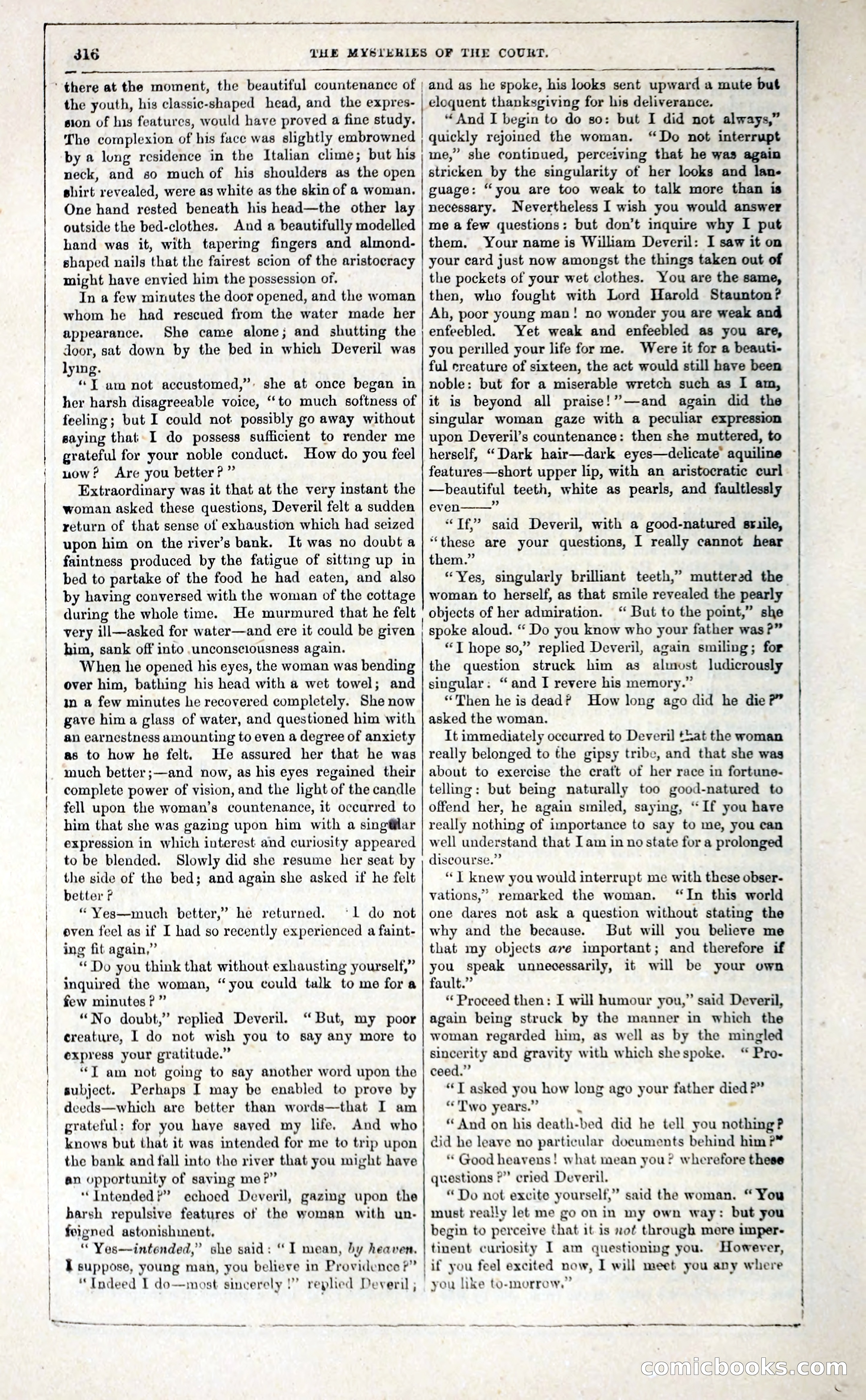
A restored page from Penny Dreadfuls, 1849. Page through the whole issue in the reader above.
📄 Transcribed text from this page (OCR, searchable)
Machine-transcribed from the original scan — historical spelling and the odd misread are preserved.
316 THE MYSYERIES OF THE COURT. a eee -— ‘there at the moment, the beautiful countenance of | and as he spoke, his looks sent upward a mute but the youth, his classic-shaped head, and the expres- | eloquent thanksgiving for his deliverance. sion of his features, would have proved a fine study. “And I begin to do so: but I did not always,” The complexion of his face was slightly embrowned | quickly rejoined the woman. “Do not interrupt by a lung residence in the Italian clime; but his; me,” she continued, perceiving that he was again neck, and so much of his shoulders as the open | stricken by the singularity of her looks and lan- shirt revealed, were as white as the skin of a woman, | guage: “you are too weak to talk more than is One hand rested beneath his head—the other lay | necessary. Nevertheless I wish you would answer outside the bed-clothes. And a beautifully modelled | me a few questions: but don’t inquire why I put hand was it, with tapering fingers and almond-| them, Your name is William Deveril: I saw it on shaped nails that the fairest scion of the aristocracy | your card just now amongst the things taken out of might have envied him the possession of, the pockets of your wet clothes. You are the same, In a few minutes the door opened, and the woman | then, who fought with Lord Harold Staunton? whom he had rescued from the water made her | Ah, poor young man! no wonder you are weak and appearance. She came alone; and shutting the) enfeebled. Yet weak and enfeebled as you are, door, sat down by the bed in which Deveril was | you perilled your life for me. Were it for a beauti- lying. ful creature of sixteen, the act would still have been “JY am not accustomed,” she at once began in| noble: but for a miserable wretch such as I am, her harsh disagreeable voice, “‘to much softness of | it is beyond all praise!”—and again did the feeling; but I could not possibly go away without | singular woman gaze with a peculiar expression saying that I do possess sufficient to render me | upon Deveril’s countenance: then she muttered, to grateful for your noble conduct. How do you feel uow? Are you better?” Extraordinary was it that at the very instant the woman asked these questions, Deveril felt a sudden return of that sense of exhaustion which had seized upon him on the river’s bank. It was no doubt a faintness produced by the fatigue of sitting up in bed to partake of the food he had eaten, and also by having conversed with the woman of the cottage during the whole time. He murmured that he felt very ill—asked for water—and ere it could be given him, sank off into unconsciousness again. When he opened his eyes, the woman was bending over him, bathing his head with a wet towel; and in a few minutes he recovered completely. She now gave him a glass of water, and questioned him with an earnestness amounting to even a degree of anxiety as to how he felt, He assured her that he was much better ;—and now, as his eyes regained their complete power of vision, and the light of the candle fell upon the woman’s countenance, it occurred to him that she was gazing upon him with a singéilar expression in which interest and curiosity appeared to be blended. Slowly did she resume her seat by the side of the bed; and again she asked if he felt better P “ Yes—much better,’ he returned. ‘Ll do not even feel as if I had so recently experienced a faint- ing fit again,” “ Do you think that without exhausting yourself,” inquired the woman, “you could talk to me fora few minutes ?” “No doubt,” replied Deveril. “But, my poor creature, I do not wish you to say any more to express your gratitude.” features—short upper lip, with an aristocratic curl —beautiful teeth, white as pearls, and faultlessly even Ai “Tf” said Deveril, with a good-natured sraile, ‘these are your questions, I really cannot hear them.” “Yes, singularly brilliant teeth,’ muttered the woman to herself, as that smile revealed the pearly objects of her admiration. ‘ But to the point,” she spoke aloud. “ Do you know who your father was?” “T hope so,” replied Deveril, again smiling; for the question struck him as almovst ludicrously singular: “and I revere his memory.” “Then he is dead? How long ago did he die?” asked the woman. It immediately occurred to Deveril that the woman really belonged to the gipsy tribe, and that she was about to exercise the cratt of her race in fortune- telling: but being naturally too good-natured to offend her, he again smiled, saying, “If you have really nothing of importance to say to me, you can well understand that Iam in no state for a prolonged discourse.” “| knew you would interrupt me with these obser- vations,” remarked the woman. “In this world one dares not ask a question without stating the why and the because. But will you believe me that my objects ave important; and therefore if you speak unnecessarily, it will be your own fault.” “ Proceed then: I will humour you,” said Deveril, again being struck by the manner in which the woman regarded him, as well as by the mingled sincerity and gravity with which shespoke. “ Pro- “T am not going to say another word upon the | ceed.” subject. Perhaps I may be enabled to prove by} “I asked you how long ago your father died?” deeds—which are better than words—that I am| “Two years.” ‘A . ee — SS eee ee wv Ooms grateful: for you haye sayed my life. And who} “And on his death-bed did he tell you nothing? knows but that it was intended for me to trip upon | cid he leave no particular documents behind him?” the bank and fall into tho river that you might have | ‘ Goodheavens! what mean you? wherefore these an opportunity of saving me?” questions ?” cried Deveril. Intended?” echoed Deveril, gazing upon the} “Do not excite yourself,” said the woman. “ You harsh repulsive features of the woman with un- | must really let me go on in my own way: but you feigned astonishment. begin to perceive that it is not through mere imper- ‘“ Yes—intended,” she said: “I mean, by heaven. | tinent curiosity I am questioning you. However, I suppose, young man, you believe in Providence?” | if you feel excited now, I will meet you any where ‘ Indeed 1 do—most sincerely 1A replied Dever ; you like to-morrow,” = eee —_ _—— ee oe 2 tee ”~_-- -——_— —_>«# — — - + Se re ~ ——— ae eee =e herself, “Dark hair—dark eyes—delicate’ aquiline ~ — a ee +e eee Se eee . — eee