
Penny Dreadfuls, 1849 · page 338 of 394
The Mysteries of the Court of London — page 338: what you’re looking at
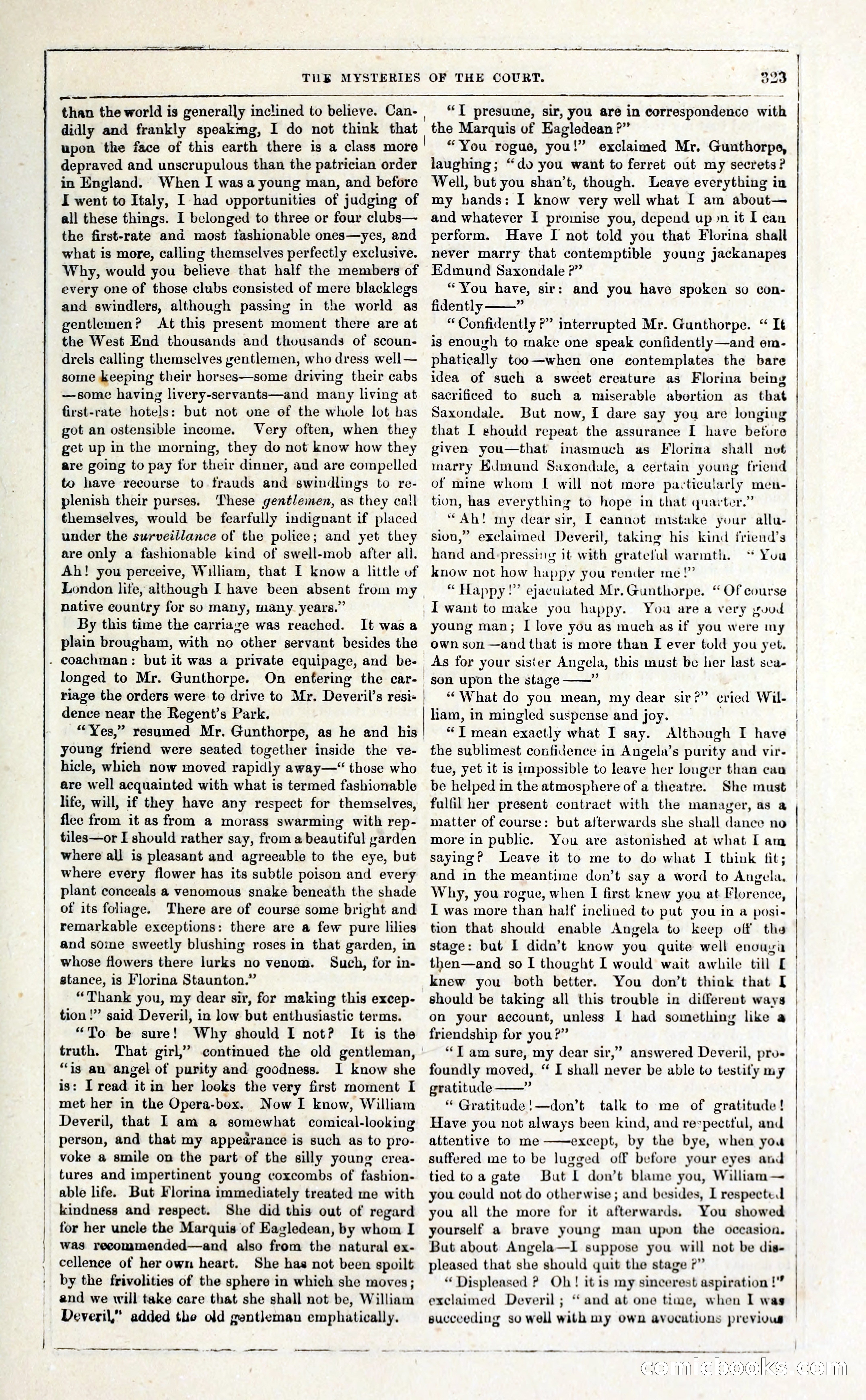
A restored page from Penny Dreadfuls, 1849. Page through the whole issue in the reader above.
📄 Transcribed text from this page (OCR, searchable)
Machine-transcribed from the original scan — historical spelling and the odd misread are preserved.
=. eee ee ee ee es TUE thr the world is generally inclined to believe. Can- | didly and frankly speakmg, I do not think that upon the face of this earth there is a class more | depraved and unscrupulous than the patrician order in England. When I wasa young man, and befvure I went to Italy, I had opportunities of judging of all these things. I belonged to three or four clubs— the first-rate and most fashionable ones—yes, and what is more, calling themselves perfectly exclusive. Why, would you believe that half the members of every one of those clubs consisted of mere blacklegs and swindlers, although passing in the world as gentlemen? At this present moment there are at the West End thousands and thousands of scoun- drels calling themselves gentlemen, who dress well— some keeping their horses—some driving their cabs —some having livery-servants—and many living at first-rate hotels: but not one of the whole lot has got an ostensible income. Very often, when they get up in the morning, they do not know how they are going to pay for their dinner, and are compelled to have recourse to frauds and swindlings to re- plenish their purses. These gentlemen, as they call themselves, would be fearfully indignant if placed under the surveillance of the police; and yet they are only a fashionable kind of swell-mob after all. Ah! you perceive, William, that I know a little of London lite, although I have been absent from my native country for so many, many years.” By this time the carriave was reached. It was a plain brougham, with no other servant besides the | . coachman: but it was a private equipage, and be- longed to Mr. Gunthorpe. On enfering the car- riage the orders were to drive to Mr. Deveril’s resi- dence near the Regent’s Park. ““Yes,” resumed Mr. Gunthorpe, as he and his young friend were seated together inside the ve- hicle, which now moved rapidly away—‘ those who are well acquainted with what is termed fashionable life, will, if they have any respect for themselves, flee from it as from a morass swarming with rep- tiles—or I should rather say, from a beautiful garden where all is pleasant and agreeable to the eye, but where every flower has its subtle poison and every plant conceals a venomous snake beneath the shade of its foliage. There are of course some bright and remarkable exceptions: there are a few pure lilies and some sweetly blushing roses in that garden, in whose flowers there lurks no venom. Such, for in- stance, is Florina Staunton.” “Thank you, my dear sir, for making this excep- tion !”’ said Deveril, in low but enthusiastic terms. “To be sure! Why should I not? It is the truth. That girl,” contmued the old gentleman, “is an angel of purity and goodness. I know she is: I read it in her looks the very first moment I met her in the Opera-box. Now I know, William Deveril, that I am a somewhat comical-looking person, and that my appearance is such as to pro- voke a smile on the part of the silly young crea- tures and impertinent young coxcombs of fashion- able life. But Florina immediately treated me with kindness and respect. She did this out of regard for her uncle the Marquis of Eagledean, by whom I was recommended—and also from the natural ex- cellence of her own heart. She has not been spoilt by the frivolities of the sphere in which she moves; and we will take care that she shall not be, William Deveril,” added the old gentleman emphatically. —_—— i —_—-—-—- —— = —_--+. < MYSTERIES OF THE COURT. ; I want to make you happy. a a + re et tu 323 “T presume, sir, you are in correspondence with ‘the Marquis of Eagledean ?” “You rogue, you!” exclaimed Mr. Gunuthorpe, laughing; “do you want to ferret out my secrets? Well, but you shan’t, though. Leave everything in my hands: I know very well what I am about— and whatever I promise you, depend up n it I can perform. Have I not told you that Florina shalt never marry that contemptible young jackanapes Edmund Saxondale ?” “You have, sir: and you have spoken so con- fidently “ Confidently ?” interrupted Mr. Gunthorpe. “ It is enough to make one speak confidently—and em- phatically too—when one contemplates the bare idea of such a sweet creature as Florina being sacrificed to such a miserable abortion as that Saxondale. But now, I dare say you are longing that I should repeat the assurance IL have betore given you—that inasmuch as Florina shall nut marry Edmund Saxondale, a certain young friend of mme whom [ will not more pacticularly men- tion, has everything to hope in that quarter.” ‘Ab! my dear sir, I cannot mistake your allu- sion,” exclaimed Deveril, taking his kind friend’s hand and-pressing it with grateful warmth. ‘* Yuu know not how happy you render me!” “Happy!” ejaculated Mr. Gunthorpe. “ Of course You are a very woud young man; I love you as much asif you were my own son—and that is more than I ever told you yet. As for your sister Angela, this must be her last sea- son upon the stage i ‘What do you mean, my dear sir?” cried Wil- liam, in mingled suspense and joy. «] mean exactly what I say. Although I have the sublimest confidence in Angela’s purity and vir- i tue, yet it is impossible to leave her longer than eau | be helped in the atmosphere of a theatre. fulfil her present contract with the manager, as a matter of course: but afterwards she shall dance no more in public. You are astonished at what I am saying? Leave it to me to do what I think fit; and in the meantime don’t say a word to Angela. Why, you rogue, when I first knew you at Florence, I was more than half inclined to put you in a posi- tion that should enable Angela to keep off the stage: but I didn’t know you quite well enouyia then—and so I thought I would wait awhile till [ knew you both better. You don’t think that I should be taking all this trouble in different ways on your account, unless I had something like a friendship for you?” “‘T am sure, my dear sir,” answered Deveril, pro- foundly moved, “ I shall never be able to testify my gratitude ? “ Gratitude!—don’t talk to me of gratitude! Have you not always been kind, and respectful, and attentive to me ——except, by the bye, when you suffered me to be lugged off before your eyes and tied toa gate But L don’t blame you, William— ” She must | you could not do otherwise ; and besides, L respected | you all the more for it afterwards. You showed yourself a brave young man upon the occasion. But about Angela—l suppose you will not be dis- pleased that she should quit the stage P” “ Displeased ? Oh! it is my sincerest aspiration !" exclaimed Deveril ; “ and at one time, when I was succeeding so well with my own avocations previous —_— DOO (CO) (CO)