
Penny Dreadfuls, 1849 · page 372 of 394
The Mysteries of the Court of London — page 372: what you’re looking at
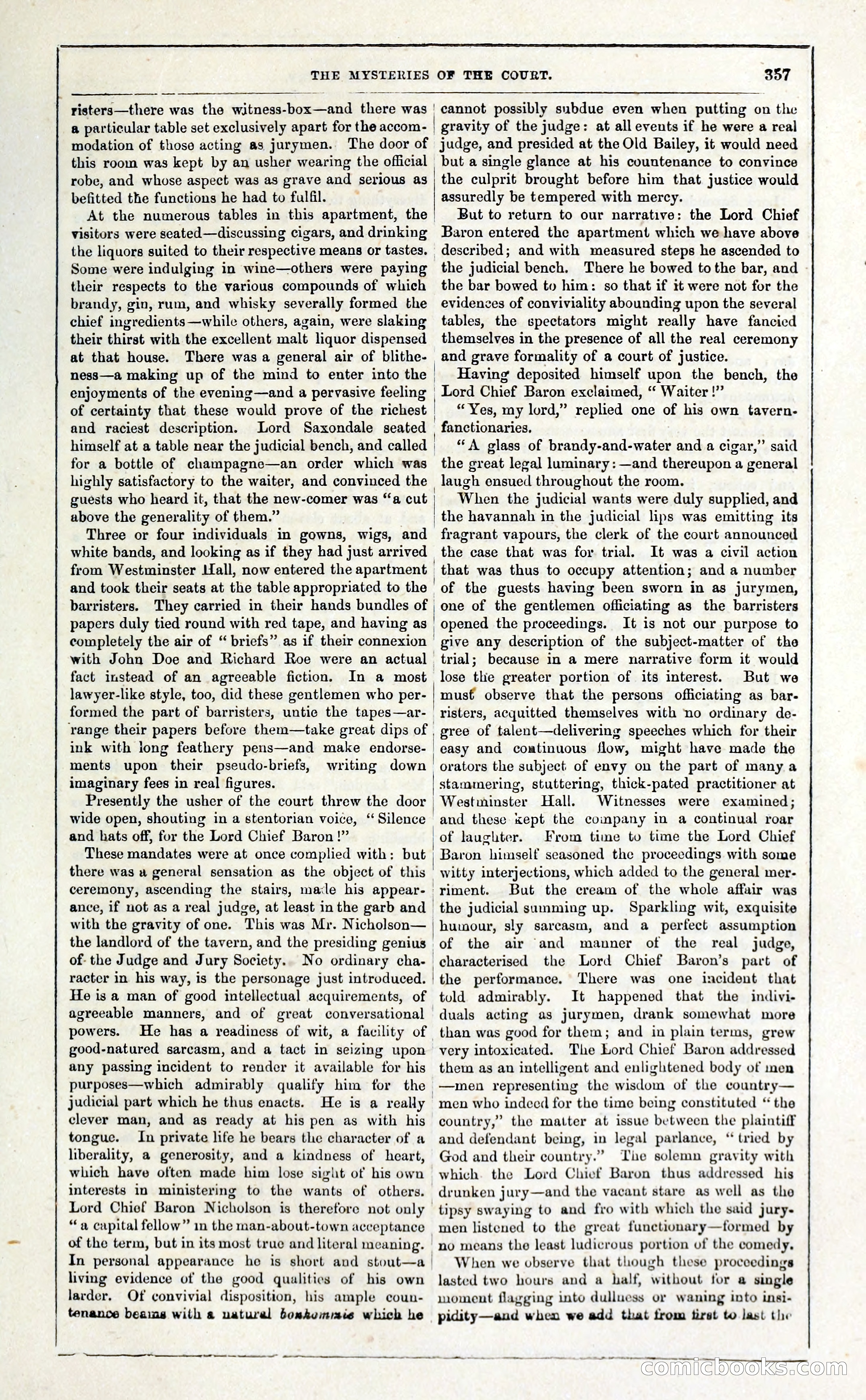
A restored page from Penny Dreadfuls, 1849. Page through the whole issue in the reader above.
📄 Transcribed text from this page (OCR, searchable)
Machine-transcribed from the original scan — historical spelling and the odd misread are preserved.
THE MYSTERIES risters—there was the witness- Pee ria there was a particular table set exclusively apart for the accom- modation of those acting as jurymen. The door of this room was kept by an usher wearing the official robe, and whose aspect was as grave and serious as befitted the functions he had to fulfil. At the numerous tables in this apartment, the visitors were seated—discussing cigars, and drinking the liquors suited to their respective means or tastes. | Some were indulging in wine—others were paying their respects to the various compounds of which brandy, gin, rum, and whisky severally formed the chief ingredients —while others, again, were slaking their thirst with the excellent malt liquor dispensed at that house. There was a general air of blithe- ness—a making up of the mind to enter into the enjoyments of the evening—and a pervasive feeling of certainty that these would prove of the richest and raciest description. Lord Saxondale seated himself at a table near the judicial bench, and called for a bottle of champagne—an order which was hichly satisfactory to the waiter, and convinced the guests who heard it, that the new-comer was “a cut above the generality of them.” Three or four individuals in gowns, wigs, and white bands, and looking as if they had just arrived | from Westminster Hall, now entered the apartment and took their seats at the table appropriated to the barristers. They carried in their hands bundles of papers duly tied round with red tape, and having as completely the air of “ briefs” as if their connexion with John Doe and Richard Roe were an actual. fact instead of an agreeable fiction. In a most lawyer-like style, too, did these gentlemen who per- formed the part of barristers, untie the tapes—ar- range their papers before them—take great dips of | ink with long feathery pens—and make endorse- ments upon their pseudo-briefs, writing down imaginary fees in real figures. Presently the usher of the court threw the door wide open, shouting in a stentorian voice, “ Silence and hats off, for the Lord Chief Baron!” These mandates were at once complied with: but there was a general sensation as the object of this — ceremony, ascending the stairs, maile his appear- ance, if not as a real judge, at least in the garb and with the gravity of one. This was Mr. Nicholson— the landlord of the tavern, and the presiding genius of- the Judge and Jury Society.. No ordinary cha- racter in his way, is the personage just introduced. He isa man of good intellectual acquirements, of agreeable manners, and of great conversational powers. good-natured sarcasm, and a tact in seizing upon any passing incident to render it available for his purposes—which admirably qualify him for the judicial part which he thus enacts. He is a really clever man, and as ready at his pen as with his tongue. In private life he bears the character of a liberality, a generosity, and a kindness of heart, which have often made him lose sight of his own interests in ministering to the wants of others. Lord Chief Baron Nicholson is therefore not only “a capital fellow” in the man-about-town acceptance of the term, but in its most true and literal meaning. In personal appearance he is short and stout—a living evidence of the good qualities of his own larder. Of convivial disposition, his ample coun- tenance beains with a uatural boskemnie which he He has a readiness of wit, a facility of OF THE COURT. 357 ' cannot possibly subdue even when putting on the gravity of the judge: at all events if he were a real judge, and presided at the Old Bailey, it would need but a single glance at his countenance to convince the culprit brought before him that justice would assuredly be tempered with mercy. But to return to our narrative; the Lord Chief Baron entered the apartment which we have above described; and with measured steps he ascended to the judicial bench. There he bowed to the bar, and the bar bowed to him: so that if tt were not for the evidences of conviviality abounding upon the several tables, the spectators might really have fancied themselves in the presence of all the real ceremony and grave formality of a court of justice. _ Having deposited himself upon the bench, the Lord Chief Baron exclaimed, ‘‘ Waiter !” “Yes, my lord,” replied one of his own tavern- fanctionaries, | “A glass of brandy-and-water and a cigar,” said the great legal luminary: —and thereupon a general laugh ensued throughout the room. When the judicial wants were duly supplied, and | the havannah in the judicial lips was emitting its fragrant vapours, the clerk of the court announced the. case that was for trial. It was a civil action ‘that was thus to occupy attention; and a number of the guests having been sworn in as jurymen, one of the gentlemen officiating as the barristers opened the proceedings. It is not our purpose to give any description of the subject-matter of the trial; because in a mere narrative form it would lose tle greater portion of its interest. But we must observe that the persons officiating as bar- risters, acquitted themselves with no ordinary de- gree of talent—delivering speeches which for their easy and comtinuous flow, might have made the orators the subject of envy on the part of many a stammering, stuttering, thick-pated practitioner at Westminster Hall. Witnesses were examined; and these kept the company in a continual roar of laughter. From time to time the Lord Chief Baron himself seasoned the proceedings with some witty interjections, which added to the general mer- ‘riment. But the cream of the whole affair was the judicial summing up. Sparkling wit, exquisite ‘humour, sly sarcasm, and a perfect assumption of the air and manner of the real judge, characterised the Lord Chief Baron’s part of 'the performance. There was one incident that tuld admirably. It happened that the indivi- duals acting as jurymen, drank somewhat more than was good for them; and in plain terms, grew very intoxicated. The Lord Chief Baron addressed them as an intelligent and enlightened body of men —men representing the wisdom of the country— men who indeed for the time being constituted “ the country,” the matter at issue between the plaintiff and defendant being, in legal parlance, “ tried by God and their country.” The solemn gravity with which. the Lord Chief Baron thus addressed his drunken jury—and the vacant stare as well as the tipsy swaying to and fro with which the said jury- men listened to the great functionary—formed by no means the least ludicrous portion of the comedy, When we observe that though these proceedings lasted two hours and a half, without for a single moment flagging into dulluess or waning into insi- pidity—and when we add that trom first to last thie ~ CommicosookKSac