
Penny Dreadfuls, 1849 · page 377 of 394
The Mysteries of the Court of London — page 377: what you’re looking at
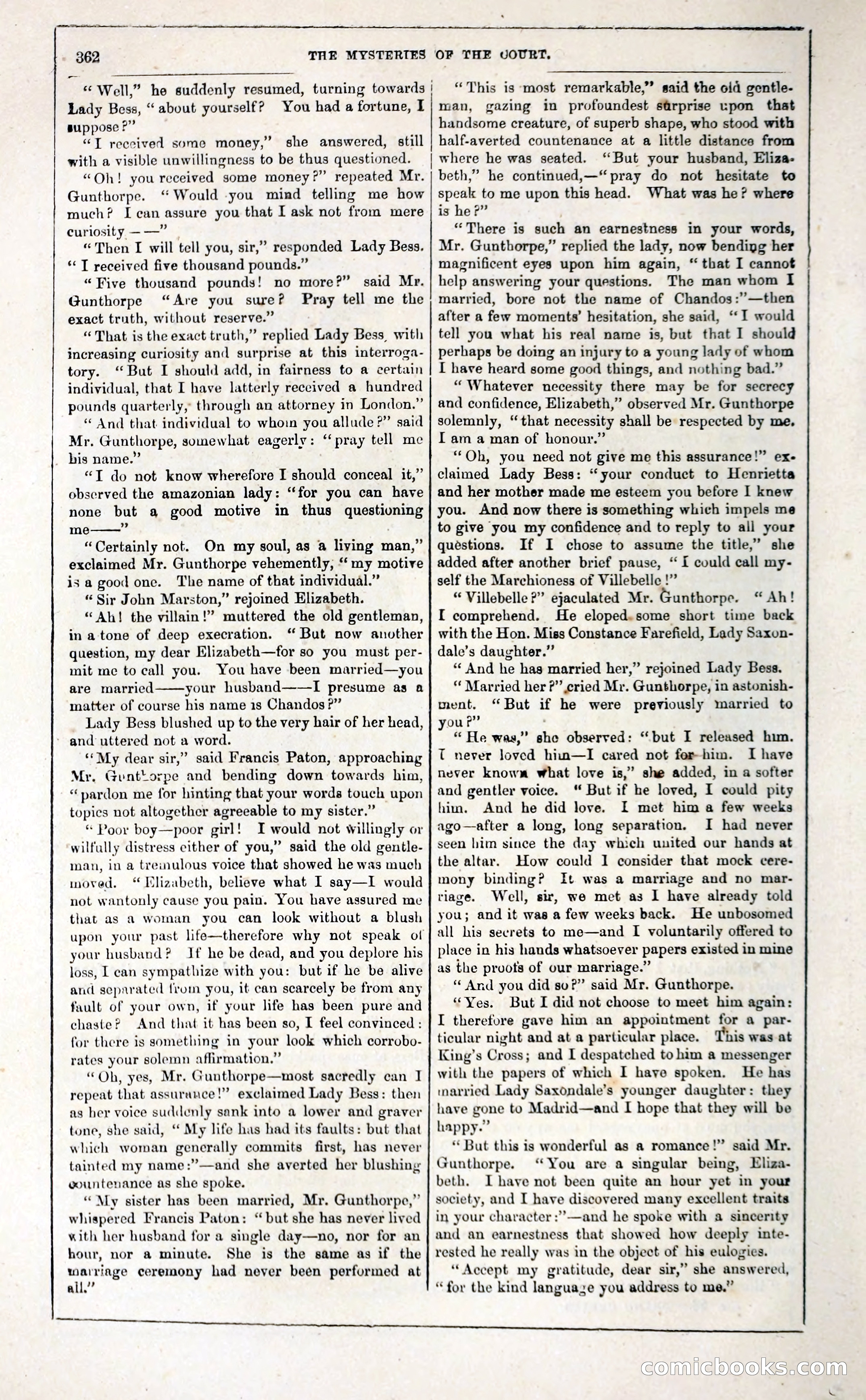
A restored page from Penny Dreadfuls, 1849. Page through the whole issue in the reader above.
📄 Transcribed text from this page (OCR, searchable)
Machine-transcribed from the original scan — historical spelling and the odd misread are preserved.
i 362 — “Well,” he suddenly resumed, turning towards Lady Bess, “about yourself? You had a fortune, I Buppose ?” “JT received some money,” she answered, still with a visible unwillingness to be thus questioned. “Oh! you received some money?” repeated Mr. Gunthorpe. “Would you mind telling me how much? I can assure you that I ask not from mere curiosity ——” “Then I will tell you, sir,” responded Lady Bess. ‘*‘ T received five thousand pounds.” “Five thousand pounds! no more?” said Mr. Gunthorpe “Are you sure? Pray tell me the exact truth, without reserve.” “That is the exact truth,” replied Lady Bess, with increasing curiosity and surprise at this interroga- tory. “But I should add, in fairness to a certain individual, that I have latterly received a hundred pounds quarterly, through an attorney in London.” ‘ And that individual to whoin you allude?” said Mr. Gunthorpe, somewhat eagerly: ‘pray tell me his name.” “T do not know wherefore I should conceal it,” observed the amazonian lady: “for you can have none but a good motive in thus questioning me ”? “Certainly not. On my soul, as a living man,” exclaimed Mr. Gunthorpe vehemently, “‘ my motive is a good one. The name of that individual.” “ Sir John Marston,” rejoined Elizabeth. “Ah! the villain!” muttered the old gentleman, in atone of deep execration. “ But now another question, my dear Elizabeth—for so you must per- mit me to call you. You have been married—you are married your husband——I presume as a matter of course his name 1s Chandos P” Lady Bess blushed up to the very hair of her head, ~ and uttered not a word. ‘My dear sir,” said Francis Paton, approaching Mr. Gunttorpe and bending down towards him, “pardon me for hinting that your words touch upon topies not altogether agreeable to my sister.” “ Poor boy—poor girl! I would not willingly or wilfully distress either of you,” said the old gentle- man, in a treinulous voice that showed he was much moved. “ Nlizabeth, believe what I say—I would not wantonly cause you pain. You have assured me that as a woman you can look without a blush upon your past life—therefore why not speak of your husband? If he be dead, and you deplore his loss, I can sympathize with you: but if he be alive and separated from you, it can scarcely be from any fault of your own, if your life has been pure and chaste? And that it has been so, I feel convinced : for there is something in your look which corrobo- rates your solemn affirmation.” “Oh, yes, Mr. Gunthorpe—most sacredly can I repeat that assurance!” exclaimed Lady Bess: then as her voice suddenly sank into a lower and graver tone, she said, “ My life has had its faults: but that which woman generally commits first, has never tainted my name:”—and she averted her blushing gountenance as she spoke. “My sister has been married, Mr. Gunthorpe,”’ whispered Francis Paton: “ but she has never lived with her husband for a single day—no, nor for an hour, nor a minute. She is the same as if the marriage ceremony had never been performed at all,” THE MYSTERIES OF THE VOURT, “This is most remarkable,” said the oid gentle- man, gazing in profoundest strprise upon that handsome creature, of superb shape, who stood with half-averted countenance at a little distance from where he was seated. “But your husband, Eliza- beth,” he continued,—“ pray do not hesitate to speak to me upon this head. What was he? where is he?” “There is such an earnestness in your words, Mr. Gunthorpe,” replied the lady, now bending her magnificent eyes upon him again, “that I cannot help answering your questions. The man whom I married, bore not the name of Chandos:’—then after a few moments’ hesitation, she said, “I would tell you what his real name is, but that I should perhaps be doing an injury to a young lady of whom I have heard some good things, and nothing bad.” “Whatever necessity there may be for secrecy and confidence, Elizabeth,” observed Mr. Gunthorpe solemnly, “that necessity shall be respected by me, I am a man of honour.” ‘‘Oh, you need not give me this assurance!” ex- claimed Lady Bess: “your conduct to Henrietta and her mother made me esteem you before I knew you. And now there is something which impels me to give you my confidence and to reply to all your questions. If I chose to assume the title,’ she added after another brief pause, “ {I could call my- self the Marchioness of Villebelle !” “ Villebelle ?” ejaculated Mr. Gunthorpe. “Ah! I comprehend. He eloped.some short time back with the Hon. Miss Constance Farefield, Lady Saxon- dale’s dauchter.”’ “And he has married her,” rejoined Lady Bess. Married her ?’”’ cried Mr. Gunthorpe, in astonish- ment. “ But if he were previously married to youre” “ He was,” she observed: “but I released him. T never loved hiu—I cared not for-him. I have never known what love is,” she added, in a softer and gentler voice. “ But if he loved, I could pity him. And he did love. I met him a few weeks ago—after a long, long separation. I had never seen him since the day which united our hands at the altar. How could I consider that mock cere- mony binding? It was a marriage and no mar- riage. Well, sir, we met az I have already told you; and it was a few weeks back. He unbosomed all his secrets to me—and I voluntarily offered to place in his hands whatsoever papers existed in mine as the proofs of our marriage.” “ And you did su?” said Mr. Gunthorpe. “Yes. But I did not choose to meet him again: I therefore gave him an appointment for a par- ticular night and at a particular place. This was at King’s Cross; and I despatched to him a messenger with the papers of which I have spoken. He has married Lady Saxondale’s younger daughter: they have gone to Madrid—and I hope that they will be happy.” “ But this is wonderful as a romance!” said Mr. Gunthorpe. “You are a singular being, Eliza- beth. I have not been quite an hour yet in your society, and I have discovered many excellent traits in your character :’’—and he spoke with a sincerity and an earnestness that showed how deeply inte- rested he really was in the object of his eulogies. “Accept my gratitude, dear sir,” she answered, “for the kind language you address to me.” SE Ls eT EORNICLOOO (C (E() Ss