
Penny Dreadfuls, 1849 · page 379 of 394
The Mysteries of the Court of London — page 379: what you’re looking at
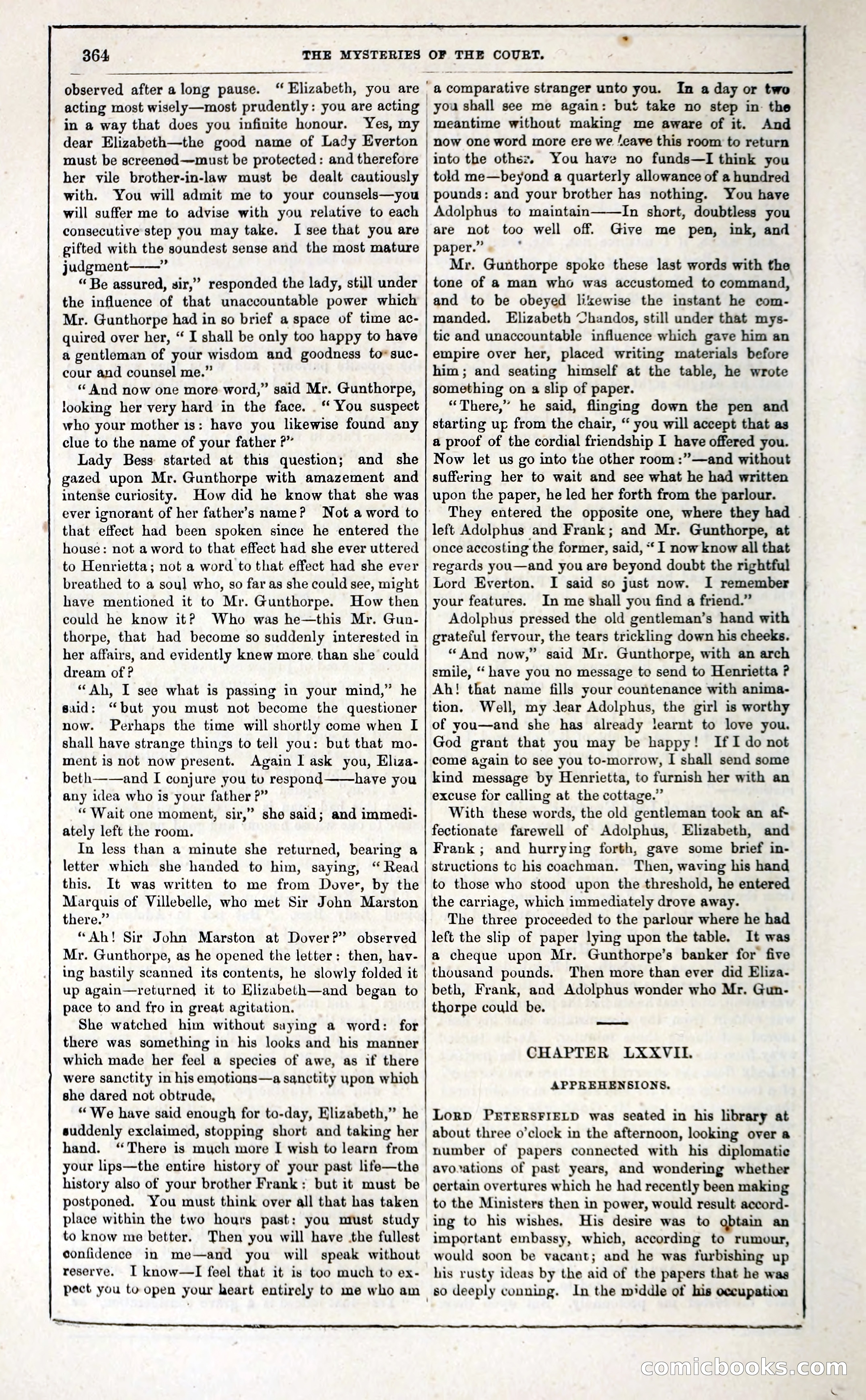
A restored page from Penny Dreadfuls, 1849. Page through the whole issue in the reader above.
📄 Transcribed text from this page (OCR, searchable)
Machine-transcribed from the original scan — historical spelling and the odd misread are preserved.
364 observed after along pause. “Elizabeth, you are acting most wisely—most prudently: you are acting in a way that does you infinite honour. Yes, my dear Elizabeth—the good name of Lady Everton must be screened—must be protected: and therefore her vile brother-in-law must be dealt cautiously with. You will admit me to your counsels—you will suffer me to advise with you relative to each consecutive step you may take. I see that you are gifted with the soundest sense and the most mature judgment——” “ Be assured, sir,” responded the lady, still under the influence of that unaccountable power which Mr. Gunthorpe had in so brief a space of time ac- quired over her, “ I shall be only too happy to have a gentleman of your wisdom and goodness to*suc- cour and counsel me.” “ And now one more word,” said Mr. Gunthorpe, looking her very hard in the face. . “ You suspect who your mother 1s: have you likewise found any clue to the name of your father ?” Lady Bess started at this question; and she gazed upon Mr. Gunthorpe with amazement and intense curiosity. How did he know that she was ever ignorant of her father’s name? Not aword to that effect had been spoken since he entered the house: not a word to that effect had she ever uttered to Henrietta; not a word to that effect had she ever breathed to a soul who, so far as she could see, might have mentioned it to Mr. Gunthorpe. How then could he know it? Who was he—this Mr. Gun- thorpe, that had become so suddenly interested in her affairs, and evidently knew more. than she could dream of? “Ah, I see what is passing in your mind,” he suid: “but you must not become the questioner now. Perhaps the time will shortly come when I shall have strange things to tell you: but that mo- ment is not now present. Again 1 ask you, Eliza- beth——and I conjure you tu respond——haye you any idea who is your father ?” “Wait one moment, sir,” she said; and immedi- ately left the room. In less than a minute she returned, bearing a letter which she handed to him, saying, “ Read this. It was written to me from Dover, by the Marquis of Villebelle, who met Sir John Marston there.” “Ah! Sir John Marston at Dover?” observed Mr. Gunthorpe, as he opened the letter: then, hav- ing hastily scanned its contents, he slowly folded it up again—returned it to EKlizabeth—and began to pace to and fro in great agitation. She watched him without saying a word: for there was something in his looks and his manner which made her feel a species of awe, as if there were sanctity in his emotions—a sanctity ypon which she dared not obtrude, “We have said enough for to-day, Elizabeth,” he suddenly exclaimed, stopping short and taking her hand. “There is much more | wish to learn from your lips—the entire history of your past life—the history also of your brother Frank: but it must be postponed. You must think over all that has taken place within the two hours past: you ntust study to know me better. Then you will have the fullest confidence in me—and you will speak without reserve. I know—I feel that it is too much to ex- pect you to open your heart entirely to me who am er eeneteeeepereen agape pmmneee eee THE MYSTERIES OF THE COURT. a comparative stranger unto you. In a day or two you shall see me again: but take no step in the meantime without making me aware of it. And now one word more ere we /eave this room to return into the other. You have no funds—I think you told me—beyond a quarterly allowance of a hundred pounds: and your brother has nothing. You have Adolphus to maintain In short, doubtless you are not too well off. Give me pen, ink, and paper.” » Mr. Gunthorpe spoke these last words with the tone of a man who was accustomed to command, and to be obeyed likewise the instant he com- manded. Elizabeth Chandos, still under that mys- tic and unaccountable influence which gave him an empire over her, placed writing materials before him; and seating himself at the table, he wrote something on a slip of paper. “There,” he said, flinging down the pen and starting up from the chair, “ you will accept that as a proof of the cordial friendship I have offered you. Now let us go into the other room :”—and without suffering her to wait and see what he had written upon the paper, he led her forth from the parlour. They entered the opposite one, where they had - left Adulphus and Frank; and Mr. Gunthorpe, at once accosting the former, said, “‘ 1 now know all that regards you—and you are beyond doubt the rightful Lord Everton. I said so just now. I remember your features. In me shall you find a friend.” Adolphus pressed the old gentleman’s hand with grateful fervour, the tears trickling down his cheeks. “And now,” said Mr. Gunthorpe, with an arch smile, “‘ have you no message to send to Henrietta ? Ah! that name fills your countenance with anima- tion. Well, my Jear Adolphus, the girl is worthy of you—and she has already learnt to love you. God grant that you may be happy! IfI do not come again to see you to-morrow, I shall send some kind message by Henrietta, to furnish her with an excuse for calling at the cottage.” With these words, the old gentleman took an af- fectionate farewell of Adolphus, Elizabeth, and Frank ; and hurrying forth, gave some brief in- structions tc his coachman. Then, waving his hand to those who stood upon the threshold, he entered the carriage, which immediately drove away. The three proceeded to the parlour where he had left the slip of paper lying upon the table. It was a cheque upon Mr. Gunthorpe’s banker for five thousand pounds. Then more than ever did Eliza- beth, Frank, and Adolphus wonder who Mr. Gun- thorpe could be. CHAPTER LXXVILI. APPREHENSIONS. Lorp PETERSFIELD was seated in his library at about three o’clock in the afternoon, looking over a number of papers connected with his diplomatic avo.ations of past years, and wondering whether certain overtures which he had recently been making to the Ministers then in power, would result accord- ing to his wishes, His desire was to gbtain an important embassy, which, according to rumour, would soon be vacant; and he was furbishing up his rusty ideas by the aid of the papers that he was so deeply conning. In the middle of his occupation GoOmiicdoo <=) (E)