
Penny Dreadfuls, 1849 · page 396 of 394
The Mysteries of the Court of London — page 396: what you’re looking at
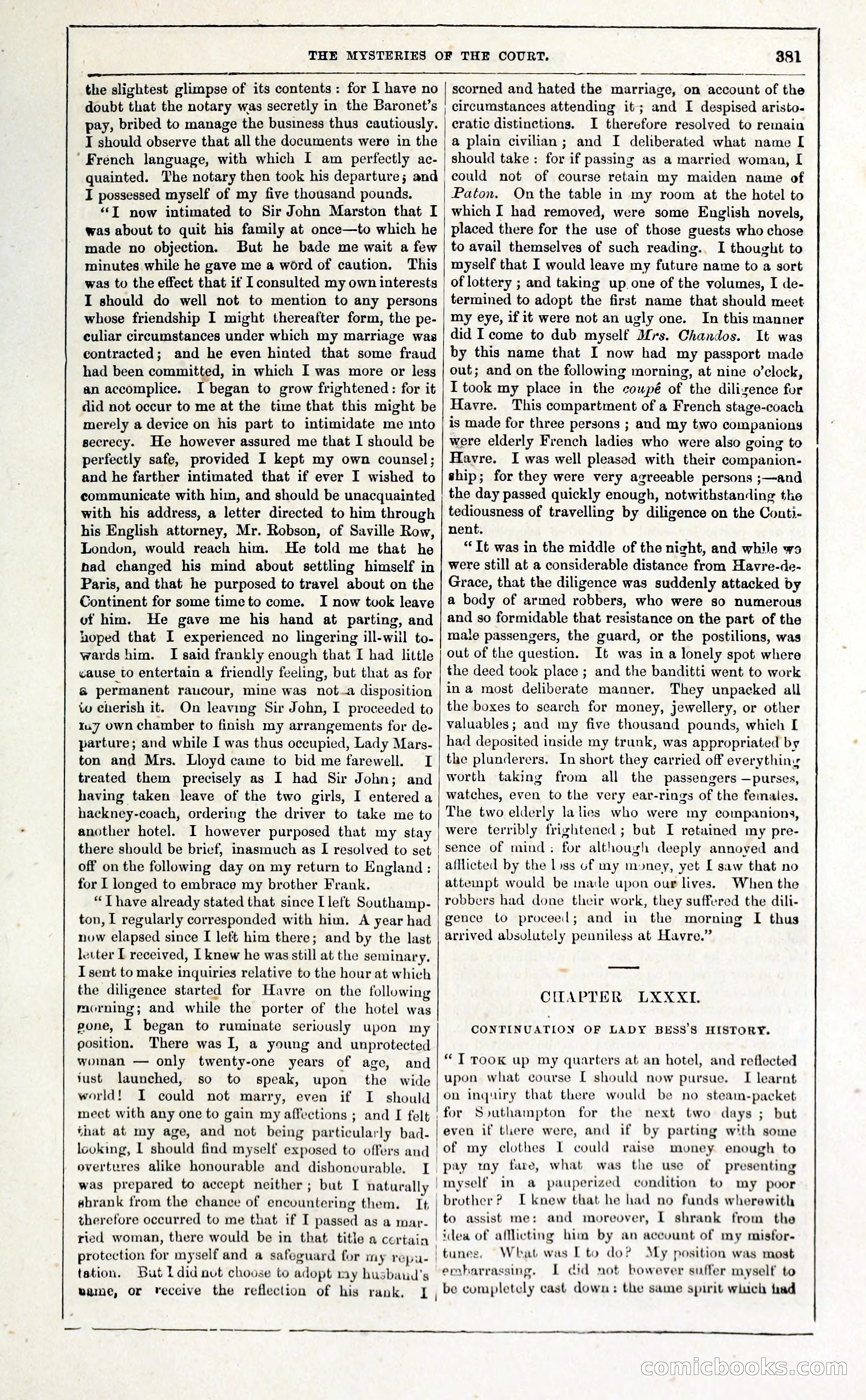
A restored page from Penny Dreadfuls, 1849. Page through the whole issue in the reader above.
📄 Transcribed text from this page (OCR, searchable)
Machine-transcribed from the original scan — historical spelling and the odd misread are preserved.
THE MYSTERIES OF THE COURT. the slightest glimpse of its contents: for I have no doubt that the notary was secretly in the Baronet’s pay, bribed to manage the business thus cautiously. I should observe that all the documents were in the ‘French language, with which I am perfectly ac- quainted. The notary then took his departure; and I possessed myself of my five thousand pounds. ‘“‘I now intimated to Sir John Marston that I was about to quit his family at once—to which he made no objection. But he bade me wait a few minutes while he gave me a word of caution. This was to the effect that if I consulted my own interests I should do well not to mention to any persons whose friendship I might thereafter form, the pe- culiar circumstances under which my marriage was contracted; and he even hinted that some fraud had been committed, in which I was more or less an accomplice. I began to grow frightened: for it did not occur to me at the time that this might be merely a device on his part to intimidate me into secrecy. He however assured me that I should be perfectly safe, provided I kept my own counsel; and he farther intimated that if ever I wished to communicate with him, and should be unacquainted with his address, a letter directed to him through his English attorney, Mr. Robson, of Saville Row, Londun, would reach him. He told me that he had changed his mind about settling himself in Paris, and that he purposed to travel about on the Continent for some time to come. I now took leave vf him. He gave me his hand at parting, and hoped that I experienced no lingering ill-wiil to- wards him. I said frankly enough that I had little cause to entertain a friendly feeling, but that as for & permanent raucour, mine was not-a disposition ww cherish it. On leaving Sir John, I proceeded to tuy own chamber to finish my arrangements for de- parture; and while I was thus occupied, Lady Mars- ton and Mrs. Lloyd came to bid me farewell. I treated them precisely as I had Sir John; and having taken leave of the two girls, I entered a hackney-coach, ordering the driver to take me to another hotel. I however purposed that my stay there should be brief, inasmuch as I resolved to set off on the following day on my return to England: for I longed to embrace my brother Frank. “have already stated that since I left Southamp- ton, I regularly corresponded with him. A year had now elapsed since I left him there; and by the last letter I received, I knew he was still at the seminary. I sent to make inquiries relative to tne hour at which the diligence started for Havre on the following raorning; and while the porter of the hotel was pone, 1 began to ruminate seriously upon my position. There was I, a young and unprotected woman — only twenty-one years of age, and just launched, so to speak, upon the wide world! I could not marry, even if I should meet with any one to gain my affections ; and I felt that at my age, and not being particularly bad- looking, L should find myself exposed to offers and overtures alike honourable and dishonourable. I was prepared to accept neither; but I naturally sbrank from the chance of encountering them. It therefore occurred to me that if I passed as a mar- ried woman, there would be in that title a certain protection for myself and a safeguard for my repu- tation. But lL didnot chouse to adopt my husbauid's wame, or receive the reflection of his rank, J 381 scorned and hated the marriage, on account of the | circumstances attending it; and I despised aristo- cratic distinctions. I therefore resolved to remain a plain civilian; and I deliberated what name [ should take : for if passing as a married woman, I could not of course retain my maiden name of Paton. On the table in my room at the hotel to which I had removed, were some English novels, placed there for the use of those guests who chose to avail themselves of such reading. I thought to myself that I would leave my future name to a sort of lottery ; and taking up one of the volumes, I de- termined to adopt the first name that should meet my eye, if it were not an ugly one. In this manner did I come to dub myself Drs. Chandos. It was by this name that I now had my passport made out; and on the following morning, at nine o’clock, I took my place in the coupé of the diligence for Havre. This compartment of a French stage-coach is made for three persons ; and my two companions were elderly French ladies who were also going to Havre. I was well pleased with their companion- ship; for they were very agreeable persons ;—and the day passed quickly enough, notwithstanding the tediousness of travelling by diligence on the Conti- nent. “Tt was in the middle of the night, and while wa were still at a considerable distance from Havre-de- Grace, that the diligence was suddenly attacked by a body of armed robbers, who were so numerous and so formidable that resistance on the part of the male passengers, the guard, or the postilions, was out of the question. It was in a lonely spot where the deed took place ; and the banditti went to work in a most deliberate manner. They unpacked all the boxes to search for money, jewellery, or other valuables; and my five thousand pounds, which I had deposited inside my trunk, was appropriated by the plunderers. In short they carried off everythiny worth taking from all the passengers —purses, watches, even to the very ear-rings of the females. The two elderly lalies who were my companions, were terribly frightened ; but I retained my pre- sence of mind: for although deeply annoyed and afflicted by the loss of my money, yet [ saw that no attempt would be inade upon our lives. When the robbers had done their work, they suffered the dili- gence to proceed; and in the morning I thus arrived absolutely peuniless at Havre.” CHAPTER LXXXI. CONTINUATION OF LADY BESS'S HISTORY. T TOOK up my quarters at an hotel, and reflected upon what course I should now pursue. I learnt on inquiry that there would be no steam-packet for Southampton for the next two days ; but even if tlere were, and if by parting with some of my clothes I could raise money enough to pay my fare, what was the use of presenting /'myself in a pauperized condition to my poor brother? I knew that he had no funds wherewith to assist me: and moreover, L shrank from the ‘dea of afflicting him by an accuunt of my misfor- ‘tunes. What was [to do? My position was most embarrassing. IL did not however suffer myself to _ be completely cast down: the same spirit which trad | ee ee sess Go NOOKS (CO)