
Penny Dreadfuls, 1849 · page 53 of 394
The Mysteries of the Court of London — page 53: what you’re looking at
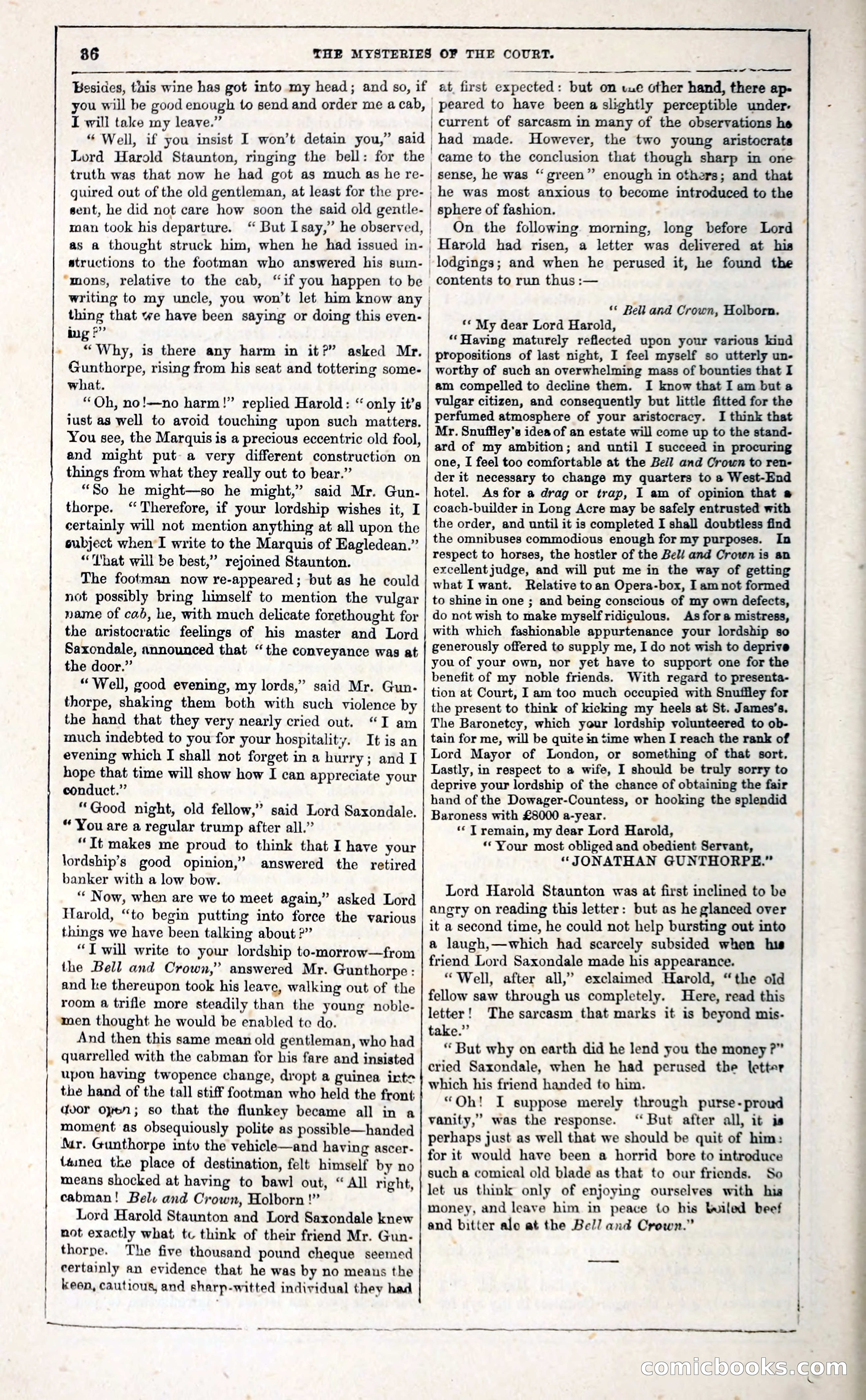
A restored page from Penny Dreadfuls, 1849. Page through the whole issue in the reader above.
📄 Transcribed text from this page (OCR, searchable)
Machine-transcribed from the original scan — historical spelling and the odd misread are preserved.
86 THE MYSTERIES OF THE COURT. ——— a —— Besides, this wine has got into my head; and so, if at, first expected: but om we other hand, there ap- you will be good enough to send and order me a cab, I will take my leave.” “ Well, if you insist I won’t detain you,” said Lord Harold Staunton, ringing the bell: for the truth was that now he had got as much as he re- guired out of the old gentleman, at least for the pre- sent, he did not care how soon the said old gentle- man took his departure. writing to my uncle, you won’t let him know any thing that we have been saying or doing this even- mg?” “Why, is there any harm in it?” asked Mr. Gunthorpe, rising from his seat and tottering some- what. “Oh, no!—no harm!” replied Harold: “only it’s ust as well to avoid touching upon such matters. You see, the Marquis is a precious eccentric old fool, and might put a very different construction on things from what they really out to bear.’’ “So he might—so he might,’ said Mr. Gun- thorpe. ‘Therefore, if your lordship wishes it, I certainly will not mention anything at all upon the subject when I write to the Marquis of Eagledean.”’ “That will be best,” rejoined Staunton. The footman now re-appeared; but as he could not possibly bring himself to mention the vulgar name of cab, he, with much delicate forethought for the aristocratic feelings of his master and Lord Saxondale, announced that “the conveyance was at the door.” “Well, good evening, my lords,” said Mr. Gun- thorpe, shaking them both with such violence by the hand that they very nearly cried out. “I am much indebted to you for your hospitality. It is an evening which I shall not forget in a hurry; and I hope that time will show how I can appreciate your conduct.” “Good night, old fellow,” said Lord Saxondale. “ You are a regular trump after all.” “It makes me proud to think that I have your lordship’s good opinion,” answered the retired banker with a low bow. ‘ Now, when are we to meet again,” asked Lord Harold, “to begin putting into force the various things we have been talking about ?” “I will write to your lordship to-morrow—from the Bell and Crown,” answered Mr. Gunthorpe : and ke thereupon took his leave, walking out of the room a trifle more steadily than the young noble- men thought he would be enabled te do. And then this same mean old gentleman, who had quarrelled with the cabman for his fare and insisted upon having twopence change, dropt a guinea ints the hand of the tall stiff footman who held the front qvor ojtv1; so that the flunkey became all in a moment as obsequiously polite as possible—handed Mr. Gunthorpe into the vehicle—and having ascer- tainea tke place of destination, felt himself by no means shocked at having to baw! out, “ All right, cabman! Belv and Crown, Holborn !” Lord Harold Staunton and Lord Saxondale knew not exactly what tc think of their friend Mr. Gun- thorpe. The five thousand pound cheque seemed certainly an evidence that he was by no means the keen, cautious, and sharp-witted individual they had “ But Isay,” he observed, | as a thought struck him, when he had issued in- | atructions to the footman who answered his sum-— “mons, relative to the cab, “if you happen to be | peared to have been a slightly perceptible under. | current of sarcasm in many of the observations he had made. However, the two young aristocrats _ came to the conclusion that though sharp in one sense, he was “green” enough in others; and that _he was most anxious to become introduced to the sphere of fashion. On the following morning, long before Lord ~ Harold had risen, a letter was delivered at his lodgings; and when he perused it, he found the contents to run thus :— ‘© Bell and Crown, Holborn. ** My dear Lord Harold, ‘*Having maturely reflected upon your various kind propositions of last night, I feel myself so utterly un- worthy of such an overwhelming mass of bounties that I am compelled to decline them. I know that I am but a vulgar citizen, and consequently but little fitted for the perfumed atmosphere of your aristocracy. I think that Mr. Snuffley’s idea of an estate will come up to the stand- ard of my ambition; and until I succeed in procuring one, I feel too comfortable at the Bell and Crown to ren- der it necessary to change my quarters to a West-End hotel. As for a drag or trap, I am of opinion that » coach-builder in Long Acre may be safely entrusted with the order, and until it is completed I shall doubtless find the omnibuses commodious enough for my purposes. In respect to horses, the hostler of the Bel/ and Crown is an excellent judge, and will put me in the way of getting what I want. Relative toan Opera-box, I am not formed to shine in one ; and being conscious of my own defects, do not wish to make myself ridiculous. As fora mistress, with which fashionable appurtenance your lordship so generously offered to supply me, I do not wish to deprive you of your own, nor yet have to support one for the benefit of my noble friends. With regard to presenta- tion at Court, I am too much occupied with Snuffley for the present to think of kicking my heels at St. James’s. The Baronetcy, which your lordship volunteered to ob- tain for me, will be quite in time when I reach the rank of Lord Mayor of London, or something of that sort, Lastly, in respect to a wife, I should be truly sorry to deprive your lordship of the chance of obtaining the fair hand of the Dowager-Countess, or hooking the splendid Baroness with £8000 a-year. ‘© T remain, my dear Lord Harold, ** Your most obliged and obedient Servant, ‘JONATHAN GUNTHORPE.” Lord Harold Staunton was at first inclined to be angry on reading this letter: but as he glanced over it a second time, he could not help bursting out into a laugh,—which had scarcely subsided when his friend Lord Saxondale made his appearance. “Well, after all,” exclaimed Harold, “the old fellow saw through us completely. Here, read this letter! The sarcasm that marks it is beyond mis- take.” “ But why on earth did he lend you the money ?” cried Saxondale, when he had perused the letter which his friend handed to him. “Oh! I suppose merely through purse-proud vanity,” was the response. “But after all, it is perhaps just as well that we should be quit of him: for it would have been a horrid bore to introduce such a comical old blade as that to our friends. So let us think only of enjoying ourselves with his money, and leave him in peace to his tiled beef and bitter alo at the Bell and Crown.” re ee eee ee = = COMMICLMOOOlKKS (E@)