
Penny Dreadfuls, 1849 · page 55 of 394
The Mysteries of the Court of London — page 55: what you’re looking at
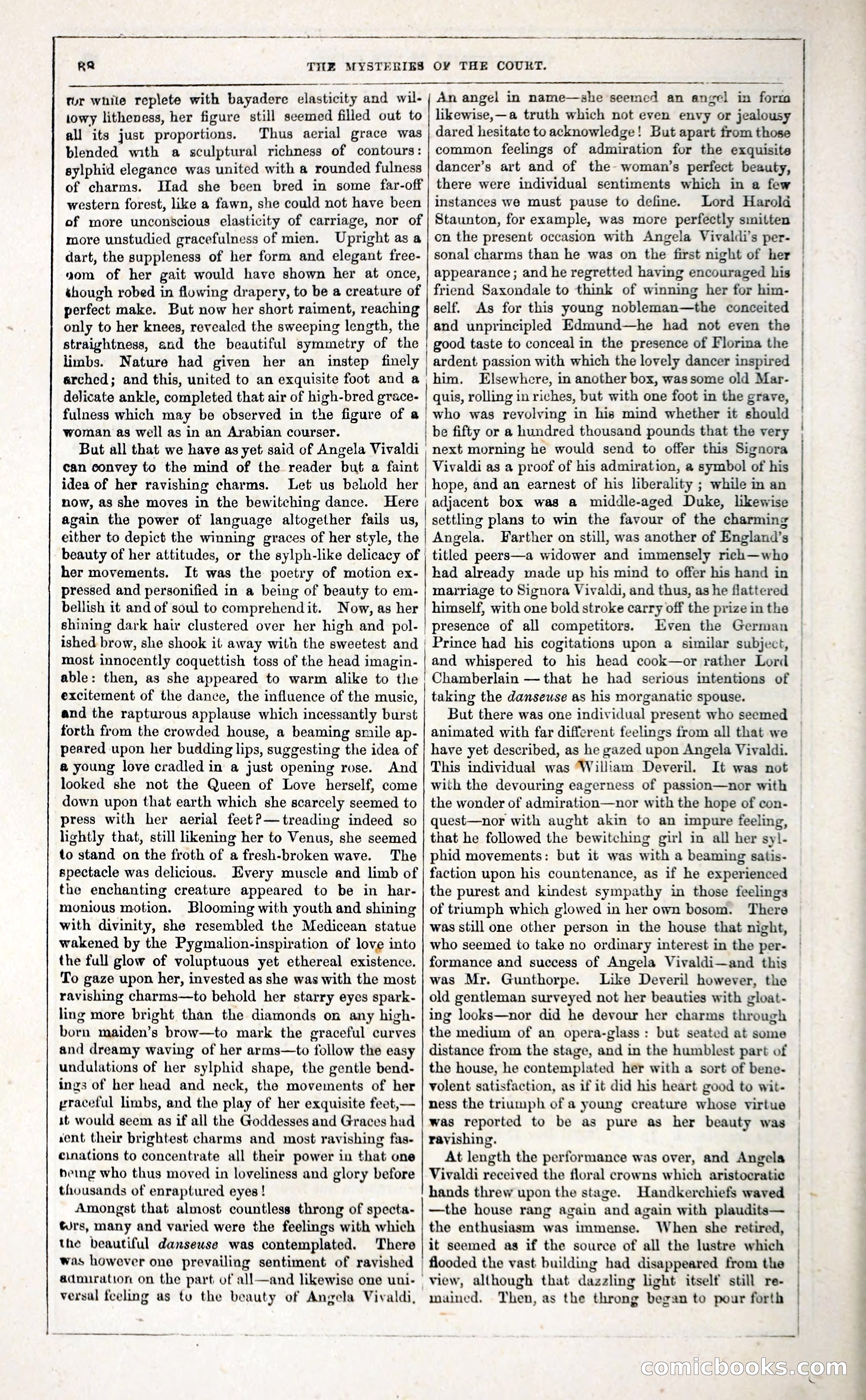
A restored page from Penny Dreadfuls, 1849. Page through the whole issue in the reader above.
📄 Transcribed text from this page (OCR, searchable)
Machine-transcribed from the original scan — historical spelling and the odd misread are preserved.
a RA tur while replete with bayadere elasticity and wil- towy lithevess, her figure still seemed filled out to all its just proportions. Thus aerial grace was blended with a sculptural richness of contours: sylphid elegance was united with a rounded fulness of charms. Had she been bred in some far-off western forest, like a fawn, she could not have been of more unconscious elasticity of carriage, nor of more unstudied gracefulness of mien. Upright as a dart, the suppleness of her form and elegant free- yom of her gait would have shown her at once, shough robed in flowing drapery, to be a creature of perfect make. But now her short raiment, reaching only to her knees, revealed the sweeping length, the straightness, and the beautiful symmetry of eo THE MYSTERIES O¥ THE COURT. An angel in name—she seemed an angel in forza likewise,—a truth which not even envy or jealousy dared hesitate to acknowledge! But apart from those common feelings of admiration for the exquisite dancer’s art and of the-woman’s perfect beauty, there were individual sentiments which in a few instances we must pause to define. Lord Harold Staunton, for example, was more perfectly smitten on the present occasion with Angela Vivaldi’s per- sonal charms than he was on the first night of her appearance; and he regretted having encouraged his friend Saxondale to think of winning her for him- self. As for this young nobleman—the conceited and unprincipled Edmund—he had not even the good taste to conceal in the presence of Florina the limbs. Nature had given her an instep finely | ardent passion with which the lovely dancer inspired arched; and this, united to an exquisite foot and a him. Elsewhere, in another box, was some old Mar- delicate ankle, completed that air of high-bred grace- | quis, rolling in riches, but with one foot in the grave, fulness which may be observed in the figure of a | woman as well as in an Arabian courser. | But all that we have as yet said of Angela Vivaldi | can convey to the mind of the reader but a faint idea of her ravishing charms. Let us behold her now, as she moves in the bewitching dance. Here again the power of language altogether fails us, either to depict the winning graces of her style, the | beauty of her attitudes, or the sylph-like delicacy of | her movements. It was the poetry of motion ex- pressed and personified in a being of beauty to em- bellish it and of soul to comprehendit. Now, as her shining dark hair clustered over her high and pol- ished brow, she shook it away with the sweetest and | most innocently coquettish toss of the head imagin- able: then, as she appeared to warm alike to the excitement of the dance, the influence of the music, and the rapturous applause which incessantly burst forth from the crowded house, a beaming smile ap- peared upon her budding lips, suggesting the idea of @ young love cradled in a just opening rose. And looked she not the Queen of Love herself, come down upon that earth which she scarcely seemed to press with her aerial feet?—treading indeed so lightly that, still likening her to Venus, she seemed to stand on the froth of a fresh-broken wave. The spectacle was delicious. Every muscle and limb of the enchanting creature appeared to be in har- monious motion. Blooming with youth and shining with divinity, she resembled the Medicean statue wakened by the Pygmalion-inspiration of love into the full glow of voluptuous yet ethereal existence. To gaze upon her, invested as she was with the most ravishing charms—to behold her starry eyes spark- ling more bright than the diamonds on any high- born maiden’s brow—to mark the graceful curves and dreamy waving of her arms—to follow the easy undulations of her sylphid shape, the gentle bend- ings of her head and neck, the movements of her graceful limbs, and the play of her exquisite feet,— it would seem as if all the Goddesses and Graces had rent their brightest charms and most ravishing fas- cinations to concentrate all their power in that one being who thus moved in loveliness and glory before thousands of enraptured eyes ! Amongst that almost countless throng of specta- turs, many and varied were the feelings with which the beautiful danseuse was contemplated. There was however one prevailing sentiment of ravished adnuration on the part of all—and likewise one uni- © versal feeling as tu the beauty of Angela Vivaldi, a who was revolving in his mind whether it should be fifty or a hundred thousand pounds that the very next morning he would send to offer this Signora Vivaldi as a proof of his admiration, a symbol of his hope, and an earnest of his liberality ; while in an adjacent box was a middle-aged Duke, likewise settling plans to win the favour of the charming Angela. Farther on still, was another of England’s titled peers—a widower and immensely rich—who had already made up his mind to offer his hand in marriage to Signora Vivaldi, and thus, as he flattered himself, with one bold stroke carry off the prize in the presence of all competitors. Even the German Prince had his cogitations upon a similar subject, and whispered to his head cook—or rather Lord Chamberlain —that he had serious intentions of taking the danseuse as his morganatic spouse. But there was one individual present who seemed animated with far different feelings from all that we have yet described, as he gazed upon Angela Vivaldi. This individual was ‘William Deveril. It was not with the devouring eagerness of passion—nor with the wonder of admiration—nor with the hope of con- quest—nor with aught akin to an impure feeling, that he followed the bewitching girl in all her sy!- phid movements: but it was with a beaming satis- faction upon his countenance, as if he experienced the purest and kindest sympathy in those feelings of triumph which glowed in her own bosom. There oe eee epee was still one other person in the house that night, who seemed to take no ordinary interest in the per- formance and success of Angela Vivaldi—and this was Mr. Gunthorpe. Like Deveril however, the old gentleman surveyed not her beauties with gloat- ing looks—nor did he devour her charms through | the medium of an opera-glass : but seated at some distance from the stage, and in the humblest part of the house, he contemplated her with a sort of bene- volent satisfaction, as if it did his heart good to wit- ness the triumph of a young creature whose virtue was reported to be as pure as her beauty was ravishing. At length the performance was over, and Angela Vivaldi received the floral crowns which aristocratic hands threw upon the stage. Handkerchiefs waved —the house rang again and again with plaudits— the enthusiasm was immense. When she retired, it seemed as if the source of all the lustre which flooded the vast building had disappeared from the view, although that dazzling light itself’ still re- mained. Then, as the throng began to pour forth i 7 COMMICLOOOKKS