
Penny Dreadfuls, 1860 · page 150 of 400
The Mysteries of the Court of London — page 150: what you’re looking at
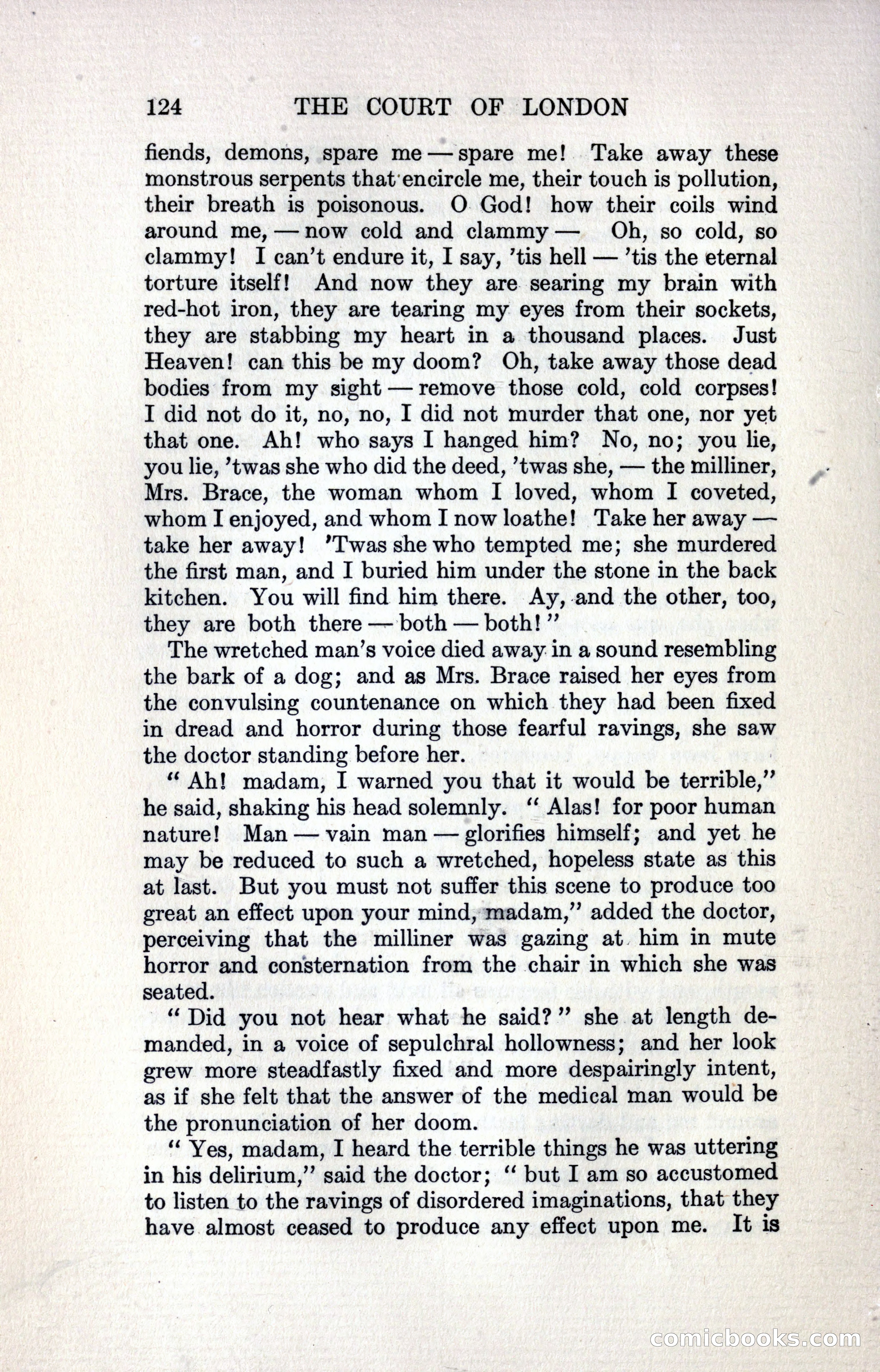
A restored page from Penny Dreadfuls, 1860. Page through the whole issue in the reader above.
📄 Transcribed text from this page (OCR, searchable)
Machine-transcribed from the original scan — historical spelling and the odd misread are preserved.
124 THE COURT OF LONDON fiends, demons, spare me—spare me! Take away these monstrous serpents that’encircle me, their touch is pollution, their breath is poisonous. O God! how their coils wind around me, — now cold and clammy— _ Oh, so cold, so clammy! I can’t endure it, I say, ’tis hell — ’tis the eternal torture itself! And now they are searing my brain with red-hot iron, they are tearing my eyes from their sockets, they are stabbing my heart in a thousand places. Just Heaven! can this be my doom? Oh, take away those dead bodies from my sight — remove those cold, cold corpses! I did not do it, no, no, I did not murder that one, nor yet that one. Ah! who says I hanged him? No, no; you lie, you lie, ’twas she who did the deed, ’twas she, — the milliner, Mrs. Brace, the woman whom I loved, whom I coveted, whom I enjoyed, and whom I now loathe! Take her away — take her away! ’Twas she who tempted me; she murdered the first man, and I buried him under the stone in the back kitchen. You will find him there. Ay, and the other, too, they are both there — both — both!” The wretched man’s voice died away in a sound resembling the bark of a dog; and as Mrs. Brace raised her eyes from the convulsing countenance on which they had been fixed in dread and horror during those fearful ravings, she saw the doctor standing before her. ‘‘ Ah! madam, I warned you that it would be terrible,” he said, shaking his head solemnly. ‘“ Alas! for poor human nature! Man— vain man — glorifies himself; and yet he may be reduced to such a wretched, hopeless state as this at last. But you must not suffer this scene to produce too great an effect upon your mind, madam,” added the doctor, perceiving that the milliner was gazing at. him in mute horror and consternation from the chair in which she was seated. “Did you not hear what he said?” she at length de- manded, in a voice of sepulchral hollowness; and her look erew more steadfastly fixed and more despairingly intent, as if she felt that the answer of the medical man would be the pronunciation of her doom. ‘Yes, madam, I heard the terrible things he was uttering ~ in his delirium,” said the doctor; ‘“ but I am so accustomed to listen to the ravings of disordered imaginations, that they have almost ceased to produce any effect upon me. It is Gomicsdoo <S m