
Penny Dreadfuls, 1860 · page 20 of 400
The Mysteries of the Court of London — page 20: what you’re looking at
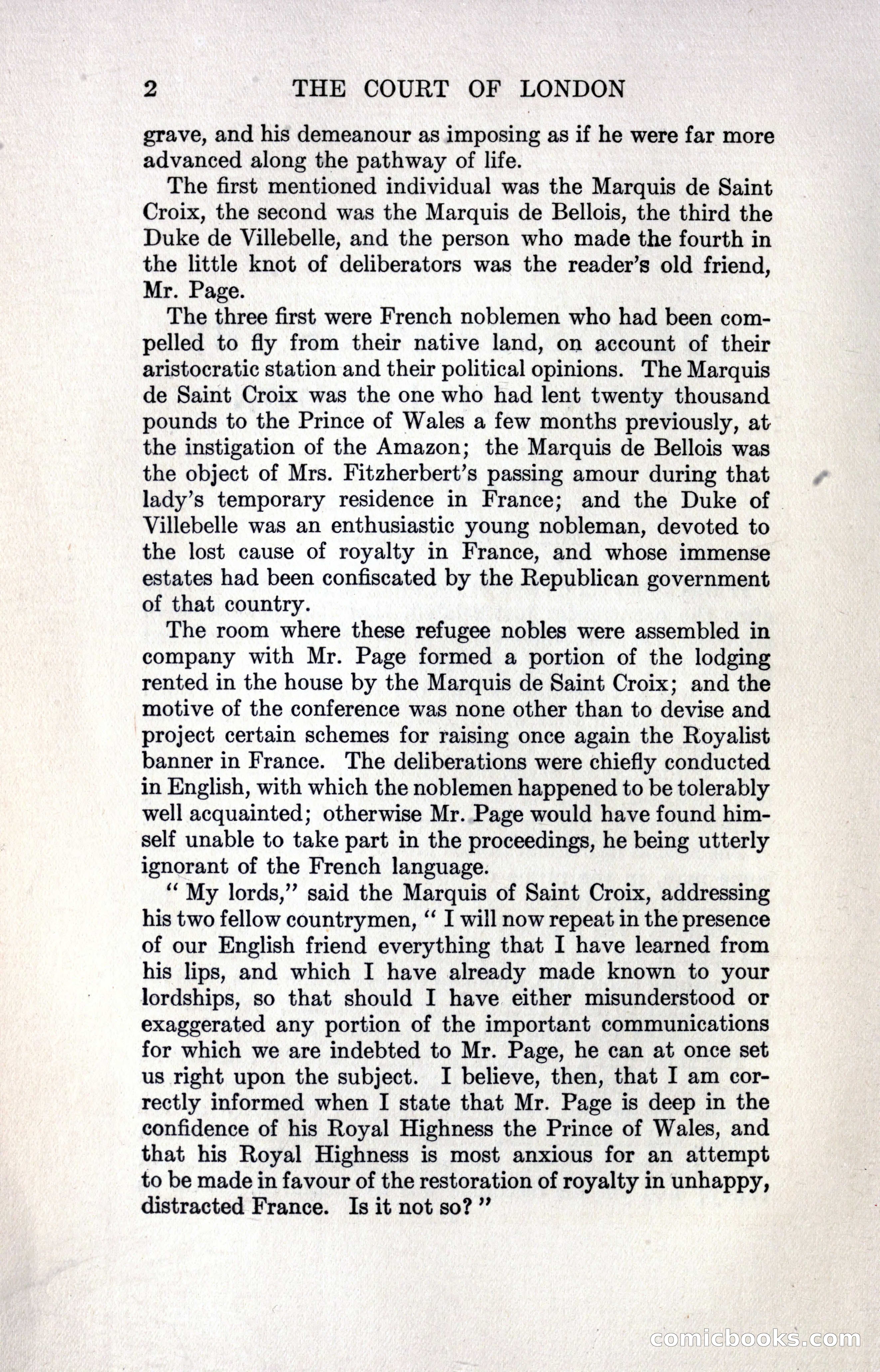
A restored page from Penny Dreadfuls, 1860. Page through the whole issue in the reader above.
📄 Transcribed text from this page (OCR, searchable)
Machine-transcribed from the original scan — historical spelling and the odd misread are preserved.
2 THE COURT OF LONDON grave, and his demeanour as imposing as if he were far more advanced along the pathway of life. The first mentioned individual was the Marquis de Saint Croix, the second was the Marquis de Bellois, the third the Duke de Villebelle, and the person who made the fourth in the little knot of deliberators was the reader’s old friend, Mr. Page. The three first were French noblemen who had been com- pelled to fly from their native land, on account of their aristocratic station and their political opinions. The Marquis de Saint Croix was the one who had lent twenty thousand pounds to the Prince of Wales a few months previously, at the instigation of the Amazon; the Marquis de Bellois was the object of Mrs. Fitzherbert’s passing amour during that lady’s temporary residence in France; and the Duke of Villebelle was an enthusiastic young nobleman, devoted to the lost cause of royalty in France, and whose immense estates had been confiscated by the Republican government of that country. The room where these refugee nobles were assembled in company with Mr. Page formed a portion of the lodging rented in the house by the Marquis de Saint Croix; and the motive of the conference was none other than to devise and project certain schemes for raising once again the Royalist banner in France. The deliberations were chiefly conducted in English, with which the noblemen happened to be tolerably well acquainted; otherwise Mr. Page would have found him- self unable to take part in the proceedings, he being utterly ignorant of the French language. ‘* My lords,” said the Marquis of Saint Croix, addressing his two fellow countrymen, “‘‘ I will now repeat in the presence of our English friend everything that I have learned from his lips, and which I have already made known to your lordships, so that should I have either misunderstood or exaggerated any portion of the important communications for which we are indebted to Mr. Page, he can at once set us right upon the subject. I believe, then, that I am cor- rectly informed when I state that Mr. Page is deep in the confidence of his Royal Highness the Prince of Wales, and that his Royal Highness is most anxious for an attempt to be made in favour of the restoration of royalty in unhappy, distracted France. Is it not so? ” Gomichboo <S (E(O)