
Penny Dreadfuls, 1860 · page 352 of 400
The Mysteries of the Court of London — page 352: what you’re looking at
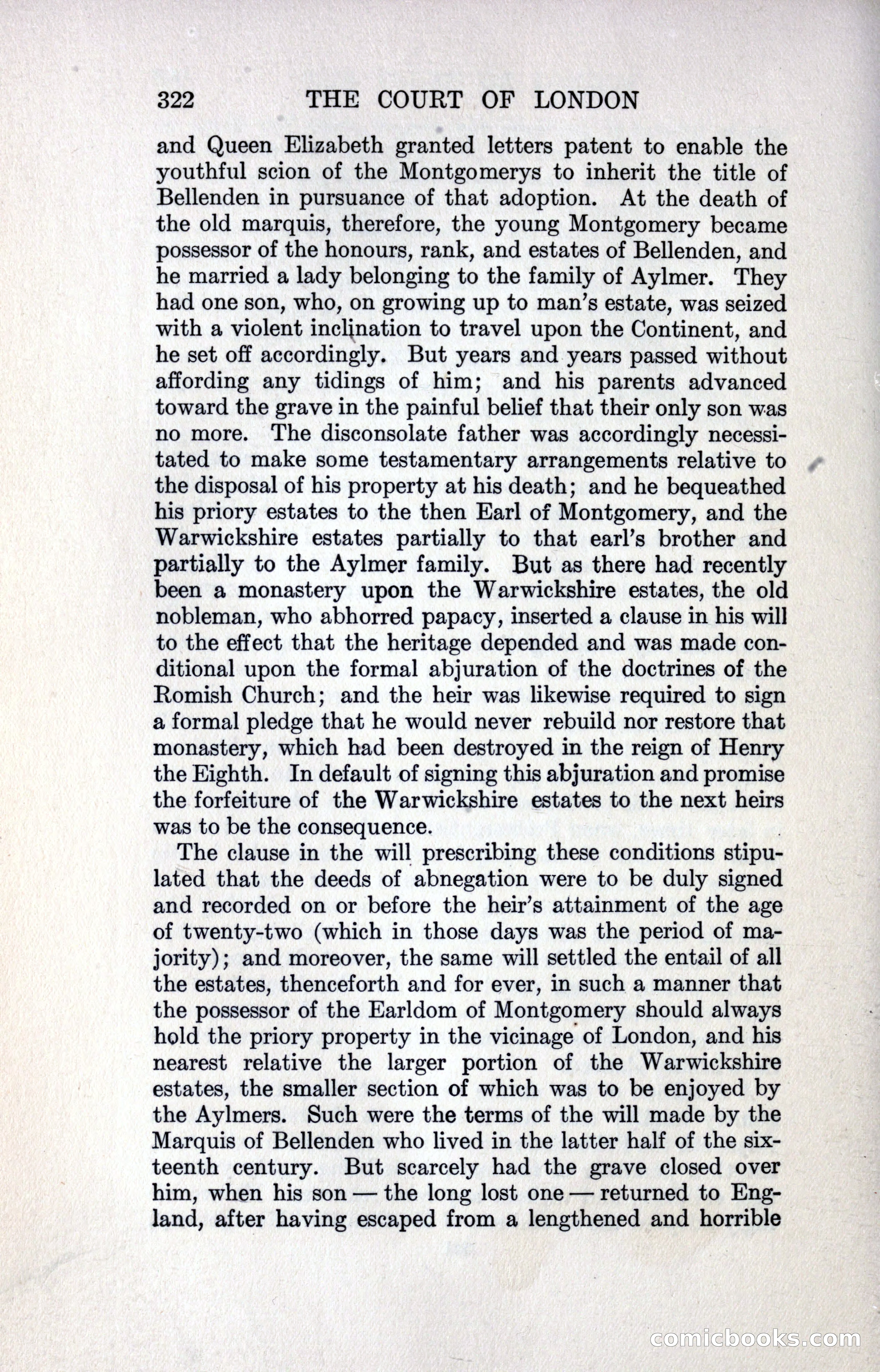
A restored page from Penny Dreadfuls, 1860. Page through the whole issue in the reader above.
📄 Transcribed text from this page (OCR, searchable)
Machine-transcribed from the original scan — historical spelling and the odd misread are preserved.
322 THE COURT OF LONDON and Queen Elizabeth granted letters patent to enable the youthful scion of the Montgomerys to inherit the title of Bellenden in pursuance of that adoption. At the death of the old marquis, therefore, the young Montgomery became possessor of the honours, rank, and estates of Bellenden, and he married a lady belonging to the family of Aylmer. They had one son, who, on growing up to man’s estate, was seized with a violent inclination to travel upon the Continent, and he set off accordingly. But years and years passed without affording any tidings of him; and his parents advanced toward the grave in the painful belief that their only son was no more. The disconsolate father was accordingly necessi- tated to make some testamentary arrangements relative to the disposal of his property at his death; and he bequeathed his priory estates to the then Earl of Montgomery, and the Warwickshire estates partially to that earl’s brother and partially to the Aylmer family. But as there had recently been a monastery upon the Warwickshire estates, the old nobleman, who abhorred papacy, inserted a clause in his will to the effect that the heritage depended and was made con- ditional upon the formal abjuration of the doctrines of the Romish Church; and the heir was likewise required to sign a formal pledge that he would never rebuild nor restore that monastery, which had been destroyed in the reign of Henry the Eighth. In default of signing this abjuration and promise the forfeiture of the Warwickshire estates to the next heirs was to be the consequence. The clause in the will prescribing these conditions stipu- lated that the deeds of abnegation were to be duly signed and recorded on or before the heir’s attainment of the age of twenty-two (which in those days was the period of ma- jority); and moreover, the same will settled the entail of all the estates, thenceforth and for ever, in such a manner that the possessor of the Earldom of Montgomery should always hold the priory property in the vicinage of London, and his nearest relative the larger portion of the Warwickshire estates, the smaller section of which was to be enjoyed by the Aylmers. Such were the terms of the will made by the Marquis of Bellenden who lived in the latter half of the six- teenth century. But scarcely had the grave closed over him, when his son — the long lost one — returned to Eng- land, after having escaped from a lengthened and horrible Gomicbooks