
Penny Dreadfuls, 1860 · page 387 of 400
The Mysteries of the Court of London — page 387: what you’re looking at
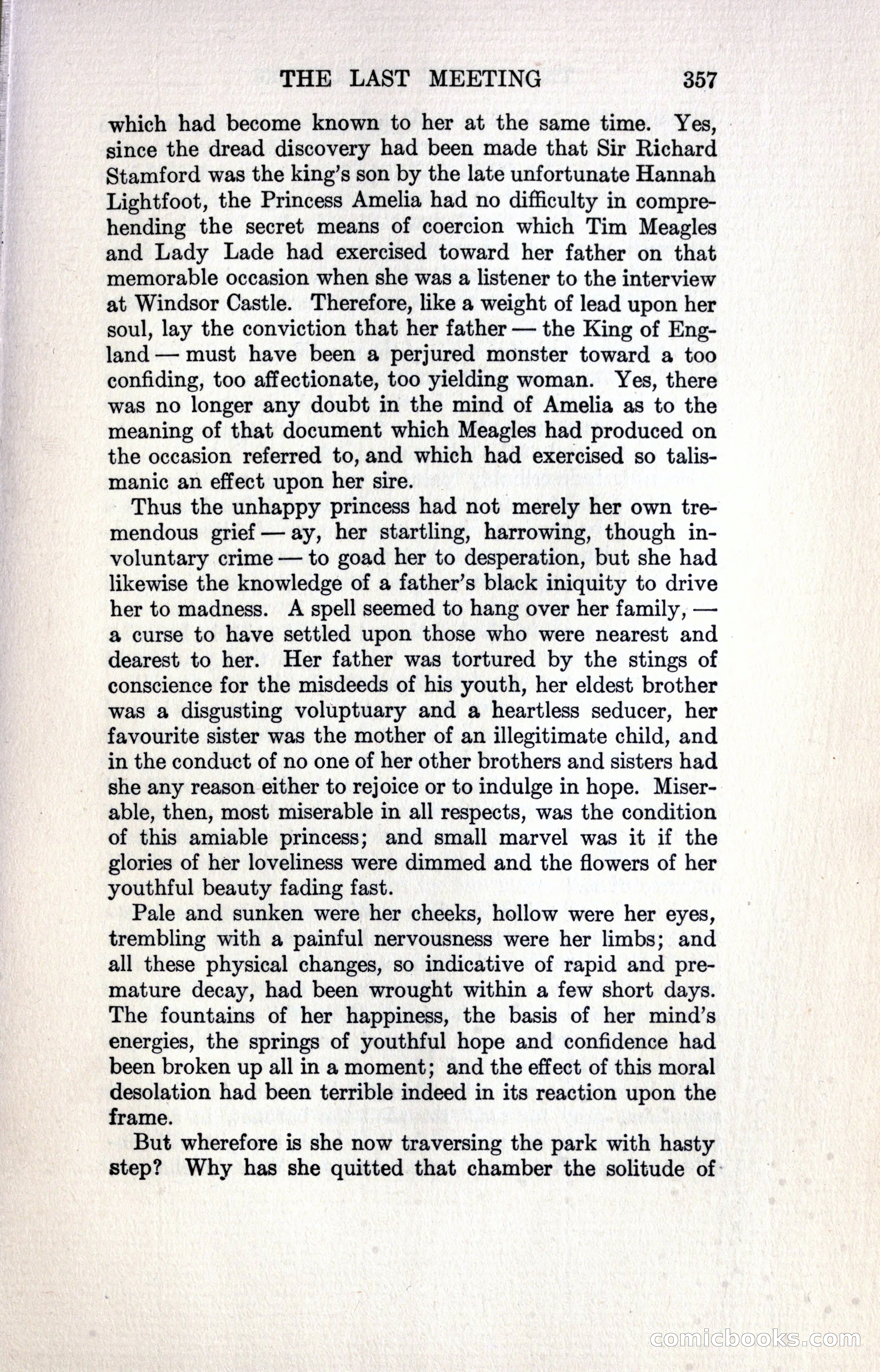
A restored page from Penny Dreadfuls, 1860. Page through the whole issue in the reader above.
📄 Transcribed text from this page (OCR, searchable)
Machine-transcribed from the original scan — historical spelling and the odd misread are preserved.
THE LAST MEETING ood which had become known to her at the same time. Yes, — since the dread discovery had been made that Sir Richard Stamford was the king’s son by the late unfortunate Hannah Lightfoot, the Princess Amelia had no difficulty in compre- hending the secret means of coercion which Tim Meagles and Lady Lade had exercised toward her father on that memorable occasion when she was a listener to the interview at Windsor Castle. Therefore, like a weight of lead upon her soul, lay the conviction that her father — the King of Eng- land — must have been a perjured monster toward a too confiding, too affectionate, too yielding woman. Yes, there was no longer any doubt in the mind of Amelia as to the meaning of that document which Meagles had produced on the occasion referred to, and which had exercised so talis- manic an effect upon her sire. Thus the unhappy princess had not merely her own tre- mendous grief — ay, her startling, harrowing, though in- voluntary crime — to goad her to desperation, but she had likewise the knowledge of a father’s black iniquity to drive her to madness. A spell seemed to hang over her family, — a curse to have settled upon those who were nearest and dearest to her. Her father was tortured by the stings of conscience for the misdeeds of his youth, her eldest brother was a disgusting voluptuary and a heartless seducer, her favourite sister was the mother of an illegitimate child, and in the conduct of no one of her other brothers and sisters had she any reason either to rejoice or to indulge in hope. Miser- able, then, most miserable in all respects, was the condition of this amiable princess; and small marvel was it if the glories of her loveliness were dimmed and the flowers of her youthful beauty fading fast. Pale and sunken were her cheeks, hollow were her eyes, trembling with a painful nervousness were her limbs; and all these physical changes, so indicative of rapid and pre- mature decay, had been wrought within a few short days. The fountains of her happiness, the basis of her mind’s energies, the springs of youthful hope and confidence had been broken up all in a moment; and the effect of this moral desolation had been terrible indeed in its reaction upon the frame. But wherefore is she now traversing the park with hasty step? Why has she quitted that chamber the solitude of- (COMMU OOO) eS (GO)