
Penny Dreadfuls, 1860 · page 314 of 394
The Mysteries of the Court of London — page 314: what you’re looking at
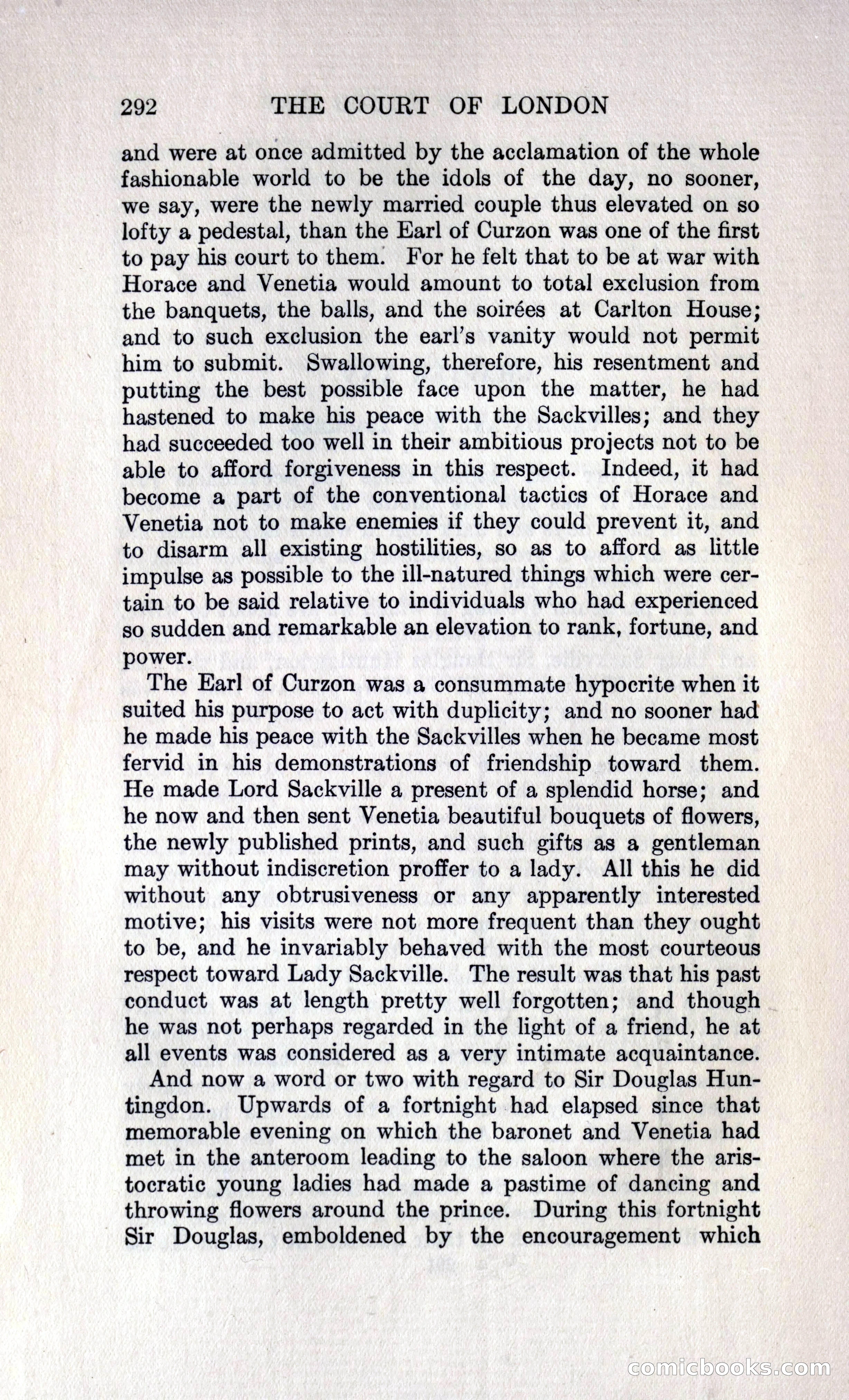
A restored page from Penny Dreadfuls, 1860. Page through the whole issue in the reader above.
📄 Transcribed text from this page (OCR, searchable)
Machine-transcribed from the original scan — historical spelling and the odd misread are preserved.
292 THE COURT OF LONDON and were at once admitted by the acclamation of the whole fashionable world to be the idols of the day, no sooner, we say, were the newly married couple thus elevated on so lofty a pedestal, than the Earl of Curzon was one of the first to pay his court to them. For he felt that to be at war with Horace and Venetia would amount to total exclusion from the banquets, the balls, and the soirées at Carlton House; and to such exclusion the earl’s vanity would not permit him to submit. Swallowing, therefore, his resentment and putting the best possible face upon the matter, he had hastened to make his peace with the Sackvilles; and they had succeeded too well in their ambitious projects not to be able to afford forgiveness in this respect. Indeed, it had become a part of the conventional tactics of Horace and Venetia not to make enemies if they could prevent it, and to disarm all existing hostilities, so as to afford as little impulse as possible to the ill-natured things which were cer- tain to be said relative to individuals who had experienced so sudden and remarkable an elevation to rank, fortune, and power. The Earl of Curzon was a consummate hypocrite when it suited his purpose to act with duplicity; and no sooner had he made his peace with the Sackvilles when he became most fervid in his demonstrations of friendship toward them. He made Lord Sackville a present of a splendid horse; and he now and then sent Venetia beautiful bouquets of flowers, the newly published prints, and such gifts as a gentleman may without indiscretion proffer to a lady. All this he did without any obtrusiveness or any apparently interested motive; his visits were not more frequent than they ought to be, and he invariably behaved with the most courteous respect toward Lady Sackville. The result was that his past conduct was at length pretty well forgotten; and though he was not perhaps regarded in the light of a friend, he at all events was considered as a very intimate acquaintance. And now a word or two with regard to Sir Douglas Hun- tingdon. Upwards of a fortnight had elapsed since that memorable evening on which the baronet and Venetia had met in the anteroom leading to the saloon where the aris- tocratic young ladies had made a pastime of dancing and throwing flowers around the prince. During this fortnight Sir Douglas, emboldened by the encouragement which CORVICLMOOOKS (E(0)