
Penny Dreadfuls, 1860 · page 85 of 394
The Mysteries of the Court of London — page 85: what you’re looking at
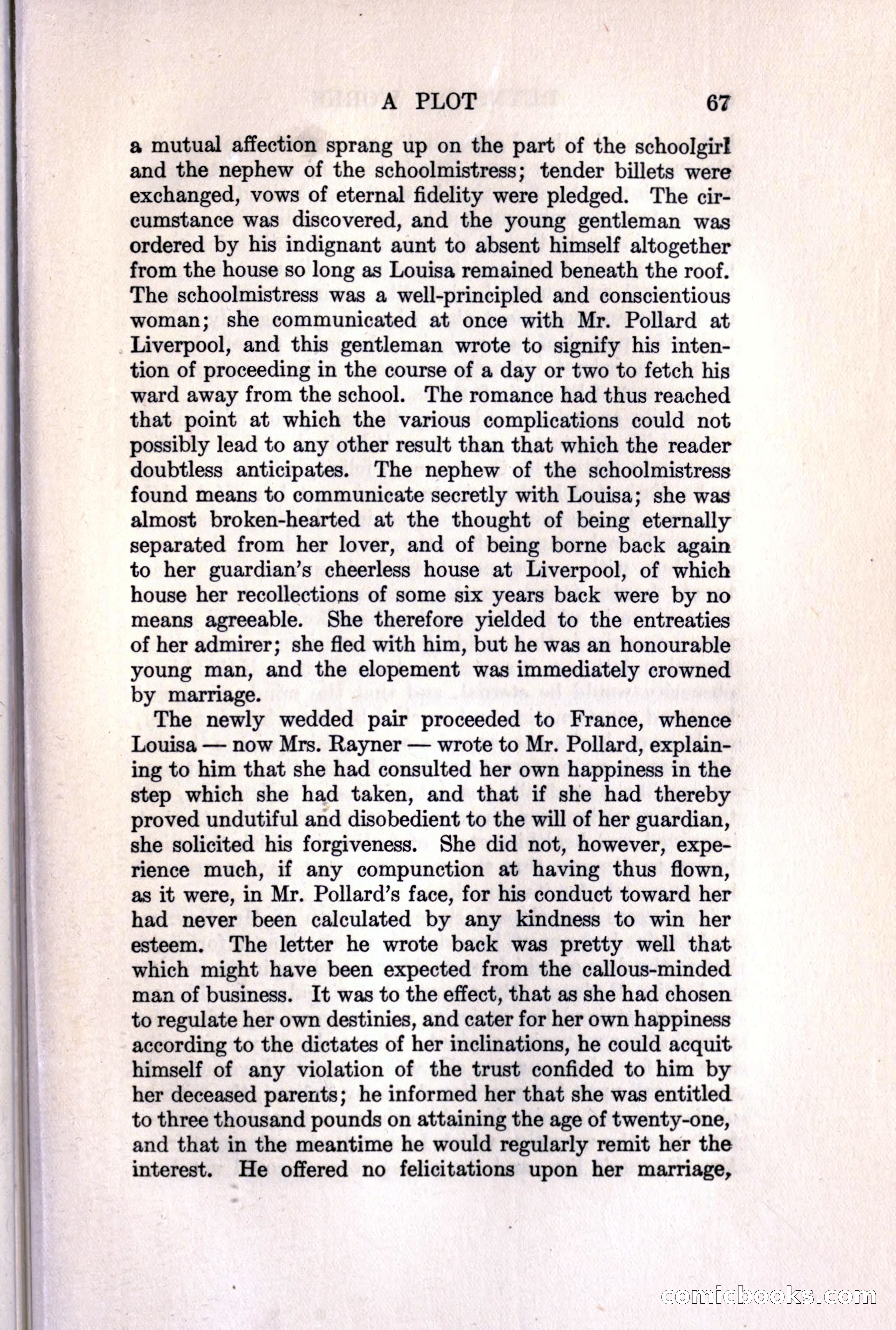
A restored page from Penny Dreadfuls, 1860. Page through the whole issue in the reader above.
📄 Transcribed text from this page (OCR, searchable)
Machine-transcribed from the original scan — historical spelling and the odd misread are preserved.
A PLOT 67 a mutual affection sprang up on the part of the schoolgirl and the nephew of the schoolmistress; tender billets were exchanged, vows of eternal fidelity were pledged. The cir- cumstance was discovered, and the young gentleman was ordered by his indignant aunt to absent himself altogether from the house so long as Louisa remained beneath the roof. The schoolmistress was a well-principled and conscientious woman; she communicated at once with Mr. Pollard at Liverpool, and this gentleman wrote to signify his inten- tion of proceeding in the course of a day or two to fetch his ward away from the school. The romance had thus reached that point at which the various complications could not possibly lead to any other result than that which the reader doubtless anticipates. The nephew of the schoolmistress found means to communicate secretly with Louisa; she was almost broken-hearted at the thought of being eternally separated from her lover, and of being borne back again to her guardian’s cheerless house at Liverpool, of which house her recollections of some six years back were by no means agreeable. She therefore yielded to the entreaties of her admirer; she fled with him, but he was an honourable young man, and the elopement was immediately crowned by marriage. The newly wedded pair proceeded to France, whence Louisa — now Mrs. Rayner — wrote to Mr. Pollard, explain- ing to him that she had consulted her own happiness in the step which she had taken, and that if she had thereby proved undutiful and disobedient to the will of her guardian, she solicited his forgiveness. She did not, however, expe- rience much, if any compunction at having thus flown, as it were, in Mr. Pollard’s face, for his conduct toward her had never been calculated by any kindness to win her esteem. The letter he wrote back was pretty well that which might have been expected from the callous-minded man of business. It was to the effect, that as she had chosen to regulate her own destinies, and cater for her own happiness according to the dictates of her inclinations, he could acquit himself of any violation of the trust confided to him by her deceased parents; he informed her that she was entitled to three thousand pounds on attaining the age of twenty-one, and that in the meantime he would regularly remit her the interest. He offered no felicitations upon her marriage, CONMIC DOO) SS) (EO) mM