
Penny Dreadfuls, 1849 · page 112 of 394
The Mysteries of the Court of London — page 112: what you’re looking at
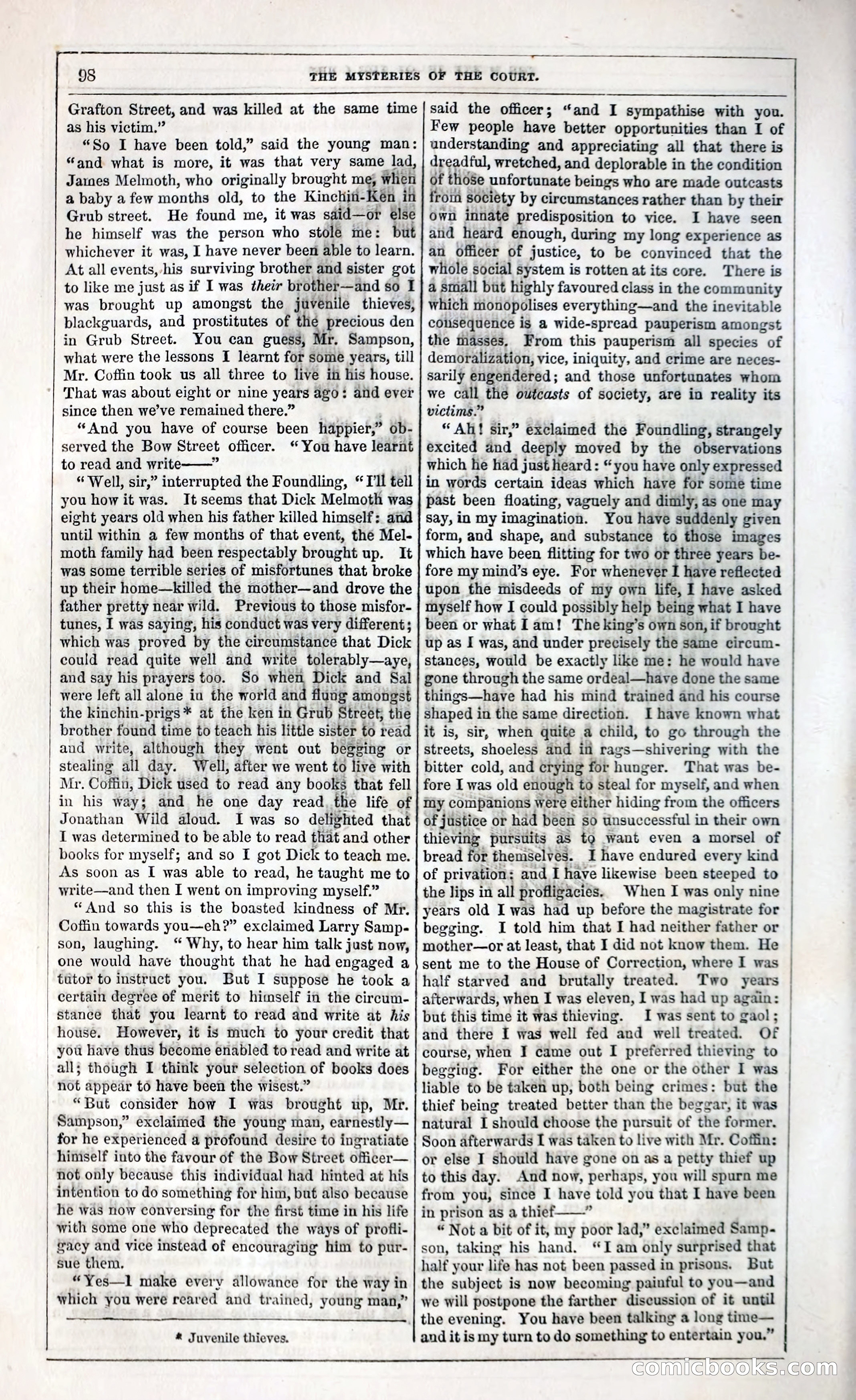
A restored page from Penny Dreadfuls, 1849. Page through the whole issue in the reader above.
📄 Transcribed text from this page (OCR, searchable)
Machine-transcribed from the original scan — historical spelling and the odd misread are preserved.
98 THE MYSTERIES Grafton Street, and was killed at the same time as his victim.” “So I have been told,” said the young man: “and what is more, it was that very same lad, Janes Melmoth, who originally brought mg a baby a few months old, to the Kinchifi-Ken in Grub street. He found me, it was sdid—or else he himself was the person who stole me: but whichever it was, I have never been able to learn. At all events,-his surviving brother and sister got to like me just as if I was their brother—and so I was brought up amongst the juvenile thieves; blackguards, and prostitutes of thé precious den in Grub Street. You can guess, Mr. Sampson, what were the lessons I learnt for some years, till Mr. Coffin took us all three to live in his house. '| That was about eight or nine years ago: and ever since then we’ve remainedthere.” __ “And you have of course been happier,” ob- served the Bow Street officer. “ You have learnt to read and write——” ‘ Well, sir,” interrupted the Foundling, “I'll tell you how it was. It seems that Dick Melmoth was eight years old when his father killed himself: and until within a few months of that event, the Mel- moth family had been respectably brought up. It was some terrible series of misfortunes that broke up their home—killed the mother—and drove the father pretty near wild. Previous to those misfor- tunes, I was saying, his conduct was very different; which was proved by the circumstance that Dick could read quite well and write tolerably—aye, and say his prayers too. So when Dick and Sal were left all alone in the world and flung amongst the kinchin-prigs* at the ken in Grub Streét; the brother found time to teach his little sister to read and write, although they went out begging or stealing all day. Well, after we went to live with Mr. Coffin, Dick used to read any books that fell in his way; and he one day read. the life of Jonathan Wild aloud. I was so delighted that I was determined to be able to read that and other books for myself; and so I got Dick to teach me. As soon as I was able to read, he taught me to write—and then I went on improving myself.” “And so this is the boasted kindness of Mr. Coffin towards you—eh?” exclaimed Larry Samp- son, laughing. ‘“ Why, to hear him talk just now, one would have thought that he had engaged a ttitor to instruct you. But I suppose he took a certain degree of merit to himself in the circum- stance that you learnt to read and write at his house. However, it is much to your credit that you have thus become enabled to read and write at all; though I think your selection of books does not appear to have been the wisest.” “But consider how I was brought up, Mr. Sampson,” exclaimed the young man, earnestly— for he experienced a profound desire to ingratiate himself into the favour of the Bow Street officer— not only because this individual had hinted at his intention to do something for him, but also because he was now conversing for the first time in his life with some one who deprecated the ways of profli- gacy and vice instead of encouraging him to pur- sue them. “Yes—l make every allowance for the way in which you were reared and trained, young man,” * Juvenile thieves. OF THE COURT. said the officer; “and I sympathise with you. Few people have better opportunities than I of understanding and appreciating all that there is dreadful, wretched, and deplorable in the condition of thdse unfortunate beings who are made outcasts from society by circumstances rather than by their own innate predisposition to vice. I have seen and heard enough, during my long experience as an officer of justice, to be convinced that the whole social system is rotten at its core. There is a small but highly favoured class in the community | which monopolises everything—and the inevitable | cousequence is a wide-spread pauperism amongst | the masses. From this pauperism all species of | demoralization, vice, iniquity, and crime are neces- | sarily engendered; and those unfortunates whom | we call the outcasts of society, are in reality its victims.” “ Ahi! sir,” exclaimed the Foundling, strangely excited and deeply moved by the observations | which he had just heard: “you have only expressed in words certain ideas which have for some time past been floating, vaguely and dimly, as one may say, in my imagination. You have suddenly given | form, and shape, and substance to those images | which have been flitting for two or three years be- fore my mind’s eye. For whenever I have reflected upon the misdeeds of my own life, I have asked myself how I could possibly help being what I have been or what Lam! The king’s own son, if brought up as I was, and under precisely the same circum- stances, would be exactly like me: he would have gone through the same ordeal—have done the same | things—have had his mind trained and his course shaped in the same direction. I have known what it is, sir, when quite a child, to go through the streets, shoeless and in rags—shivering with the bitter cold, and crying for hunger. That was be- fore I was old enough to steal for myself, and when | my companions were either hiding from the officers | of justice or had been so tinsuccessful in their own | thieving pursuits as t9 want even a morsel of | bread for themselves. I have endured every kind of privation: and I have likewise been steeped to the lips in all profligacies. When I was only nine years old I was had up before the magistrate for begging. I told him that I had neither father or mother—or at least, that I did not know them. He | sent me to the House of Correction, where I was | half starved and brutally treated. Two years afterwards, when I was eleven, I was had up again: | but this time it was thieving. I was sent to gaol; | and there I was well fed and well treated. Of | course, when I came out I preferred thieving to | begging. For either the one or the other I was liable to be taken up, both being crimes: but the thief being treated better than the beggar, it was natural I should choose the pursuit of the former. Soon afterwards I was taken to live with Mr. Coffin: or else I should have gone on as a petty thief up to this day. And now, perhaps, you will spurn me from you, since I have told you that I have been in prison as a thief ——” “ Not a bit of it, my poor lad,” exclaimed Samp- son, taking his hand. I am only surprised that half your life has not been passed in prisons. But the subject is now becoming painful to you—and we will postpone the farther discussion of it until | the evening. You have been talking a long time— and it is my turn to do something to entertain you.” CONMICWOOKSn(EO)