
Penny Dreadfuls, 1849 · page 16 of 394
The Mysteries of the Court of London — page 16: what you’re looking at
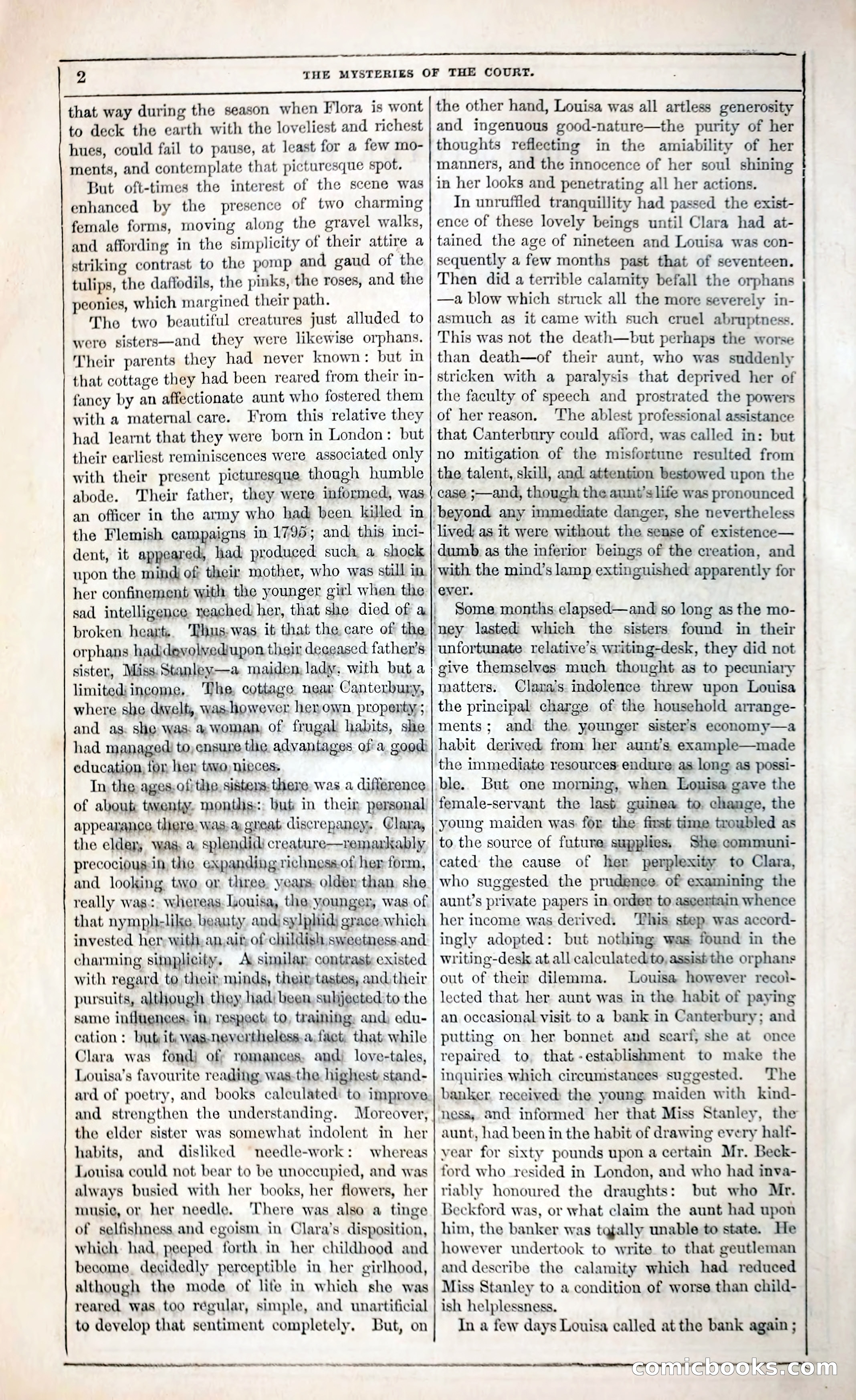
A restored page from Penny Dreadfuls, 1849. Page through the whole issue in the reader above.
📄 Transcribed text from this page (OCR, searchable)
Machine-transcribed from the original scan — historical spelling and the odd misread are preserved.
ae y/ THE MYSTERIES OF THE COURT. that way during the season when Flora is wont to deck the earth with the loveliest and richest hues, could fail to pause, at least for a few mo- ments, and contemplate that picturesque spot. But oft-times the interest of the scene was enhanced by the presence of two charming female forms, moving along the gravel walks, and affording in the simplicity of their attire a striking contrast to the pomp and gaud of the tulips, the daffodils, the pinks, the roses, and the peonies, which margined their path. The two beautiful creatures just alluded to were sisters—and they were likewise orphans. Their parents they had never known: but in that cottage they had been reared from their in- fancy by an affectionate aunt who fostered them with a maternal care. From this relative they had learnt that they were born in London: but their earliest reminiscences were associated only with their present picturesque though humble abode. Their father, they were informed, was an officer in the army who had been killed in the Flemish campaigns in 1795; and this inci- dent, it appeared, had produced such, a shock upon the mindj of their mother, who was still in her confinement with the younger girl when the sad intelligence yeached her, that she died of a broken hearts. Thus-was it that the care of the orphans hadidevolvediupon their deceased father’s sister, Miss. Stanley—a maiden lady, with but a limitediincome, The. cottage near Canterbuny, where she diyelt, was-however henown. property ; and as: she was: a woman of frugal habits, she the other hand, Louisa was all artless generosity and ingenuous good-nature—the purity of her thoughts reflecting in the amiability of her manners, and the innocence of her soul shining in her looks and penetrating all her actions. In unruffled tranquillity had passed the exist- ence of these lovely beings until Clara had at- tained the age of nineteen and Louisa was con- sequently a few months past that of seventeen. Then did a terrible calamity befall the orphans —a blow which struck all the more severely in- asmuch as it came with such cruel abruptness. This was not the death—but perhaps the worse than death—of their aunt, who was suddenly stricken with a paralysis that deprived her of the faculty of speech and prostrated the powers of her reason. The ablest professional assistance that Canterbury could afiord, was called in: but no mitigation of the misfortune resulted from the talent, skill, and attention bestowed upon the case ;—and, though the aunt’s life was pronounced ‘beyond any immediate danger, she nevertheless lived; as 1t were without the seuse of existence— dumb. as the inferior beings of the creation, and with the mind’s lamp extinguished apparently for ever. _ Some months elapsed—and so long as the mo- ney lasted which the sisters found in their unfortunate relative’s writing-desk, they did not give themselves much thought as to pecuniary matters. Clana’s indolence threw upon Louisa the principal charge of the household arrange- ments; and the younger sister’s economy—a had managed to, ensue the advantages of a good) habit derived from her aunt’s. example—made education, ton her tao, nieces. In. the ages, of} the, sistens: there. was a difference of about twenty. months: but in their personal appearance, there, was, a great discrepaney. Clana, the elder; was; & splendid creature—remankably precocious:in, the expandivg richness.of her form, and looking, tivo. or three, yeans: older than, she really was.:. whereas. Louisa, the: younger, was of that nymph-like. beauty andjsylphid) grace which invested her with, an,aif of childish sweetness.and charming simplicity. A similar contrast existed with regard to their, minds, theiytastes; and their pursuits, although they had) been subjected to the same influences: in, respect: to, training, and, edu- cation: but it was-nevertheless.a, fact that while Clara was fondj of romances, and) love-tales, Louisa’s favourite reading, was-the highest stand- the immediate resources: endure; as long as possi- ble. But one morning, when Lonisa gave the female-servant the last guinea to, change, the young maiden was: for the fixst time troubled as to the source of future: supplies, She: communi- cated the cause of her perplexity to Clara, who suggested the prudence. of examining the aunt’s private papers in order to ascertain whence her income was derived. ‘This step was accord- ingly adopted: but nothing was found in the writing-desk at all calculated to, assistthe orphans out of their dilemma. Louisa however recol- lected that her aunt was in the habit of paying an occasional visit to a bank in Canterbury; and putting on her bonnet and scarf, she at once repaired to, that-establishment to make the inquiries which circumstances suggested. The ard of poetry, and books calculated: to improve.| banker. received: the young maiden with kind- and strengthen the understanding. Moreover, the elder sister was somewhat indolent in her habits, and disliked needle-work: whereas Louisa could not bear to be unoccupied, and was always busied with her books, her flowers, her musie, or her needle. ‘There was also a tinge of selfishness and egoism in Clara’s disposition, which had, peeped forth in her childhood and become. decidedly perceptible in her girlhood, although the mode of lite in which she was reared was too regular, simple, and unartificial to develop that sentiment completely. But, on tN eee eee Cann ar nr er eee ve « COMC 0 Coo) ness, and informed her that Miss Stanley, the aunt, had been in the habit of drawing every half- year for sixty pounds upon a certain Mr. Beck- ford who resided in London, and who had inva- riably honoured the draughts: but who Mr. Beckford was, or what claim the aunt had upon him, the banker was tggally unable to state. He however undertook to write to that geutleman and describe the calamity which had reduced Miss Stanley to a condition of worse than child- ish helplessness. In a few days Louisa called at the bank again ;