
Penny Dreadfuls, 1849 · page 171 of 394
The Mysteries of the Court of London — page 171: what you’re looking at
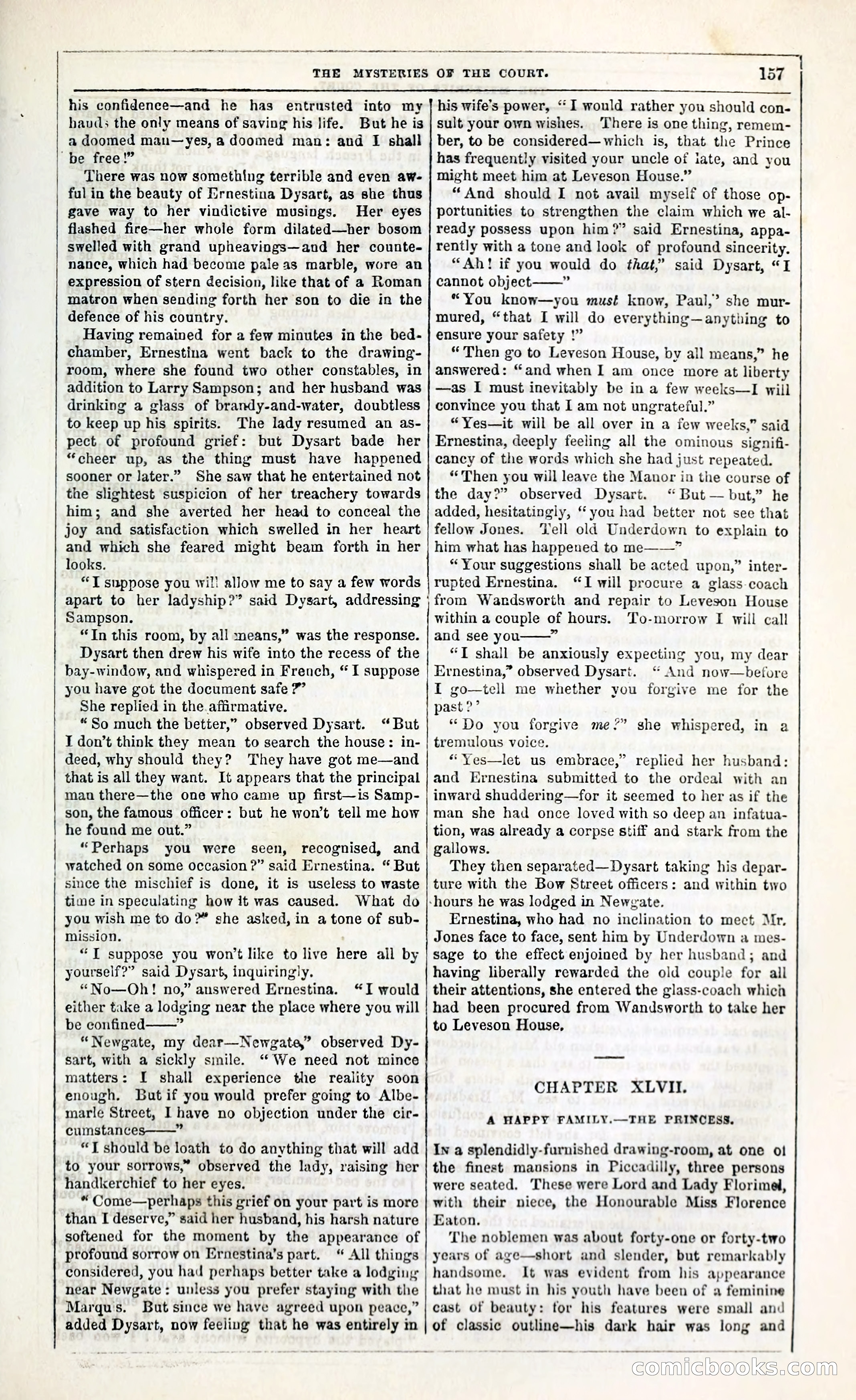
A restored page from Penny Dreadfuls, 1849. Page through the whole issue in the reader above.
📄 Transcribed text from this page (OCR, searchable)
Machine-transcribed from the original scan — historical spelling and the odd misread are preserved.
a ee ee ee rn we eee - ee eee THE MYSTERIES OF THE COURT. etametitones= at ee Uae eucetstesiinite-meentbaewiiceecintcoteiLamanld.rather son should cont confidence—and he has entrusted into my haud; the only means of saving his Jife. But he is a doomed mau—yes, a doomed man: and I shall be free!” There was now something terrible and even aw- ful in the beauty of Ernestina Dysart, as she thus gave way to her vindictive musings. Her eyes flashed fire—her whole form dilated—her bosom swelled with grand upheavings—and her counte- nance, which had become pale as marble, wore an expression of stern decision, like that of a Roman matron when sending forth her son to die in the defence of his country. Having remained for a few minutes in the bed- chamber, Ernestina went back to the drawing- room, where she found two other constables, in addition to Larry Sampson; and her husband was drinking a glass of brandy-and-water, doubtless to keep + up his spirits. The lady resumed an as- pect of profound grief: but Dysart bade her “cheer up, as the thing must have happened sooner or later.” She saw that he entertained not the slightest suspicion of her treachery towards him ; and she averted her head to conceal the joy and satisfaction which swelled in her heart and which she feared might beam forth in her looks. “IT suppose you wil! allow me to say a few words apart to her ladyship?” said Dysart, addressing | Sampson. “Tn this room, by all means,” was the response. Dysart then drew his wife into the recess of the bay-window, and whispered in French, “ I suppose you have got the document safe 7” She replied in the affirmative. “So much the better,” observed Dysart. “But I don’t think they mean to search the house: in- deed, why should they? They have got me—and that is all they want. It appears that the principal man there—the one who came up first—is Samp- son, the famous officer: but he won't tell me how he found me out.” “Perhaps you were seen, recognised, and watched on some occasion ?” said Ernestina. “ But since the mischief is done, it is useless to waste time in speculating how it was caused. What do you wish me to do™ she asked, in a tone of sub- mission. “TI suppose you won't like to live here ail by yourself?” said Dysart, inquiringly. *No—Oh! no,” answered Ernestina. “I would either take a lodging near the place where you will be confined——” “Newgate, my dear—Newgate,” observed Dy- sart, with a sickly smile. ‘“‘ We need not wince matters: I shall experience the reality soon enough. Butif you would prefer going to Albe- marle Street, I have no objection under the cir- cumstances——” “JT should be loath to do anything that will add to your sorrows,” observed the lady, raising her handkerchief to her eyes. “ Come—perhaps this grief on your part is more than I deserve,” said her husband, his harsh nature softened for the moment by the appearance of profound sorrow on Ernestina’s part. “ All things considered, you had perhaps better take a lodging near Newgate: unless you prefer staying with the Marqu's. But since we have agreed upon peace,” added Dysart, now feeling that he was entirely in oa ee oe RS -_ otal ho SE 2 | nF his wife’s power, “I would rather you should con- sult your own wishes. ‘There is one thing, remem- ber, to be considered— which is, that the Prince has frequently visited your uncle of iate, and you might meet him at Leveson House.” “And should I not avail myself of those op- portunities to strengthen the claim which we al- ready possess upon him?” said Ernestina, appa- rently with a tone and look of profound sincerity. “Ah! if you would do that,” said Dysart, “I cannot object-——” “You know—you must know, Paul,’ she mur- mured, “that I will do everything—anything to ensure your safety !” * Then go to Leveson House, by all means,” he answered: “and when I am once more at liberty —as I must inevitably be in a few weeks—lI will convince you that I am not ungrateful.” “ Yes—it will be all over in a few weeks,” said Ernestina, deeply feeling all the ominous signifi- cancy of the words which she had just repeated. “Then you will leave the Manor 1 in the course of the day?” observed Dysart. “But — but,” he added, hesitatingly, “you had better not see that fellow Jones. ‘Vell old Underdown to explain to him what has happened to me——” * Your suggestions shall be acted upon,” inter- rupted Ernestina. “I will procure a glass coach Soin Wandsworth and repair to Leveson House within a couple of hours. To-morrow I wiil call and see you < “T shall be anxiously expecting you, my dear Ernestina,” observed Dysart. “ And now—before I go—tell me whether you forgive me for the past ?’ “Do you forgive tremulous voice. *Yes—let us embrace,” replied her husband: and Ernestina submitted to the ordeal with an inward shuddering—for it seemed to her as if the man she had once loved with so deep an infatua- tion, was already a corpse stiff and stark from the gallows. They then separated—Dysart taking his depar- ture with the Bow Street officers: and within two me?” she whispered, in a ‘hours he was lodged in Neweate. Ernestina, who had no inclination to meet Mr. Jones face to face, sent him by Underdown a mes- sage to the effect enjoined by her husband; and having liberally rewarded the old couple for all their attentions, she entered the glass-coach which had been procured from Wandsworth to take her to Leveson House, CHAPTER XLVII. A HAPPY FAMILY.—THE PRINCESS. In a splendidly-furnished drawing-room, at one ol the finest mausions in Piccadilly, three persons were seated. These were Lord and Lady Florimed, with their niece, the Honourable Miss Florence Eaton. The noblemen was about forty-one or forty-two years of age—short and slender, but remarkably handsome. It was evident from his appearance that he must in his youth have been of a feminine cast of beauty: tor his features were small and of classic outline—his dark hair was long and JOO (Cc S COLT! (CO)