
Penny Dreadfuls, 1849 · page 173 of 394
The Mysteries of the Court of London — page 173: what you’re looking at
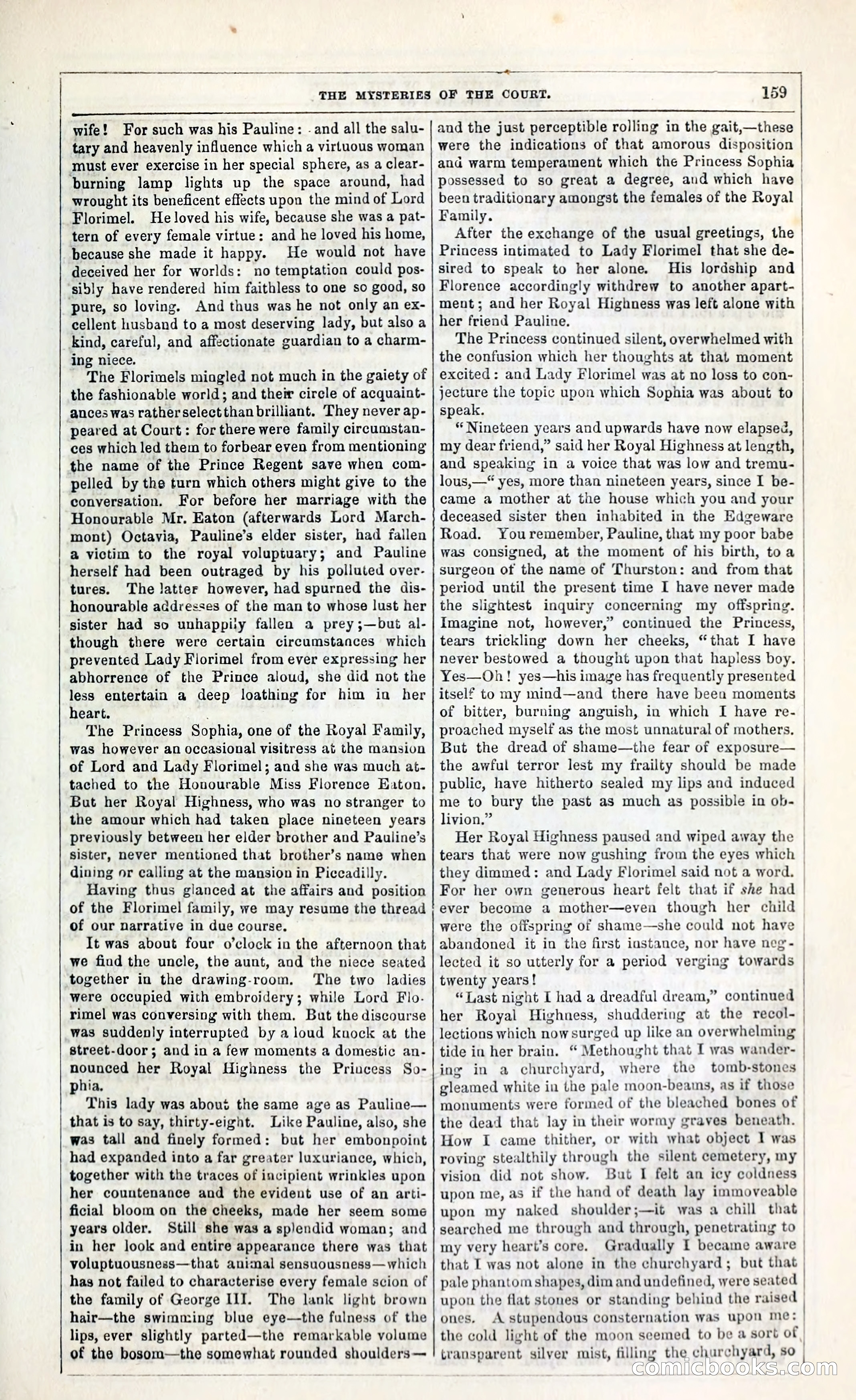
A restored page from Penny Dreadfuls, 1849. Page through the whole issue in the reader above.
📄 Transcribed text from this page (OCR, searchable)
Machine-transcribed from the original scan — historical spelling and the odd misread are preserved.
eee THE MYSTERIES OF THE COURT. 159 Se —— —————— ee ee er ee wife! For such was his Pauline: - and all the salu- tary and heavenly influence which a virtuous woman must ever exercise in her special sphere, as a clear- ‘burning lamp lights up the space around, had wrought its beneficent effects upon the mind of Lord Florimel. He loved his wife, because she was a pat- tern of every female virtue: and he loved his home, because she made it happy. He would not have deceived her for worlds: no temptation could pos- sibly have rendered him faithless to one so good, so pure, so loving. And thus was he not only an ex- cellent husband to a most deserving lady, but also a kind, careful, and affectionate guardian to a charm- ing niece. The Florimels mingled not much in the gaiety of the fashionable world; and their circle of acquaint- ances was rather selectthan brilliant. They never ap- peared at Court: for there were family circumstan- ces which led them to forbear even from mentioning the name of the Prince Regent save when com- pelled by the turn which others might give to the conversation. For before her marriage with the Honourable Mr. Eaton (afterwards Lord March- mont) Octavia, Pauline’s elder sister, had fallen a victim to the royal voluptuary; and Pauline herself had been outraged by his polluted over- tures. The latter however, had spurned the dis- honourable addresses of the man to whose lust her sister had so unhappiiy fallen a prey ;—but al- though there were certain circumstances which prevented Lady Florimel from ever expressing her abhorrence of the Prince aloud, she did not the less entertain a deep loathing for him in her heart. . The Princess Sophia, one of the Royal Family, was however an occasional visitress at the mansion of Lord and Lady Florimel; and she was much at- tached to the Honourable Miss Florence Eaton. But her Royal Highness, who was no stranger to the amour which had taken place nineteen years previously between her elder brother and Pauline’s sister, never mentioned that brother’s name when dining or calling at the mansion in Piccadilly. Having thus glanced at the affairs and position of the Florimel family, we may resume the thread of our narrative in due course. It was about four o’clock in the afternoon that we find the uncle, the aunt, and the niece seated together in the drawing-room. ‘The two ladies were occupied with embroidery; while Lord Flo. rimel was conversing with them. But the discourse was suddenly interrupted by aloud kuock at the street-door; and in a few moments a domestic an- nounced her Royal HWiginess the Priucess So- phia, This lady was about the same age as Pauline— that is to say, thirty-eight. Like Pauline, also, she was tall and finely formed: but her embonpoint had expanded into a far greater luxuriance, which, together with the traces of incipient wrinkles upon her countenance and the evident use of an arti- ficial bloom on the cheeks, made her seem some years older. Still she was a splendid woman; and in her look and entire appearance there was that voluptuousness—that animal sensuousness—which has not failed to characterise every female scion of the family of George III. The lank light brown hair—the swimming blue eye—the fulness of the lips, ever slightly parted—the remarkable volume of the bosom—the somewhat rounded shoulders— and the just perceptible rolling in the gait,—these were the indications of that amorous disposition and warm temperament which the Princess Sophia possessed to so great a degree, aud which have been traditionary amongst the females of the Royal Family. After the exchange of the usual greetings, the Princess intimated to Lady Florimel that she de- sired to speak to her alone. His lordship and Florence accordingly withdrew to another apart- ment; and her Royal Highness was left alone with her friend Pauline. The Princess continued silent, overwhelmed with the confusion which her thoughts at that moment ——— — excited: and Lady Florimel was at no loss to con- | jecture the topic upon which Sophia was about to speak. * Nineteen years and upwards have now elapsed, my dear friend,” said her Royal Highness at length, and speaking in a voice that was low and tremu- lous,—* yes, more than nineteen years, since I be- came a mother at the house which you and your deceased sister then inhabited in the Edgeware | Road. Youremember, Pauline, that my poor babe was consigned, at the moment of his birth, toa surgeon of the name of Thurston: and from that period until the present time I have never made the slightest inquiry concerning my offspring. Imagine not, however,” continued the Princess, | tears trickling down her cheeks, “that I have never bestowed a thought upon that hapless boy. | Yes—Oh! yes—his image has frequently presented itself to my mind—and there have beea moments of bitter, burning anguish, in which I have re- proached myself as the most unnatural of mothers, | But the dread of shame—the fear of exposure— the awful terror lest my frailty should be made public, have hitherto sealed my lips and induced me to bury the past as much as possible in ob- livion.” Her Royal Highness paused and wiped away the | tears that were now gushing from the eyes which | they dimmed: and Lady Florimel said not a word. For her own generous heart felt that if she had ever become a mother—even though her child were the offspring of shame—she could not have abandoned it in the first instance, nor have neg - lected it so utterly for a period verging towards twenty years! “Last night I had a dreadful dream,” continued her Royal Highness, shuddering at the recol- lections which nowsurged up like an overwhelming tide in her brain. “ Methought that I was wander- ing in a churchyard, where the tomb-stones | gleamed white in the pale moon-beams, as if those | monuments were formed of the bleached bones of the dead that lay in their wormy graves beneath. | How I came thither, or with what object I was | roving stealthily through the silent cemetery, my vision did not show. But I felt an icy coldness upon me, as if the hand of death lay immoveable upon my naked shoulder;—it was a chill that searched me through and through, penetrating to my very heart’s core. Gradually I became aware | that I was not alone in the churchyard; but that | pale phantom shapes, dim and undefined, were seated upon the flat stones or standing behind the raised ones, the cold light of the moon seemed to be a sort of transparent silver mist, filling the, churchyard, so A stupendous consternation was upon me; | | | (CONMICLOOOKS 9)