
Penny Dreadfuls, 1849 · page 190 of 394
The Mysteries of the Court of London — page 190: what you’re looking at
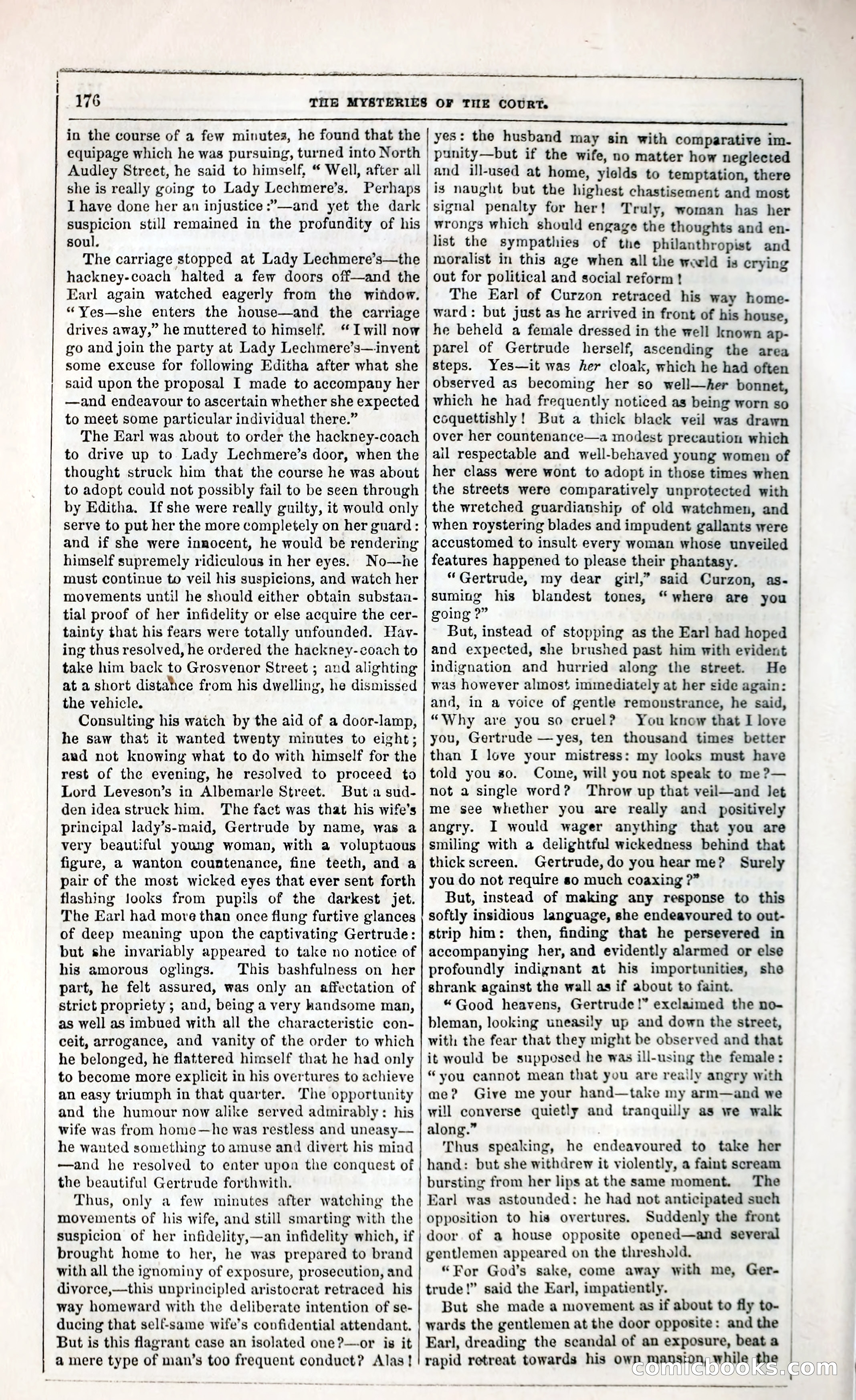
A restored page from Penny Dreadfuls, 1849. Page through the whole issue in the reader above.
📄 Transcribed text from this page (OCR, searchable)
Machine-transcribed from the original scan — historical spelling and the odd misread are preserved.
176 in the course of a few minutes, he found that the equipage which he was pursuing, turned into North Audley Street, he said to himself, “ Well, after all she is really going to Lady Lechmere’s. Perhaps I have done her an injustice :’—and yet the dark suspicion still remained in the profundity of his soul. The carriage stopped at Lady Lechmere’s—the hackney-coach halted a few doors off—and the Earl again watched eagerly from the window. *“ Yes—she enters the house—and the carriage drives away,” he muttered to himself. Iwill now go and join the party at Lady Lechmere’s—inyent some excuse for following Editha after what she said upon the proposal I made to accompany her —and endeavour to ascertain whether she expected to meet some particular individual there.” The Earl was about to order the hackney-coach to drive up to Lady Lechmere’s door, when the thought struck him that the course he was about to adopt could not possibly fail to be seen through by Editha. If she were really guilty, it would only serve to put her the more completely on her guard: and if she were innocent, he would be rendering himself supremely ridiculous in her eyes. No—he must continue to veil his suspicions, and watch her movements until he should either obtain substai- tial proof of her infidelity or else acquire the cer- tainty that his fears were totally unfounded. Hay- ing thus resolved, he ordered the hackney-coach to take him back to Grosvenor Street ; and alighting at a short distahce from his dwelling, he dismissed the vehicle. Consulting his watch by the aid of a door-lamp, he saw that it wanted twenty minutes to eight; aud not knowing what to do with himself for the rest of the evening, he resolved to proceed to Lord Leveson’s in Albemarle Street. But a sud- den idea struck him. The fact was that his wife’s principal lady’s-maid, Gertrude by name, was a very beautiful young woman, with a voluptuous figure, a wanton countenance, fine teeth, and a pair of the most wicked eyes that ever sent forth flashing looks from pupils of the darkest jet. The Earl had move than once flung furtive glances of deep meaning upon the captivating Gertrude: but she invariably appeared to take no notice of his amorous oglings. This bashfulness on her part, he felt assured, was only an affectation of strict propriety ; and, being a very handsome man, as well as imbued with all the characteristic con- ceit, arrogance, and vanity of the order to which he belonged, he flattered himself that he had only to become more explicit in his overtures to achieve an easy triumph in that quarter. The opportunity and the humour now alike served admirably: his wife was from home—he was restless and uneasy— he wanted something to amuse and divert his mind —and he resolved to enter upon the conquest of the beautiful Gertrude forthwith. Thus, only a few minutes after watching the movements of his wife, and still smarting with the suspicion of her infidelity,—an infidelity which, if brought home to her, he was prepared to brand with all the ignominy of exposure, prosecution, and divorce,—this unprincipled aristocrat retraced his way homeward with the deliberate intention of se- ducing that self-same wife’s confidential attendant. But is this flagrant case an isolated one ?—-or is it a mere type of man’s too frequent conduct? Alas! rapid retreat towards his own, mansion whe THE MYSTERIES OF THE COURT. yes: the husband may sin with comparative im- punity—but if the wife, no matter how neglected and ill-used at home, yields to temptation, there ig naught but the highest chastisement and most signal penalty for her! Truly, woman has her wrongs which should engage the thoughts and en- list the sympathies of the philanthropist and moralist in this age when all the world is crying out for political and social reform ! The Earl of Curzon retraced his way home- ward: but just as he arrived in front of his house, he beheld a female dressed in the well known ap- parel of Gertrude herself, ascending the area steps. Yes—it was her cloak, which he had often observed as becoming her so well—her bonnet, which he had frequently noticed as being worn so coquettishly! But a thick black veil was drawn over her countenance—a modest precaution which ail respectable and well-behaved young women of her class were wont to adopt in those times when the streets were comparatively unprotected with the wretched guardianship of old watchmen, and when roystering blades and impudent gallants were accustomed to insult every woman whose unveiled features happened to please their phantasy. “Gertrude, my dear girl,” said Curzon, as- suming his blandest tones, “where are you going ?” But, instead of stopping as the Earl had hoped and expected, she brushed past him with evident indignation and hurried along the street. He was however almost immediately at her side again: and, in a voice of gentle remoustrance, he said, “Why are you so cruel? You know that I love you, Gertrude — yes, ten thousand times better than I love your mistress: my looks must have told you 80. Come, will you not speak to me ?— not a single word? ‘Throw up that veil—and Jet me see whether you are really and positively angry. I would wager anything that you are smiling with a delightful wickedness behind that thick screen. Gertrude,do you hear me? Surely you do not require so much coaxing ?” But, instead of making any response to this softly insidious language, she endeavoured to out- strip him: then, finding that he persevered in accompanying her, and evidently alarmed or else profoundly indignant at his importunities, she shrank against the wall as if about to faint. “Good heavens, Gertrude!” exclaimed the no- bleman, looking uneasily up and down the street, with the fear that they might be observed and that it would be supposed he was ill-using the female: | “you cannot mean that you are really angry with me? Give me your hand—take my arm—and we will converse quietly and tranquilly as we walk along.” | Thus speaking, he endeavoured to take her hand: but she withdrew it violently, a faint scream bursting from her lips at the same moment. The Earl was astounded: he had not anticipated such opposition to his overtures. Suddenly the front door of a house opposite opened—and several gentlemen appeared on the threshold. “For God’s sake, come away with me, Ger- trude!” said the Earl, impatiently. But she made a movement as if about to fly to- wards the gentlemen at the door opposite: and the Earl, dreading the scandal of an exposure, beat a se — eee OE : Eo — oe — ee SL Ce —— —— =