
Penny Dreadfuls, 1849 · page 229 of 394
The Mysteries of the Court of London — page 229: what you’re looking at
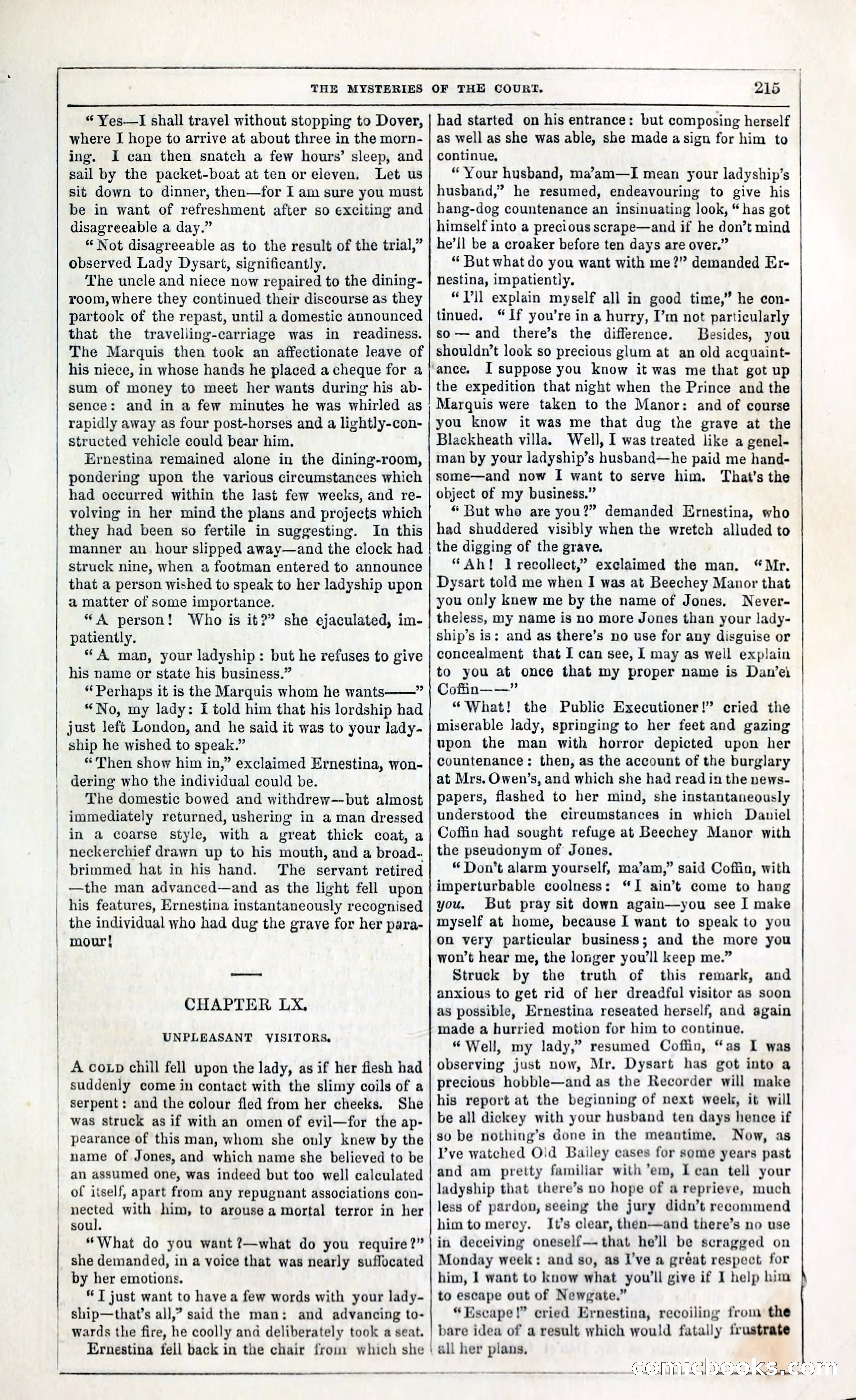
A restored page from Penny Dreadfuls, 1849. Page through the whole issue in the reader above.
📄 Transcribed text from this page (OCR, searchable)
Machine-transcribed from the original scan — historical spelling and the odd misread are preserved.
THE MYSTERIES OF THE COURT. ————_ ee 215 | “ Yes—I shall travel without stopping to Dover, where I hope to arrive at about three in the morn- ing. I can then snatch a few hours’ sleep, and sail by the packet-boat at ten or eleven, Let us sit down to dinner, then—for I am sure you must be in want of refreshment after so exciting and disagreeable a day.” “ Not disagreeable as to the result of the trial,” observed Lady Dysart, significantly. The uncle and niece now repaired to the dining- room, where they continued their discourse as they partook of the repast, until a domestic announced that the traveliing-carriage was in readiness. The Marquis then took an affectionate leave of his niece, in whose hands he placed a cheque for a sum of money to meet her wants during his ab- sence: and in a few minutes he was whirled as rapidly away as four post-horses and a lightly-con- structed vehicle could bear him. Ernestina remained alone in the dining-room, pondering upon the various circumstances which had occurred within the last few weeks, and re- volving in her mind the plans and projects which they had been so fertile in suggesting. In this manner an hour slipped away—and the clock had struck nine, when a footman entered to announce that a person wished to speak to her ladyship upon a matter of some importance. “A person! Who is it?” she ejaculated, im- patiently. * A man, your ladyship: but he refuses to give his name or state his business.” * Perhaps it is the Marquis whom he wants——” “No, my lady: i told him that his lordship had just left London, and he said it was to your lady- ship he wished to speak.” * Then show him in,” exclaimed Ernestina, won- dering who the individual could be. The domestic bowed and withdrew—but almost immediately returned, ushering in aman dressed in a coarse style, with a great thick coat, a neckerchief drawn up to his mouth, and a broad-. brimmed hat in his hand. The servant retired —the man advanced—and as the light fell upon his features, Ernestina instantaneously recognised the individual who had dug the grave for her para- mour! CHAPTER LX, | UNPLEASANT YISITORS, A coxp chill fell upon the lady, as if her flesh had suddenly come in contact with the slimy coils of a serpent: and the colour fled from her cheeks, She | was struck as if with an omen of evil—for the ap- | pearance of this man, whom she only knew by the name of Jones, and which name she believed to be | an assumed one, was indeed but too well calculated of itself, apart from any repugnant associations con- oe with him, to arouse a mortal terror in her soul. “What do you want ?—what do you require?” she demanded, in a voice that was nearly suflocated by her emotions. “T just want to have a few words with your lady- ship—that’s all,” said the man: and advancing to- | wards the fire, he coolly and deliberately took a seat. | Ernestina fell back in the chair from which she | all her plans, ee ee eee had started on his entrance: but composing herself as well as she was able, she made asign for him to continue, “Your husband, ma’am—I mean your ladyship’s husband,” he resumed, endeavouring to give his hang-dog countenance an insinuating look, “ has got himself into a precious scrape—and if he don’t mind he’ll be a croaker before ten days are over.” “ But what do you want with me?” demanded Er- nestina, impatiently. “ll explain myself all in good time,” he con- tinued. “If you’re in a hurry, I’m not particularly so— and there’s the difference. Besides, you shouldn’t look so precious glum at an old acquaint- ‘ance. J suppose you know it was me that got up the expedition that night when the Prince and the Marquis were taken to the Manor: and of course you know it was me that dug the grave at the Blackheath villa. Well, I was treated like a genel- man by your ladyship’s husband—he paid me hand- some—and now I want to serve him. That’s the object of my business.” * But who are you?” demanded Ernestina, who had shuddered visibly when the wretch alluded to the digging of the grave, * Ah! 1 recollect,” exclaimed the man. “Mr. Dysart told me when I was at Beechey Manor that you ouly knew me by the name of Jones. Never- theless, my name is no more Jones than your lady- ship’s is: and as there’s no use for any disguise or concealment that I can see, I may as well explain to you at once that my proper name is Dan’e) Cofin——” “What! the Public Executioner!” cried the miserable lady, springing to her feet and gazing upon the man with horror depicted upon her countenance: then, as the account of the burglary at Mrs. Owen’s, and which she had read in the news- papers, flashed to her mind, she instantaneously understood the circumstances in which Daniel Coffin had sought refuge at Beechey Manor with the pseudonym of Jones, Don't alarm yourself, ma’am,” said Coffin, with imperturbable coolness: “I ain’t come to hang you. But pray sit down again—you see I make myself at home, because I want to speak to you on very particular business; and the more you won’t hear me, the longer you'll keep me.” Struck by the truth of this remark, and anxious to get rid of her dreadful visitor as soon as possible, Ernestina reseated herself, and again made a hurried motion for him to continue. “Well, my lady,” resumed Coffin, “as I was observing just now, Mr. Dysart has got into a precious hobble—and as the Recorder will make his report at the beginning of next weels, it will be all dickey with your husband ten days hence if so be nothing’s done in the meantime. Now, as I’ve watched Old Bailey cases for some years past and am pretty familiar with’em, I can tell your ladyship that there’s no hope of a reprieve, much less of pardon, seeing the jury didn’t recommend him to mercy. It’s clear, then—and there’s no use in deceiving oneself—that he'll be scragged on Monday week: and so, as I’ve a gréat respect for him, I want to know what you'll give if I help him to escape out of Newgate.” “Escape!” cried Ernestina, recoiling from the bare idea of a result which would fatally frustrate _ ee — — GOnmichbooksre