
Penny Dreadfuls, 1849 · page 23 of 394
The Mysteries of the Court of London — page 23: what you’re looking at
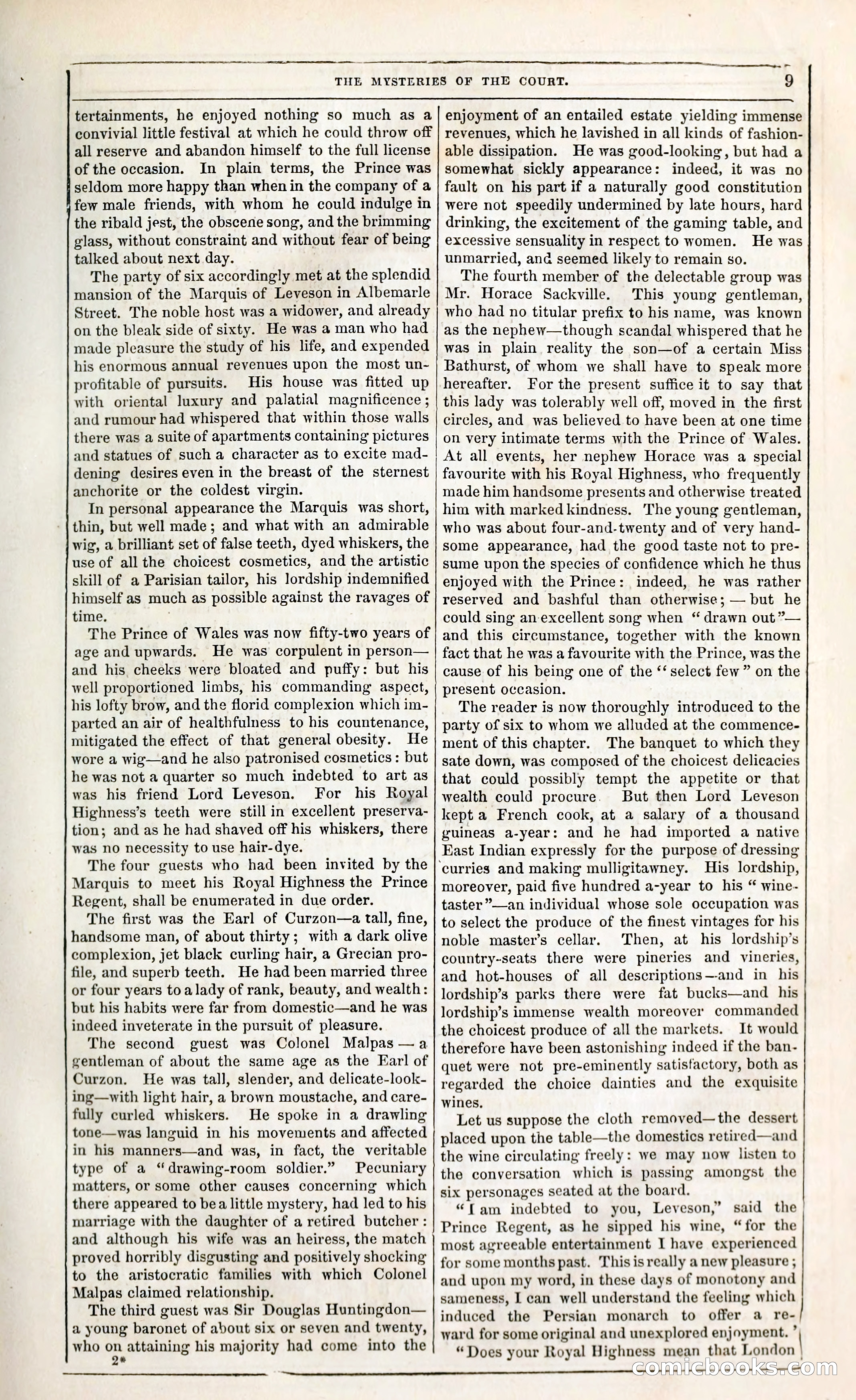
A restored page from Penny Dreadfuls, 1849. Page through the whole issue in the reader above.
📄 Transcribed text from this page (OCR, searchable)
Machine-transcribed from the original scan — historical spelling and the odd misread are preserved.
A EE — NER EE ns P~ THE MYSTERIES OF THE COURT. 9 tertainments, he enjoyed nothing so much as a convivial little festival at which he could throw off all reserve and abandon himself to the full license of the occasion. In plain terms, the Prince was seldom more happy than when in the company of a few male friends, with whom he could indulge in the ribald jest, the obscene song, and the brimming glass, without constraint and without fear of being talked about next day. The party of six accordingly met at the splendid mansion of the Marquis of Leveson in Albemarle Street. The noble host was a widower, and already on the bleak side of sixty. He was a man who had made pleasure the study of his life, and expended his enormous annual revenues upon the most un- profitable of pursuits. His house was fitted up with oriental luxury and palatial magnificence ; and rumour had whispered that within those walls there was a suite of apartments containing pictures and statues of such a character as to excite mad- dening desires even in the breast of the sternest anchorite or the coldest virgin. In personal appearance the Marquis was short, thin, but well made; and what with an admirable wig, a brilliant set of false teeth, dyed whiskers, the use of all the choicest cosmetics, and the artistic skill of a Parisian tailor, his lordship indemnified himself as much as possible against the ravages of time. , The Prince of Wales was now fifty-two years of age and upwards. He was corpulent in person— and his cheeks were bloated and puffy: but his well proportioned limbs, his commanding aspect, his lofty brow, and the florid complexion which im- parted an air of healthfulness to his countenance, mitigated the effect of that general obesity. He wore a wig—and he also patronised cosmetics: but he was not a quarter so much indebted to art as was his friend Lord Leveson. For his Royal Highness’s teeth were still in excellent preserva- tion; and as he had shaved off his whiskers, there was no necessity to use hair-dye. The four guests who had been invited by the Marquis to meet his Royal Highness the Prince Regent, shall be enumerated in due order. The first was the Earl of Curzon—a tall, fine, handsome man, of about thirty; with a dark olive complexion, jet black curling hair, a Grecian pro- file, and superb teeth. He had been married three or four years toalady of rank, beauty, and wealth: but his habits were far from domestic—and he was indeed inveterate in the pursuit of pleasure. The second guest was Colonel Malpas —a gentleman of about the same age as the Ear! of Curzon. He was tall, slender, and delicate-look- ing—with light hair, a brown moustache, and care- fully curled whiskers. He spoke in a drawling tone—was lancuid in his movements and affected in his manners—and was, in fact, the veritable type of a “drawing-room soldier.” Pecuniary matters, or some other causes concerning which there appeared to bea little mystery, had led to his marriage with the daughter of a retired butcher : and although his wife was an heiress, the match proved horribly disgusting and positively shocking to the aristocratic families with which Colonel Malpas claimed relationship. The third guest was Sir Douglas Huntingdon— a young baronet of about six or seven and twenty, who om attaining his majority had come into the % enjoyment of an entailed estate yielding immense revenues, which he lavished in all kinds of fashion- able dissipation. He was good-looking, but had a somewhat sickly appearance: indeed, it was no fault on his part if a naturally good constitution were not speedily undermined by late hours, hard drinking, the excitement of the gaming table, and excessive sensuality in respect to women. He was unmarried, ana seemed likely to remain so. The fourth member of the delectable group was Mr. Horace Sackville. This young gentleman, who had no titular prefix to his name, was known as the nephew—though scandal whispered that he was in plain reality the son—of a certain Miss Bathurst, of whom we shall have to speak more hereafter. For the present suffice it to say that this lady was tolerably well off, moved in the first circles, and was believed to have been at one time on very intimate terms with the Prince of Wales. At all events, her nephew Horace was a special favourite with his Royal Highness, who frequently made him handsome presents and otherwise treated him with marked kindness. The young gentleman, who was about four-and-twenty and of very hand- some appearance, had the good taste not to pre- sume upon the species of confidence which he thus enjoyed with the Prince: indeed, he was rather reserved and bashful than otherwise; — but he could sing an excellent song when ‘ drawn out ”— and this circumstance, together with the known fact that he was a favourite with the Prince, was the cause of his being one of the ‘‘ select few ” on the present occasion. The reader is now thoroughly introduced to the party of six to whom we alluded at the commence- ment of this chapter. The banquet to which they sate down, was composed of the choicest delicacies that could possibly tempt the appetite or that wealth could procure. But then Lord Leveson kept a French cook, at a salary of a thousand guineas a-year: and he had imported a native East Indian expressly for the purpose of dressing ‘curries and making mulligitawney. His lordship, moreover, paid five hundred a-year to his “ wine- taster ”—an individual whose sole occupation was to select the produce of the finest vintages for his noble master’s cellar. Then, at his lordship’s country-seats there were pineries and vineries, and hot-houses of all descriptions—-and in his lordship’s parks there were fat bucks—and his lordship’s immense wealth moreover commanded the choicest produce of all the markets. It would therefore have been astonishing indeed if the ban- quet were not pre-eminently satisfactory, both as regarded the choice dainties and the exquisite wines. Let us suppose the cloth removed—the dessert placed upon the table—the domestics retired—and the wine circulating freely: we may now listen to the conversation which is passing amongst the six personages seated at the board. “fam indebted to you, Leveson,” said the Prince Regent, as he sipped his wine, “for the most agreeable entertainment I have experienced for some months past. This is really a new pleasure ; and upon my word, in these days of monotony and sameness, I can well understand the feeling which induced the Persian monarch to offer a re- ward for some original and unexplored enjoyment. ’ “Does your Royal Highness mean that London | IME bDoOOkKS-CO