
Penny Dreadfuls, 1849 · page 232 of 394
The Mysteries of the Court of London — page 232: what you’re looking at
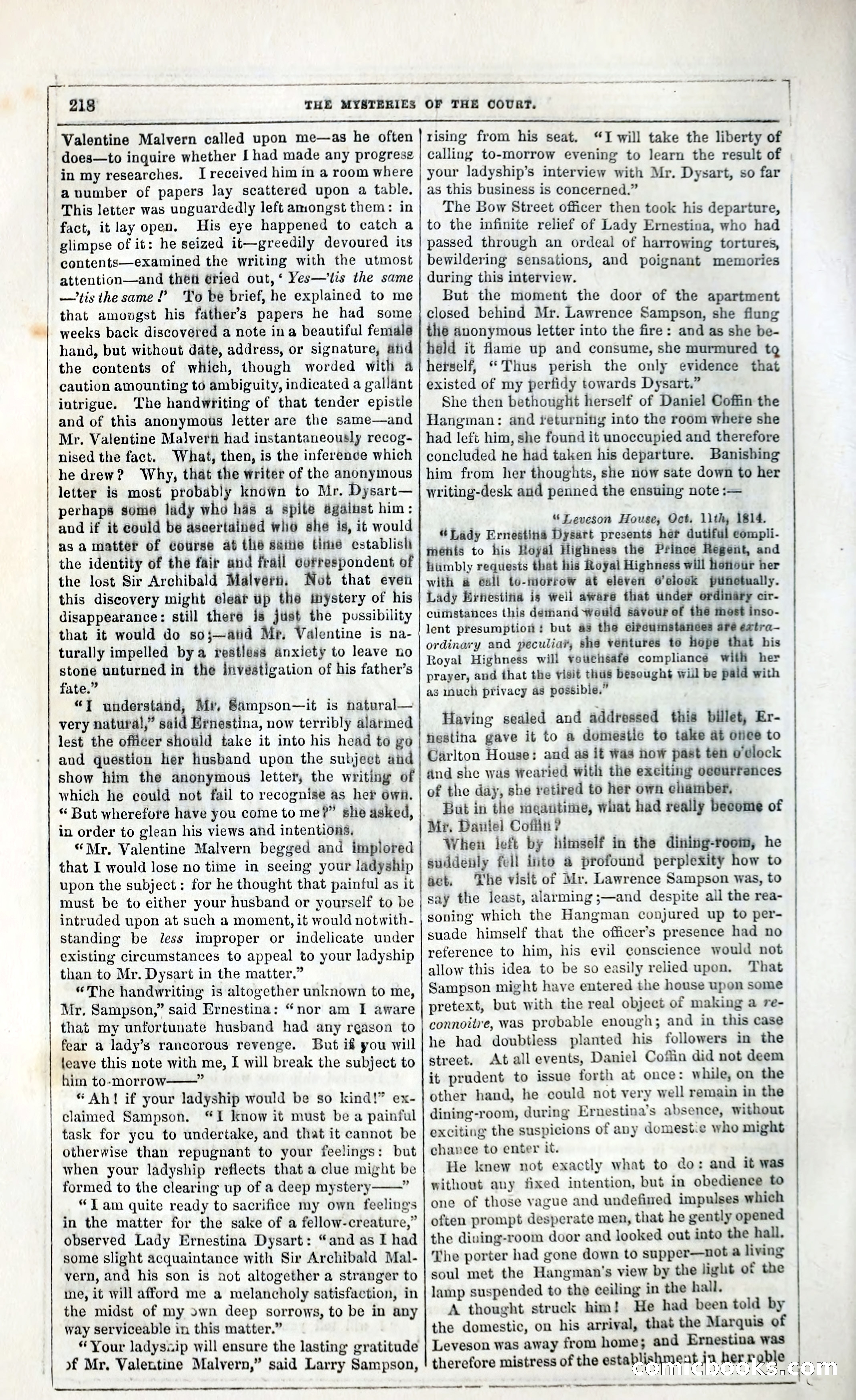
A restored page from Penny Dreadfuls, 1849. Page through the whole issue in the reader above.
📄 Transcribed text from this page (OCR, searchable)
Machine-transcribed from the original scan — historical spelling and the odd misread are preserved.
a a cee a -— 218 a ee rm we owe - _——w as orm oo - ~ -- THE MYSTERIES OF THE COURT. a Valentine Malvern called upon me—as he often does—to inguire whether [ had made any progress in my researches. I received him in a room where auumber of papers lay scattered upon a table. This letter was unguardedly left amongst them: in fact, it lay open. His eye happened to catch a glimpse of it: he seized it—greedily devoured its contents—examined the writing with the utmost attention—and thefi éried out,‘ Yes—tis the same —tisthesame ! To be brief, he explained to me that amongst his father’s papers he had some weeks back discovered a note ina beautiful female hand, but without date, address, or signature, atid the contents of which, though worded with 4 caution amounting to ambiguity, indicated a gallant intrigue. The handwriting of that tender epistle and of this anonymous letter are the same—and Mr. Valentine Malverti had instantaneously recog- nised the fact. What, then, is the inference which he drew? Why, that the writer of the anonymous letter is most probably known to Mr. Dysart— perhaps some lady who has a spite against him: and if it eould be aseertained who she is, it would as a matter of course at tlié saitie Lime establisli the identity of the fair and frail correspondent of the lost Sir Archibald Malverti. Not that even this discovery might cleat up the mystery of his disappearance: still there is just the pussibility that it would do soj—atid Mr. Valentine is na- turally impelled bya restiéss anxiety to leave no stone unturned in the investigation of his father’s fate.” “JT understand, Mv, Sampson—it is natural— very natural,” said Hrnestina, now terribly alarmed lest the officer should take it into his head to go and question her husband upon the subject and show him the anonymous letter, the writing of which he could not fail to recognise as he¥ own. “ But wherefore have you come to me?” she asked, in order to glean his views and intentions. “Mr. Valentine Malvern begged and implored that I would lose no time in seeing your ladyship upon the subject: for he thought that painful as it must be to either your husband or yourself to be intruded upon at such a moment, it would notwith- standing be less improper or indelicate under existing circumstances to appeal to your ladyship than to Mr. Dysart in the matter,” “The handwriting is altogether unknown to me, Mr, Sampson,” said Ernestina: “nor am I aware that my unfortunate husband had any reason to fear a lady’s rancorous revenge. But if you will leave this note with me, I will break the subject to him to-morrow——” * Ah! if your ladyship would be so kind!” ex- claimed Sampson. “I know it must be a painful task for you to undertake, and that it cannot be otherwise than repugnant to your feelings: but when your ladyship reflects that a clue might be formed to the clearing up of a deep mystery , * J am quite ready to sacrifice my own feeling’s in the matter for the sake of a fellow-creature,” observed Lady Ernestina Dysart: “and as I had some slight acquaintance with Sir Archibald Mal- vern, and his son is aot altogether a stranger to ine, it will afford me a melancholy satisfaction, in the midst of my 2wn deep sorrows, to be in any way serviceable in this matter.” * Your ladysaip will ensure the lasting gratitude of Mr, Valentine Malvern,” said Larry Sampson, me ee ee 8 ae ee eee ra oe ee. ae rising from his seat, calling to-morrow evening to learn the result of your ladyship’s interview with Mr. Dysart, so far as this business is concerned.” The Bow Street officer then took his departure, to the infinite relief of Lady Ernestina, who had passed through an ordeal of harrowing tortures, bewildering sensations, and poignant memories during this interview. But the moment the door of the apartment j “J will take the liberty of closed behind Mr. Lawrence Sampson, she flung | tlie anonymous letter into the fire: and as she be- held it flame up and consume, she murmured tg herself, “Thus perish the only evidence that existed of my perfidy towards Dysart.” She then bethought herself of Daniel Coffin the Hangman: and feturnifig into the room where she had left him, she found it unoccupied and therefore concluded he had taken his departure. Banishing him from her thoughts, she now sate down to her writing-desk and penned the ensuing note :— “ Leveson House, Oct. llth, 1814. “Lady Ernestitia Dysart presents het dutiful eompli- métits to his Royal Highness the Prince Regent, and liumbly reauests that his Royal Highness will hettour her with # Gall to-morrow at eleven o’cloek piifictually. Lady Ertestitia is well aware that under ordinary cir- curhstances this deihand weuld savour ef thé most inso- lent presumption: but a8 the ciPewnistances are extra- ordinary and peculiar, she ventures to hope that his Royal Highness will ¥owehsafe compliance with her prayer, and that the visit thus besought will be paid with as much privacy as possible.” Having sealed and addressed this billet, Er- hestina gave it to a domestic to take at otiee to Carlton House: and as it Was how past ten o'dlock and she was Wearied with the exciting oeeutrences of the day, she retired to her own cliamber, But in the meatitime, what had really become of Mi. Daiiiel Coffin? When ieft by himself in the dining-room, he suddenly fell into a profound perplexity how to act. ‘he visit of Mr. Lawrence Sampson was, to say the least, alarming ;—and despite all the rea- soning which the Hangman conjured up to per- suade himself that the officer’s presence had no reference to him, his evil conscience would not allow this idea to be so easily relied upon. That Sampson might have entered the house upon some pretext, but with the real object of making a re- connoitre, was probable enough; and in this case he had doubtless planted his followers in the street. At all events, Daniel Coffin did not deem it prudent to issue forth at once: while, on the other hand, he could not very well remain in the dining-room, during Ernestina’s absence, without exciting the suspicions of any domestic who might chanee to enter it. He knew not exactly what to do: and it was without any fixed intention, but in obedience to one of those vague and undefined impulses which often prompt desperate men, that he gently opened the diving-room door and looked out into the hall. The porter had gone down to supper—not a living soul met the Hangman’s view by the light of the lamp suspended to the ceiling in the hall. A thought struck him! He had been told by the domestic, on his arrival, that the Marquis of Leveson was away from home; and Ernestina was therefore mistress of the esta iahment herrpble -_— Ao iy Ae eon (2)