
Penny Dreadfuls, 1849 · page 241 of 394
The Mysteries of the Court of London — page 241: what you’re looking at
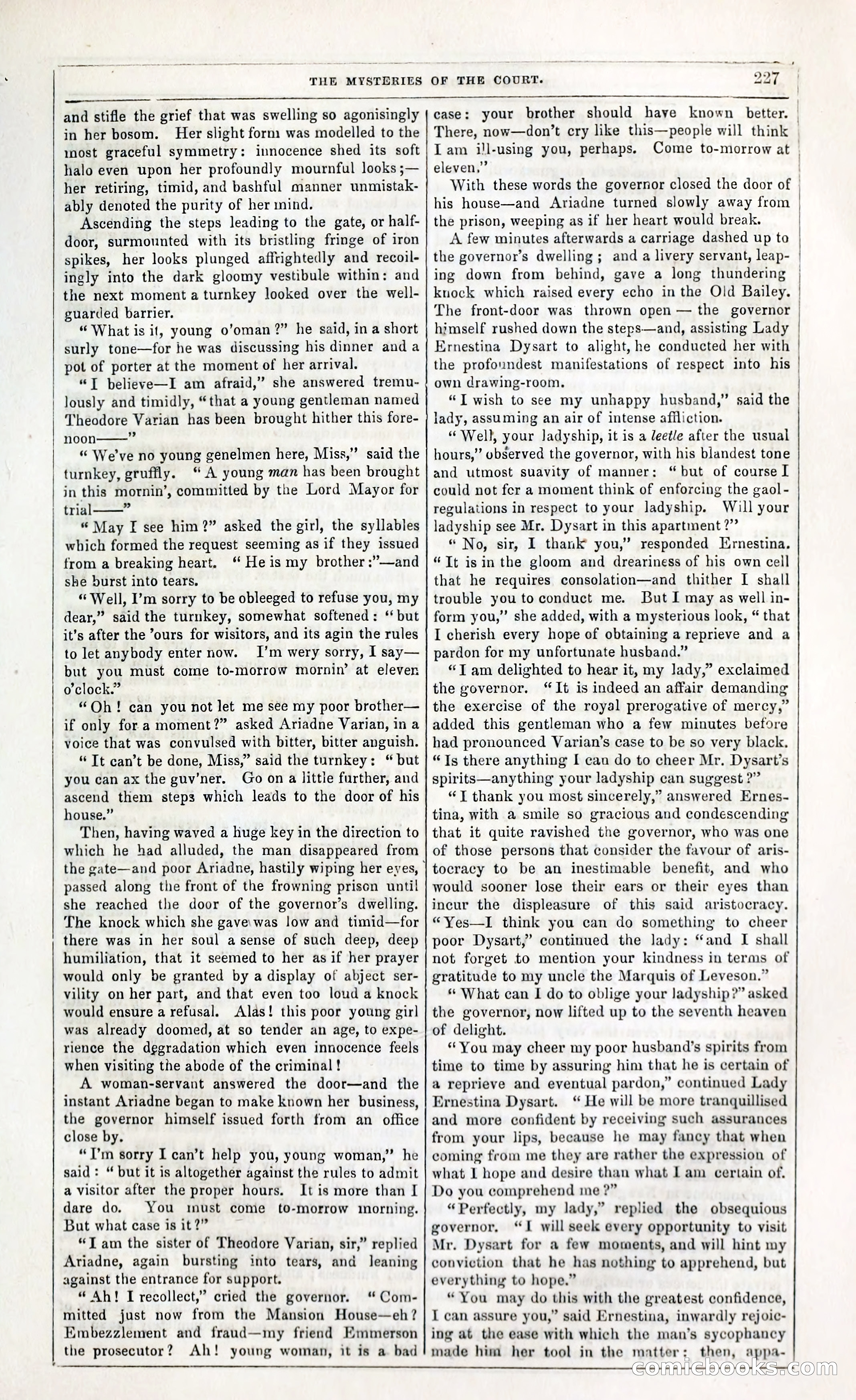
A restored page from Penny Dreadfuls, 1849. Page through the whole issue in the reader above.
📄 Transcribed text from this page (OCR, searchable)
Machine-transcribed from the original scan — historical spelling and the odd misread are preserved.
oo — —— :dOROOo—FjT FT YTtITN™ —-— — ——————————_-C vvwOOwOwOlOOWOWW@OoooooaoooaassaasaassSsasSsSssooooo oon a ———— —_—_ - and stifle the grief that was swelling so agonisingly in her bosom. Her slight form was modelled to the most graceful symmetry: innocence shed its soft halo even upon her profoundly mournful looks ;— her retiring, timid, and bashful manner unmistak- ably denoted the purity of her mind. Ascending the steps leading to the gate, or half- door, surmounted with its bristling fringe of iron spikes, her looks plunged affrightedly and recoil- ingly into the dark gloomy vestibule within: and the next moment a turnkey looked over the well- guarded barrier. “ What is it, young o’oman 2” he said, in a short surly tone—for he was discussing his dinner anda pot of porter at the moment of her arrival. “T believe—I am afraid,” she answered tremu- lously and timidly, “that a young gentleman named Theodore Varian has been brought hither this fore- noon 6 “ We've no young genelmen here, Miss,” said the turnkey, gruffly. “A young man has been brought in this mornin’, committed by the Lord Mayor for trial a * May I see him 2” asked the girl, the syllables which formed the request seeming as if they issued from a breaking heart. ‘ He is my brother :”—and she burst into tears. ‘“ Well, I’m sorry to be obleeged to refuse you, my dear,” said the turnkey, somewhat softened: ‘ but it’s after the ’ours for wisitors, and its agin the rules to let anybody enter now. I’m wery sorry, I say— but you must come to-morrow mornin’ at eleven o'clock.” “Oh! can you not let me see my poor brother— if only for a moment?” asked Ariadne Varian, in a voice that was convulsed with bitter, bitter anguish. “ Tt can’t be done, Miss,” said the turnkey: “ but you can ax the guv’ner. Go on a little further, and ascend them steps which leads to the door of his house.” Then, having waved a huge key in the direction to which he had alluded, the man disappeared from the gate—and poor Ariadne, hastily wiping her eves, passed along the front of the frowning prison until she reached the door of the governor’s dwelling. The knock which she gave\was low and timid—for there was in her soul asense of such deep, deep humiliation, that it seemed to her as if her prayer would only be granted by a display of abject ser- vility on her part, and that even too loud a knock would ensure a refusal. Alas! this poor young girl was already doomed, at so tender an age, to expe- rience the degradation which even innocence feels when visiting the abode of the criminal! A woman-servant answered the door—and the instant Ariadne began to make known her business, the governor himself issued forth from an office close by. “I’m sorry I can’t help you, young woman,” he said: “ but it is altogether against the rules to admit a visitor after the proper hours. It is more than I dare do. You imust come to-morrow morning. But what case is it?” *T am the sister of Theodore Varian, sir,” replied Ariadne, again bursting into tears, and leaning against the entrance for support. “ Ah! I recollect,” cried the governor. ‘ Com- mitted just now from the Mansion House—eh? Embezzlement and fraud—my friend Emmerson the prosecutor? Ah! young woman, it is a bad )*) THE MYSTERIES OF THE COURT. yA fee case: your brother should have known better. | There, now—don’t cry like this—people will think Iam ill-using you, perhaps. Come to-morrow at | eleven,” | With these words the governor closed the door of his house—and Ariadne turned slowly away from the prison, weeping as if her heart would break. A few minutes afterwards a carriage dashed up to | the governor’s dwelling; and a livery servant, leap- ing down from behind, gave a long thundering knock which raised every echo in the Old Bailey. | The front-door was thrown open — the governor | himself rushed down the steps—and, assisting Lady | Ernestina Dysart to alight, he conducted her with | the profoundest manifestations of respect into his | own drawing-room, “T wish to see my unhappy husband,” said the | lady, assuming an air of intense affliction. “ Well, your Jadyship, it is a leetle after the usual hours,” observed the governor, with his blandest tone and utmost suavity of manner: “but of course I could not fer a moment think of enforcing the gaol- regulations in respect to your ladyship. Will your ladyship see Mr. Dysart in this apartment?” “ No, sir, I thank you,’ responded Hrnestina. “Tt isin the gloom and dreariness of his own cell that he requires consolation—and thither I shall trouble you to conduct me. But I may as well in- form you,” she added, with a mysterious look, “ that I cherish every hope of obtaining a reprieve and a pardon for my unfortunate husbaad.” “T am delighted to hear it, my lady,” exclaimed the governor. “It is indeed an affair demanding the exercise of the royal prerogative of mercy,” added this gentleman who a few minutes before had pronounced Varian’s case to be so very black. “Ts there anything I can do to cheer Mr. Dysart’s spirits—anything your ladyship can suggest ?” “T thank you most sincerely,” answered Ernes- tina, with a smile so gracious and condescending that it quite ravished the governor, who was one of those persons that consider the favour of aris- tocracy to be an inestimable benefit, and who would sooner lose their ears or their eyes than incur the displeasure of this said aristocracy. “Yes—I think you can do something to cheer poor Dysart,” continued the lady: “and I shall not forget to mention your kindness in terms of gratitude to my uncle the Marquis of Leveson.” *“ What can I do to oblige your Jadyship?” asked the governor, now lifted up to the seventh heaven of delight. “You may cheer my poor husband’s spirits from time to time by assuring him that he is certain of a reprieve and eventual pardon,” continued Lady Ernestina Dysart. ‘ He will be more tranquillised and more confident by receiving such assurances from your lips, because he may fancy that when coming from me they are rather the expression of what 1 hope and desire than what lL am certain of. Do you comprehend me ?” “Perfectly, my lady,” replied the obsequious governor, “I will seek every opportunity to visit Mr. Dysart for a few moments, and will hint my conviction that he has nothing to apprehend, but everything to hope.” “You may do this with the greatest confidence, I can assure you,” said Ernestina, inwardly rejoic- ing at the ease with which the man’s sycophancy made him her tool in the matter; then, appa- CONG DOOKS. GO