
Penny Dreadfuls, 1849 · page 246 of 394
The Mysteries of the Court of London — page 246: what you’re looking at
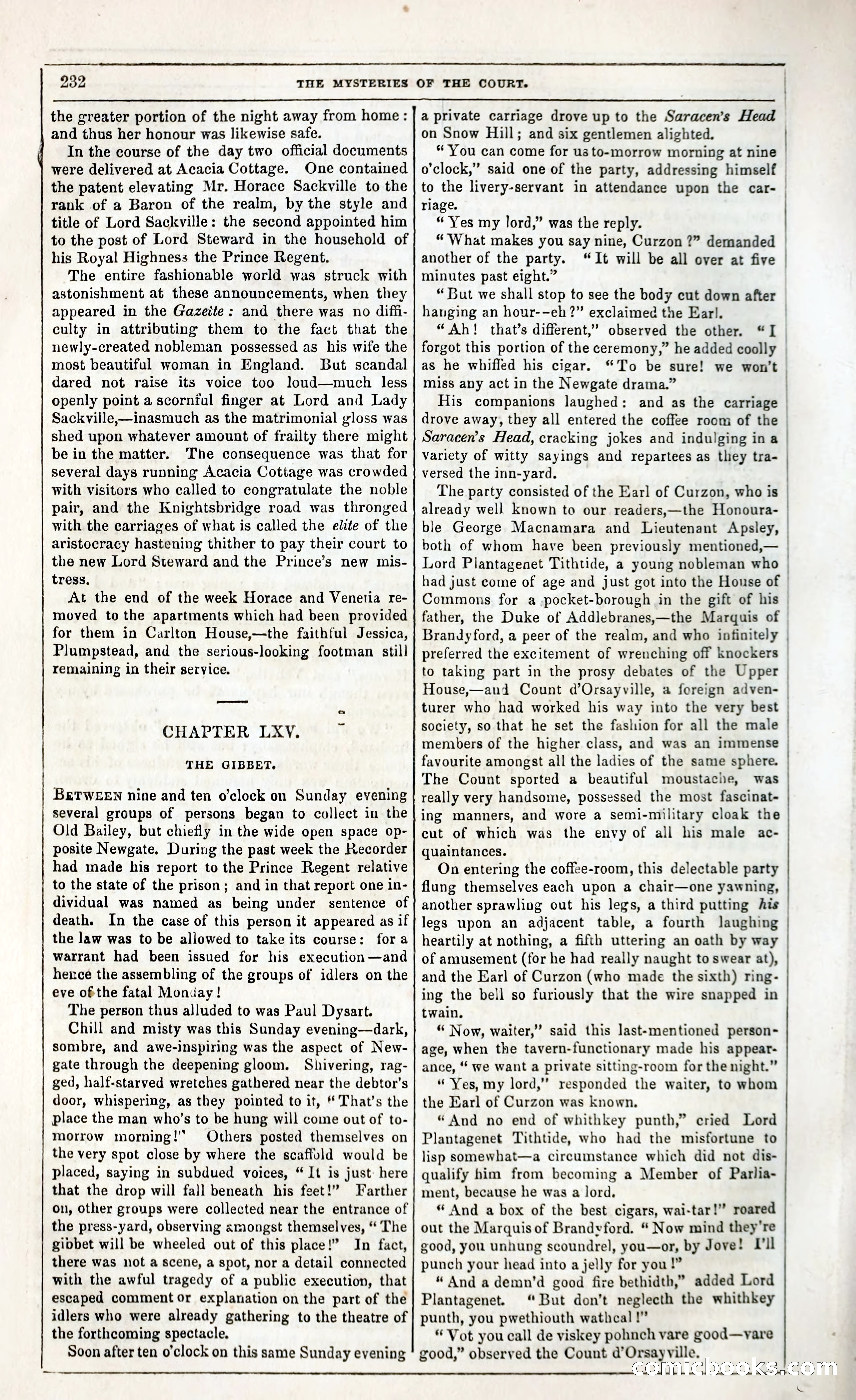
A restored page from Penny Dreadfuls, 1849. Page through the whole issue in the reader above.
📄 Transcribed text from this page (OCR, searchable)
Machine-transcribed from the original scan — historical spelling and the odd misread are preserved.
232 THE MYSTERIES OF THE COURT. the greater portion of the night away from home: and thus her honour was likewise safe. In the course of the day two official documents were delivered at Acacia Cottage. One contained the patent elevating Mr. Horace Sackville to the rank of a Baron of the realm, by the style and title of Lord Sackville: the second appointed him to the post of Lord Steward in the household of his Royal Highness the Prince Regent. The entire fashionable world was struck with astonishment at these announcements, when they appeared in the Gazette: and there was no diffi- culty in attributing them to the fact that the newly-created nobleman possessed as his wife the most beautiful woman in England. But scandal dared not raise its voice too loud—much less openly point a scornful finger at Lord and Lady Sackville,—inasmuch as the matrimonial gloss was shed upon whatever amount of frailty there might be in the matter. The consequence was that for several days running Acacia Cottage was crowded with visitors who called to congratulate the noble pair, and the Knightsbridge road was thronged with the carriages of what is called the elite of the aristocracy hastening thither to pay their court to the new Lord Steward and the Prince’s new mis- tress. At the end of the week Horace and Venetia re- moved to the apartments which had been provided for them in Carlton House,—the faithful Jessica, Plumpstead, and the serious-looking footman still remaining in their service. ee CHAPTER LXV. THE GIBBET. BrTWEEN nine and ten o'clock on Sunday evening several groups of persons began to collect in the Old Bailey, but chiefly in the wide open space op- posite Newgate. During the past week the Recorder had made his report to the Prince Regent relative to the state of the prison; and in that report one in- dividual was named as being under sentence of death. In the case of this person it appeared as if the law was to be allowed to take its course: fora warrant had been issued for his execution —and hence the assembling of the groups of idlers on the eve ofthe fatal Monday! The person thus alluded to was Paul Dysart. Chill and misty was this Sunday evening—dark, sombre, and awe-inspiring was the aspect of New- gate through the deepening gloom. Shivering, rag- ged, half-starved wretches gathered near the debtor's door, whispering, as they pointed to it, That's the place the man who’s to be hung will come out of to- morrow morning!'"* Others posted themselves on the very spot close by where the scafluld would be placed, saying in subdued voices, “ It is just: here that the drop will fall beneath his feet!” Farther on, other groups were collected near the entrance of the press-yard, observing amongst themselves, “ The gibbet will be wheeled out of this place!” In fact, there was not a scene, a spot, nor a detail connected with the awful tragedy of a public execution, that escaped comment or explanation on the part of the idlers who were already gathering to the theatre of the forthcoming spectacle. Soon after ten o'clock on this same Sunday evening a private carriage drove up to the Saracen’s Head on Snow Hill; and six gentlemen alighted. * You can come for us to-morrow morning at nine — o’clock,” said one of the party, addressing himself to the livery-servant in attendance upon the car- riage. “Yes my lord,” was the reply. “ What makes you say nine, Curzon ?” demanded | another of the party. “It will be all over at five minutes past eight.” “But we shall stop to see the body cut down after hanging an hour--eh?” exclaimed the Earl. “Ah! that’s different,’ observed the other. “[ forgot this portion of the ceremony,” he added coolly as he whifled his cigar. “To be sure! we won't miss any act in the Newgate drama.” | His companions laughed: and as the carriage drove away, they all entered the coffee room of the Saracen’s Head, cracking jokes and indulging ina variety of witty sayings and repartees as they tra- versed the inn-yard. | The party consisted of the Earl of Curzon, who is | already well known to our readers,—the Honoura- ble George Macnamara and Lieutenant Apsley, both of whom have been previously mentioned,— Lord Plantagenet Tithtide, a young nobleman who | had just come of age and just got into the House of Commons for a pocket-borough in the gift of his father, the Duke of Addlebranes,—the Marquis of Brandy ford, a peer of the realm, and who infinitely | preferred the excitement of wrenching off knockers to taking part in the prosy debates of the Upper | House,—and Count d’Orsayville, a foreign adven- | turer who had worked his way into the very best society, so that he set the fashion for all the male members of the higher class, and was an immense favourite amongst all the ladies of the same sphere. The Count sported a beautiful moustache, was really very handsome, possessed the most fascinat- ing manners, and wore a semi-military cloak the cut of which was the envy of all his male ac- quaintances. On entering the coffee-room, this delectable party flung themselves each upon a chair—one yawning, another sprawling out his legs, a third putting Ais legs upon an adjacent table, a fourth laughing heartily at nothing, a fifth uttering an oath by way of amusement (for he had really naught to swear at), and the Earl of Curzon (who made the sixth) ring- ing the bell so furiously that the wire snapped in twain. “ Now, waiter,” said this last-mentioned person- age, when the tavern-functionary made his appear- ance, “ we want a private sitting-room for the night.” “ Yes, my lord,’’ responded the waiter, to whom the Earl of Curzon was known. “And no end of whithkey punth,” cried Lord Plantagenet Tithtide, who had the misfortune to lisp somewhat—a circumstance which did not dis- qualify him from becoming a Member of Parlia- ment, because he was a lord, “ And a box of the best cigars, wai-tar!” roared out the Marquis of Brandvford. “ Now mind they're cood, you unhung scoundrel, you—or, by Jove! I'll punch your head into a jelly for you!” “ And ademn'd good fire bethidth,” added Lord Plantagenet. “But don’t neglecth the whithkey punth, you pwethiouth wathcal !” “ Vot you call de viskey pohnch vare good—yvyare good,” observed the Count d’Orsayville. ee raiclacval KSdeE@