
Penny Dreadfuls, 1849 · page 262 of 394
The Mysteries of the Court of London — page 262: what you’re looking at
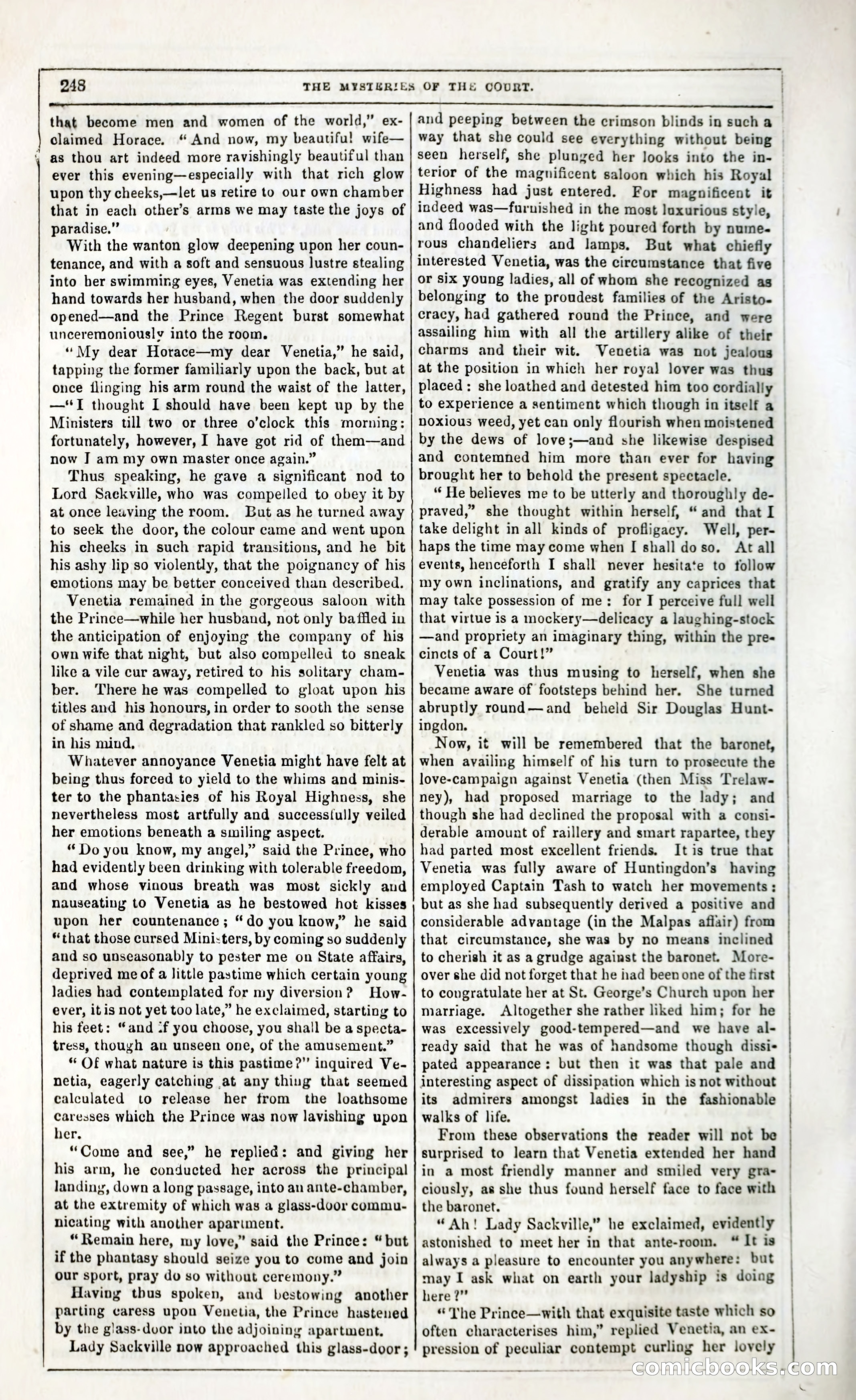
A restored page from Penny Dreadfuls, 1849. Page through the whole issue in the reader above.
📄 Transcribed text from this page (OCR, searchable)
Machine-transcribed from the original scan — historical spelling and the odd misread are preserved.
248 THE MYSTERIES OF THE COURT. a: LL ccc ar OO and peeping between the crimson blinds in such a — that become men and women of the world,” ex- claimed Horace. “ And now, my beautiful wife— « as thou art indeed more ravishingly beautiful than ever this evening—especially with that rich glow upon thy cheeks,—let us retire to our own chamber that in each other’s arms we may taste the joys of paradise.” With the wanton glow deepening upon her coun- tenance, and with a soft and sensuous lustre stealing into her swimming eyes, Venetia was extending her hand towards her husband, when the door suddenly opened—and the Prince Regent burst somewhat unceremoniously into the room. “My dear Horace—my dear Venetia,” he said, tapping the former familiarly upon the back, but at once flinging his arm round the waist of the latter, —T thought I should have been kept up by the Ministers till two or three o’clock this morning: fortunately, however, I have got rid of them—and now J] am my own master once again.” Thus speaking, he gave a significant nod to Lord Sackville, who was compelled to obey it by at once leaving the room. But as he turned away to seek the door, the colour came and went upon his cheeks in such rapid transitions, and he bit his ashy lip so violently, that the poignancy of his emotions may be better conceived than described. Venetia remained in the gorgeous saloon with the Prince—while her husband, not only baffled in the anticipation of enjoying the company of his own wife that night, but also compelled to sneak like a vile cur away, retired to his solitary cham- ber. ‘There he was compelled to gloat upon his titles and his honours, in order to sooth the sense of shame and degradation that rankled so bitterly in his mind, Whatever annoyance Venetia might have felt at being thus forced to yield to the whims and minis- ter to the phantasies of his Royal Highness, she nevertheless most artfully and successfully veiled her emotions beneath a siniling aspect. “Do you know, my angel,” said the Prince, who had evidently been drinking with tolerable freedom, and whose vinous breath was most sickly and nauseating to Venetia as he bestowed hot kisses upon her countenance; “do you know,” he said “that those cursed Ministers, by coming so suddenly and so unseasonably to pester me on State affairs, deprived me of a little pastime which certain young Jadies had contemplated for my diversion? How- ever, itis not yet too late,” he exclaimed, starting to his teet: “and :f you choose, you shall be a specta- tress, though an unseen one, of the amusement.” * Of what nature is this pastime?” inquired Ve- netia, eagerly catching at any thing that seemed calculated to release her from the loathsome caresses which the Prince was now lavishing upon her. “Come and see,” he replied: and giving her his arm, he conducted her across the principal landing, down a long passage, into an ante-chamber, at the extremity of which was a glass-door commu- nicating with another apariment. “Remain here, my love,” said the Prince: “but if the phantasy should seize you to come and join our sport, pray do so without ceremony.” Having thus spoken, and bestowing another parting caress upon Venetia, the Prince hastened by the glass-dvor into the adjoining apartment. Lady Sackville now approached this glass-door; way that she could see everything without being seen herself, she plunged her looks into the in- terior of the magnificent saloon which his Royal Highness had just entered. For magnificent it indeed was—furuished in the most luxurious style, and flooded with the light poured forth by nume- rous chandeliers and lamps. But what chiefly interested Venetia, was the circumstance that five | or six young ladies, all of whom she recognized as belonging to the proudest families of the Aristo- cracy, had gathered round the Prince, and were assailing him with all the artillery alike of their charms and their wit. Venetia was not jealous at the position in which her royal lover was thus placed: she loathed and detested him too cordially to experience a sentiment which though in itself a noxious weed, yet can only flourish when moistened | by the dews of love;—and she likewise despised — and contemned him more than ever for having — brought her to behold the present spectacle. ‘* He believes me to be utterly and thoroughly de- praved,” she thought within herself, “and that I take delight in all kinds of profligacy. Well, per- haps the time may come when I[ shall doso. At all events, henceforth I shall never hesitate to follow my own inclinations, and gratify any caprices that may tale possession of me: for I perceive full well that virtue is a mockery—delicacy a laughing-stock —and propriety an imaginary thing, within the pre- cincts of a Court!” Venetia was thus musing to herself, when she became aware of footsteps behind her. She turned abruptly round—and beheld Sir Douglas Hunt- ingdon. Now, it will be remembered that the baronet, when availing himself of his turn to prosecute the love-campaign against Venetia (then Miss Trelaw- ney), had proposed marriage to the lady; and though she had declined the proposal with a consi- derable amount of raillery and smart rapartee, they had parted most excellent friends. It is true that Venetia was fully aware of Huntingdon’s having employed Captain Tash to watch her movements; but as she had subsequently derived a positive and considerable advantage (in the Malpas aflair) from that circumstance, she was by no means inclined to cherish it as a grudge against the baronet. More- over she did not forget that he had been one of the first to congratulate her at St. George’s Church upon her marriage. Altogether she rather liked him; for he was excessively good-tempered—and we have al- ready said that he was of handsome though dissi- pated appearance: but then it was that pale and interesting aspect of dissipation which is not without its admirers amongst ladies in the fashionable walks of life. From these observations the reader will not be surprised to learn that Venetia extended her hand in a most friendly manner and smiled very gra- ciously, as she thus found herself face to face with the baronet. “Ah! Lady Sackville,” he exclaimed, evidently astonished to meet her in that ante-room. “ It is always a pleasure to encounter you anywhere: but may I ask what on earth your ladyship is doing here ?” “The Prince—with that exquisite taste which so often characterises him,” replied Venetia, an ex- pression of peculiar contempt curling her lovely CORMKEL OO) S- —— ne $A A