
Penny Dreadfuls, 1849 · page 264 of 394
The Mysteries of the Court of London — page 264: what you’re looking at
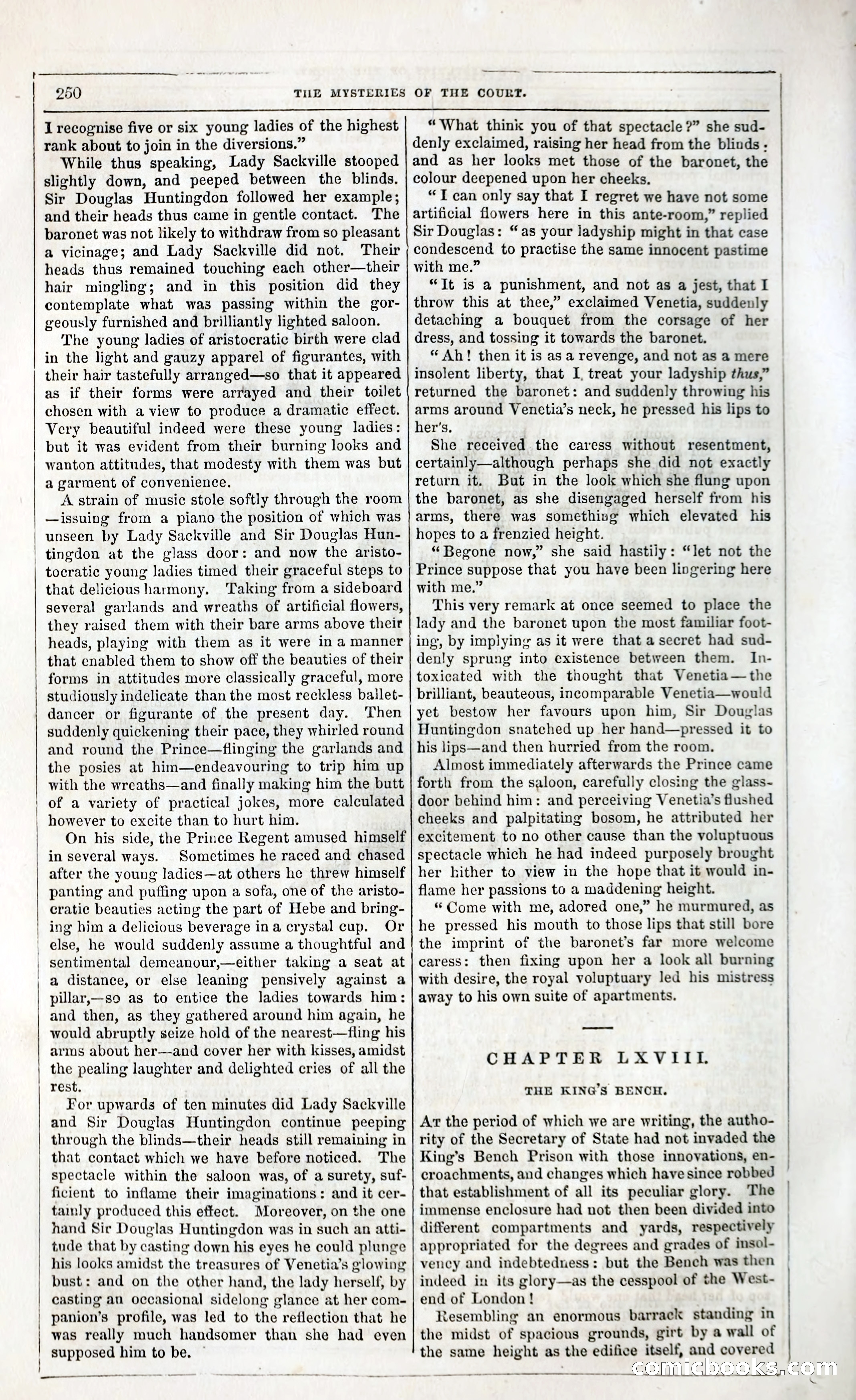
A restored page from Penny Dreadfuls, 1849. Page through the whole issue in the reader above.
📄 Transcribed text from this page (OCR, searchable)
Machine-transcribed from the original scan — historical spelling and the odd misread are preserved.
EEE TT TT ~_— 250 te TUE MYSTERIES OF THE COURT. I recognise five or six young ladies of the highest rank about to join in the diversions.” While thus speaking, Lady Sackville stooped slightly down, and peeped between the blinds. Sir Douglas Huntingdon followed her example; and their heads thus came in gentle contact. The baronet was not likely to withdraw from so pleasant a vicinage; and Lady Sackville did not. Their heads thus remained touching each other—their hair mingling; and in this position did they contemplate what was passing within the gor- geously furnished and brilliantly lighted saloon. The young ladies of aristocratic birth were clad in the light and gauzy apparel of figurantes, with their hair tastefully arranged—so that it appeared as if their forms were arrayed and their toilet chosen with a view to produce a dramatic effect. Very beautiful indeed were these young ladies: but it was evident from their burning looks and wanton attitudes, that modesty with them was but a garment of convenience. A strain of music stole softly through the room —issuing from a piano the position of which was unseen by Lady Sackville and Sir Douglas Hun- tingdon at the glass door: and now the aristo- tocratic young ladies timed their graceful steps to that delicious harmony. Taking from a sideboard several garlands and wreaths of artificial flowers, they raised them with their bare arms above their heads, playing with them as it were in a manner that enabled them to show off the beauties of their forms in attitudes more classically graceful, more studiously indelicate than the most reckless ballet- dancer or figurante of the present day. ‘Then suddenly quickening their pace, they whirled round and round the Prince—flinging the garlands and the posies at him—endeavouring to trip him up with the wreaths—and finally making him the butt of a variety of practical jokes, more calculated however to excite than to hurt him. On his side, the Prince Regent amused himself in several ways. Sometimes he raced and chased after the young ladies—at others he threw himself panting and puffing upon a sofa, one of the aristo- cratic beauties acting the part of Hebe and bring- ing him a delicious beverage ina crystal cup. Or else, he would suddenly assume a thoughtful and sentimental demeanour,—either taking a seat at a distance, or else leaning pensively against a pillar,—so as to entice the ladies towards him: and then, as they gathered around him again, he would abruptly seize hold of the nearest—fling his arms about her—and cover her with kisses, amidst the pealing laughter and delighted cries of all the rest. For upwards of ten minutes did Lady Sackville and Sir Douglas Huntingdon continue peeping through the blinds—their heads still remaining in that contact which we have before noticed. The spectacle within the saloon was, of a surety, suf- ficient to inflame their imaginations: and it cer- tamly produced this effect. Moreover, on the one hand Sir Douglas Huntingdon was in such an atti- tude that by casting down his eyes he could plunge his looks amidst the treasures of Venetia’s glowing bust: and on the other hand, the lady herself, by casting an occasional sidelong glance at her com- panion’s profile, was led to the reflection that he was really much handsomer than she had even supposed him to be. ~ —— nine “What think you of that spectacle?” she sud- denly exclaimed, raising her head from the blinds - and as her looks met those of the baronet, the colour deepened upon her cheeks, “T can only say that I regret we have not some artificial flowers here in this ante-room,” replied Sir Douglas: “as your ladyship might in that case condescend to practise the same innocent pastime with me.” “It is a punishment, and not as a jest, that I throw this at thee,” exclaimed Venetia, suddenly detaching a bouquet from the corsage of her dress, and tossing it towards the baronet, * Ah! then it is as a revenge, and not as a mere insolent liberty, that I, treat your ladyship thus,” returned the baronet: and suddenly throwing his arms around Venetia’s neck, he pressed his lips to her’s. She received the caress without resentment, certainly—although perhaps she did not exactly return it. But in the look which she flung upon the baronet, as she disengaged herself from his arms, there was something which elevated his hopes to a frenzied height. “Begone now,” she said hastily: “let not the Prince suppose that you have been lingering here with me.” This very remark at once seemed to place the lady and the baronet upon the most familiar foot- ing, by implying as it were that a secret had sud- denly sprung into existence between them. In- toxicated with the thought that Venetia—the brilliant, beauteous, incomparable Venetia—would yet bestow her favours upon him, Sir Douglas Huntingdon snatched up her hand—pressed it to his lips—and then hurried from the room. Almost immediately afterwards the Prince came forth from the saloon, carefully closing the glass- door behind him: and perceiving Venetia’s flushed cheeks and palpitating bosom, he attributed her excitement to no other cause than the voluptuous spectacle which he had indeed purposely brought her hither to view in the hope that it would in- flame her passions to a maddening height. “ Come with me, adored one,” he murmured, as he pressed his mouth to those lips that still bore the imprint of the baronet’s far more welcome caress: then fixing upon her a look all burning with desire, the royal voluptuary led his mistress away to his own suite of apartments. —_—_-_—_— CHAPTER LXVIIL THE KING’S BENCH. Art the period of which we are writing, the autho- rity of the Secretary of State had not invaded the King’s Bench Prison with those innovations, en- croachments, and changes which have since robbed that establishment of all its peculiar glory. The immense enclosure had not then been divided into different compartments and yards, respectively appropriated for the degrees and grades of insol- vency and indebtedness: but the Bench was then indeed in its glory—as the cesspool of the West- end of London! Resembling an enormous barrack standing in the midst of spacious grounds, girt by a wall of the same height as the edifice itself, and covered _ TT oP —————— + “ ee CoOmcoaookxs ia (E(0)