
Penny Dreadfuls, 1849 · page 294 of 394
The Mysteries of the Court of London — page 294: what you’re looking at
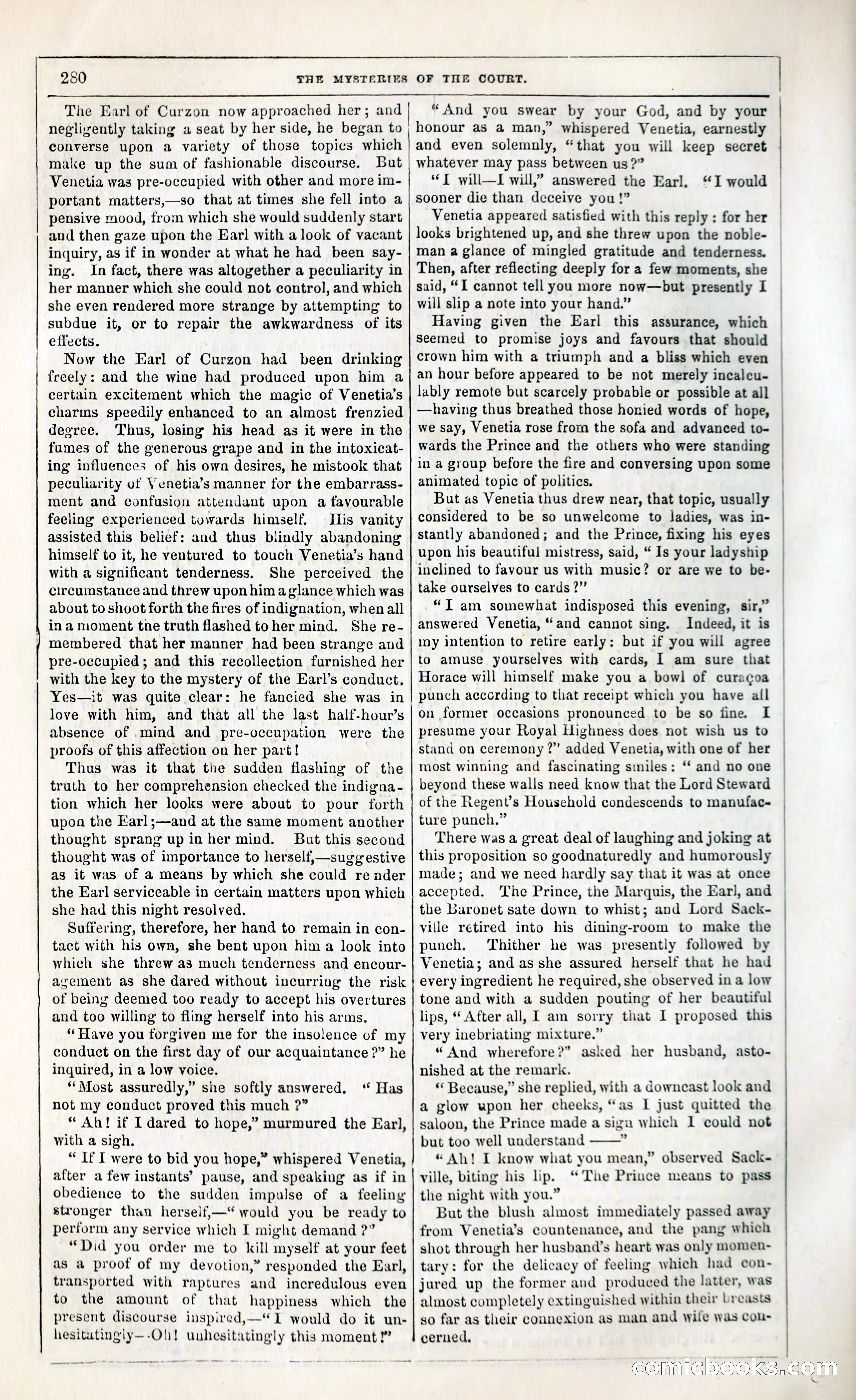
A restored page from Penny Dreadfuls, 1849. Page through the whole issue in the reader above.
📄 Transcribed text from this page (OCR, searchable)
Machine-transcribed from the original scan — historical spelling and the odd misread are preserved.
eee. ee _————u“——_- —- ol: 250 THE MYSTERIES OF THE COURT. The Earl of Curzon now approached her; and “And you swear by your God, and by your neglizently taking a seat by her side, he began to | honour as a man,” whispered Venetia, earnestly converse upon a variety of those topics which make up the sum of fashionable discourse. But Venetia was pre-occupied with other and more im- portant matters,—so that at times she fell into a pensive mood, from which she would suddenly start and then gaze upon the Earl with a look of vacant inquiry, as if in wonder at what he had been say- ing. In fact, there was altogether a peculiarity in her manner which she could not control, and which she even rendered more strange by attempting to subdue it, or to repair the awkwardness of its effects. Now the Earl of Curzon had been drinking freely: and the wine had produced upon him a certain excitement which the magic of Venetia’s charms speedily enhanced to an almost frenzied degree. Thus, losing his head as it were in the fumes of the generous grape and in the intoxicat- ing influences of his own desires, he mistook that peculiarity of Venetia’s manner for the embarrass- ment and confusion attendant upon a favourable feeling experienced towards himself. His vanity assisted this belief: and thus blindly abandoning himself to it, he ventured to touch Venetia’s hand with a significant tenderness. She perceived the circumstance and threw upon hima glance which was about to shoot forth the fires of indignation, when all in a moment the truth flashed toher mind. She re- membered that her manner had been strange and pre-occupied; and this recollection furnished her with the key to the mystery of the Earl’s conduct, Yes—it was quite clear: he fancied she was in love with him, and that all the last half-hour’s absence of .mind and pre-occupation were the proofs of this affection on her part! Thus was it that the sudden flashing of the truth to her comprehension checked the indigna- tion which her looks were about to pour forth upoa the EKarl;—and at the same moment another thought sprang up in her mind. But this second thought was of importance to herself,—sugg estive as it was of a means by which she could render the Earl serviceable in certain matters upon which she had this night resolved. Suffering, therefore, her hand to remain in con- tact with his own, she bent upon him a look into which she threw as much tenderness and encour- agement as she dared without incurring the risk of being deemed too ready to accept his overtures and too willing’ to fling herself into his arms. “TJave you forgiven me for the insolence of my conduct on the first day of our acquaintance ?” he inquired, in a low voice. * Most assuredly,” she softly answered. not my conduct proved this much ?” “ Ah! if I dared to hope,” murmured the Earl, with a sigh. “If I were to bid you hope,” whispered Venetia, after afew instants’ pause, and speaking as if in obedience to the sudden impulse of a feeling stronger than herself,—“ would you be ready to perform any service which I might demand ?” “Did you order me to kill myself at your feet as a proof of my devotion,” responded the Earl, transported with raptures and incredulous even to the amount of that happiness which the present discourse inspired,—“I would do it un- hesitatingly—-Oli! uuhesitatingly this moment “ Has i and even solemnly, “that you will keep secret whatever may pass between us ?” **T will—I will,” answered the Earl, sooner die than deceive you!” Venetia appeared satisfied with this reply : for her looks brightened up, and she threw upon the noble- man a glance of mingled gratitude and tenderness. Then, after reflecting deeply for a few moments, she said, “I cannot tell you more now—but presently I will slip a note into your hand.” Having given the Earl this assurance, which Seemed to promise joys and favours that should crown him with a triumph and a bliss which even an hour before appeared to be not merely incalcu- lably remote but scarcely probable or possible at all —having thus breathed those horied words of hope, we say, Venetia rose from the sofa and advanced to- wards the Prince and the others who were standing in a group before the fire and conversing upon some animated topic of politics. But as Venetia thus drew near, that topic, usually considered to be so unwelcome to ladies, was in- stantly abandoned; and the Prince, fixing his eyes upon his beautiful mistress, said, “ Is your ladyship inclined to favour us with music? or are we to be- take ourselves to cards ?” “JT am somewhat indisposed this evening, sir,” answered Venetia, “and cannot sing. Indeed, it is ny intention to retire early: but if you will agree to amuse yourselves with cards, 1 am sure that Horace will himself make you a bowl of curacoa punch according to that receipt which you have all on former occasions pronounced to be so fine. LI presume your Royal Highness does not wish us to stand on ceremony 2?” added Venetia, with one of her most winning and fascinating smiles: “ and no one beyond these walls need know that the Lord Steward of the Regent’s Household condescends to manufac- ture punch.” There was a great deal of laughing and joking at this proposition so goodnaturedly and humorously made; and we need hardly say that it was at once accepted. The Prince, the Marquis, the Earl, and the baronet sate down to whist; and Lord Sack- ville retired into his dining-room to make the punch. ‘hither he was presently followed by Venetia; and as she assured herself that he had every ingredient he required, she observed ina low tone and with a sudden pouting of her beautiful lips, * After all, I am sorry that I proposed this very inebriating mixture.” “And wherefore?” asked her husband, asto- nished at the remark. ‘** Because,” she replied, with a downcast look and a glow upon her cheeks, “as I just quitted the saloon, the Prince made a sign which 1 could not but too well understand 24 «Ah! I know what you mean,” observed Sack- ville, biting his lip. “The Prince means to pass the night with you.” But the blush almost immediately passed away from Venetia’s countenance, and the pang which shot through her husband’s heart was only momen- tary: for the delicacy of feeling which had con- jured up the former and produced the latter, was almost completely extinguished within their breasts so far as their connexion as man and wile was Cou- cerned, “T would —— et ee eee S GoOmicdoo (C (€)