
Penny Dreadfuls, 1849 · page 299 of 394
The Mysteries of the Court of London — page 299: what you’re looking at
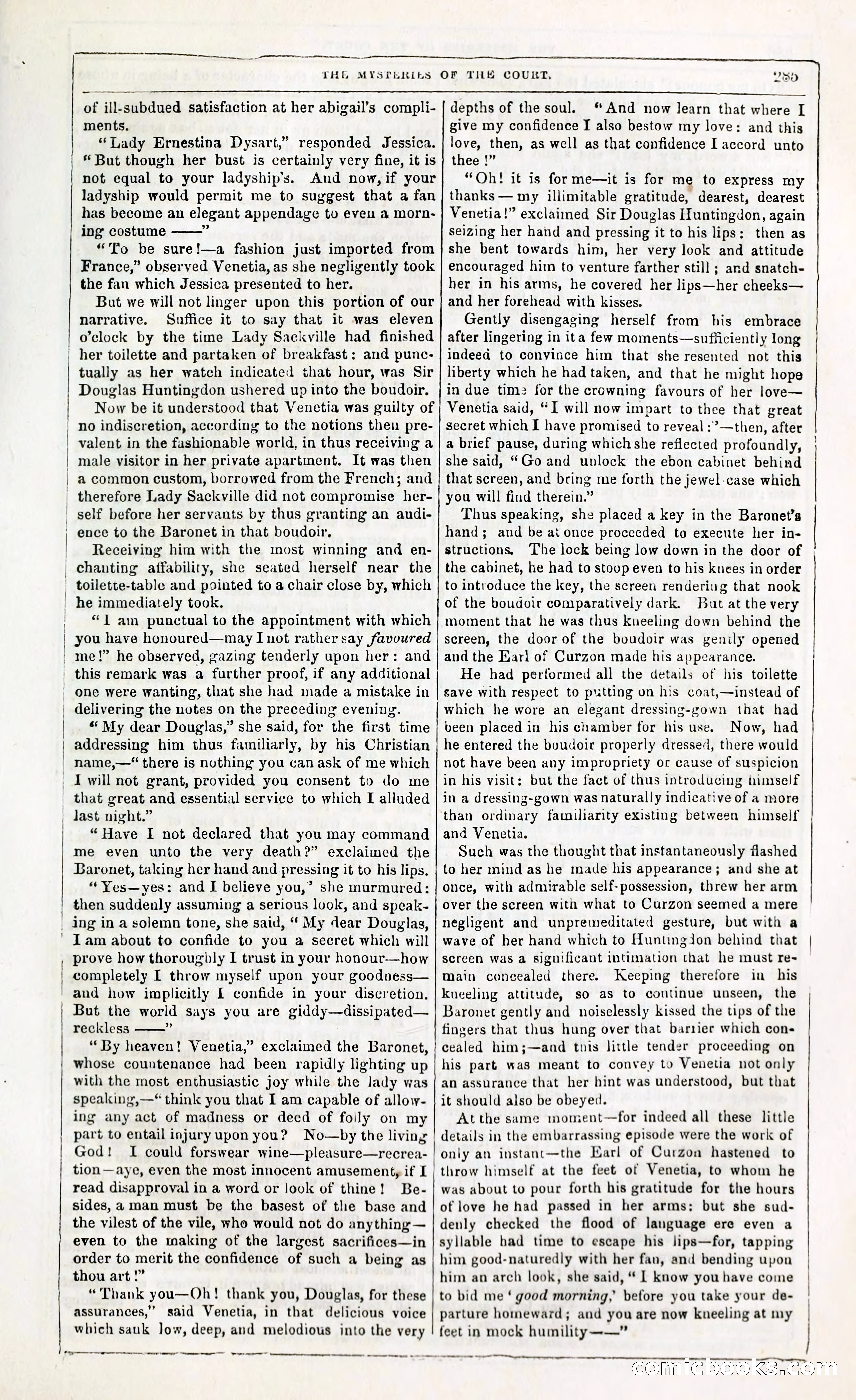
A restored page from Penny Dreadfuls, 1849. Page through the whole issue in the reader above.
📄 Transcribed text from this page (OCR, searchable)
Machine-transcribed from the original scan — historical spelling and the odd misread are preserved.
—-—_——_—_—_——— _—_— SS | ee I A THE MYSPERItsS OF THE 0° - oO ee eee ee ee ——— a, COULT, of ill-subdued satisfaction at her abigail’s compli- ments. “Tady Ernestina Dysart,” responded Jessica. * But though her bust is certainly very fine, it is not equal to your ladyship’s. And now, if your ladyship would permit me to suggest that a fan has become an elegant appendage to even a morn- ing costume ——” “To be sure!—a fashion just imported from France,” observed Venetia, as she negligently took the fan which Jessica presented to her. But we will not linger upon this portion of our narrative. Suffice it to say that it was eleven o'clock by the time Lady Sackville had finished her toilette and partaken of breakfast: and punc- tually as her watch indicated that hour, was Sir Douglas Huntingdon ushered up into the boudoir. Now be it understood that Venetia was guilty of no indiscretion, according to the notions then pre- valent in the fashionable world, in thus receiving a male visitor in her private apartment. It was then a common custom, borrowed from the French; and therefore Lady Sackville did not compromise her- self before her servants by thus granting an audi- ence to the Baronet in that boudoir. Receiving him with the most winning and en- chanting affability, she seated herself near the toilette-table and pointed to a chair close by, which he immediately took. “JT am punctual to the appointment with which you have honoured—may [not rather say favoured me!” he observed, gazing tenderly upon her: and this remark was a further proof, if any additional one were wanting, that she had made a mistake in delivering the notes on the preceding evening. “‘ My dear Douglas,” she said, for the first. time addressing him thus familiarly, by his Christian name,—* there i is nothing you can ask of me which I will not grant, provided you consent to do me that great and essential service to which I alluded last night.” “Have I not declared that you may command me even unto the very death?” exclaimed the Baronet, taking her hand and pressing it to his lips. “‘Yes—yes: and I believe you,” she murmured: then suddenly assuming a serious look, and speak- ing in a solemn tone, we said, ‘‘ My dear Douglas, I am about to confide to you a secret which will prove how thorougbly I trust in your honour—how completely I throw myself upon your goodness— and how implicitly I confide in your discretion. But the world says you are giddy—dissipated— reckless a ‘“‘ By heaven! Venetia,’ exclaimed the Baronet, whose countenance had been rapidly lighting up with the most enthusiastic joy while the lady was speaking,—* think you that I am capable of allow- ing any act of madness or deed of folly on my part to entail injury upon you? No—by the living God! I could forswear wine—pleasure—recrea- tion—aye, even the most innocent amusement, if I read disapproval i in a word or look of thine! Be- sides, a man must be the basest of tlle base and the vilest of the vile, who would not do anything — even to the making of the largest sacrifices—in order to merit the confidence of such a being as thou art !” “Thank you—Oh! thank you, Douglas, for these assurances,” said Venetia, in that delicious voice which sank low, deep, and melodious into the very i ee me ee + depths of the soul. And now learn that where I give my confidence I also bestow my love: and this love, then, as well as that confidence I accord unto thee !” “Oh! it is for me—it is for me to express my thanks — my illimitable gratitude, dearest, dearest Venetia!” exclaimed Sir Douglas Huntingdon, again seizing her hand and pressing it to his lips: then as she bent towards him, her very look and attitude encouraged him to venture farther still ; and snatch- her in his arms, he covered her lips—her cheeks— and her forehead with kisses. Gently disengaging herself from his embrace after lingering in ita few moments—suficiently long indeed to convince him that she resented not this liberty which he had taken, and that he might hope in due time for the crowning favours of her love— Venetia said, “I will now impart to thee that great secret which I have promised to reveal :’—then, after a brief pause, during which she reflected profoundly, she said, “Go and unlock the ebon cabinet behind that screen, and bring me forth the jewel-case which you will find therein.” Thus speaking, she placed a key in the Baronet’s hand; and be at once proceeded to execute her in- structions, ‘The lock being low down in the door of the cabinet, he had to stoop even to his knees in order to introduce the key, the screen rendering that nook of the boudoir comparatively dark. But at the very moment that he was thus kneeling down behind the screen, the door of the boudoir was genily opened and the Karl of Curzon made his appearance. He had performed all the details of his toilette gave with respect to putting on his coat,—instead of which he wore an elegant dressing-gown that had been placed in his chamber for his use. Now, had he entered the boudoir properly dressed, there would not have been any impropriety or cause of suspicion in his visit: but the fact of thus introducing himself in a dressing-gown was naturally indicative of a more than ordinary familiarity existing between himself and Venetia. Such was the thought that instantaneously flashed to her mind as he made his appearance; and she at once, with admirable self- possession, threw her arm over the screen with what to Curzon seemed a mere negligent and unpremeditated gesture, but with a wave of her hand which to Huntingdon behind that screen was a significant intimation that he must re- main concealed there. Keeping therefore in his kneeling attitude, so aS to continue unseen, the Baronet gently and noiselessly kissed the tips of the fingers that thus hung over that bar1ier which cons cealed him;—and this little tender proceeding on his part was meant to convey to Venetia not only an assurance that her hint was understood, but that it should also be obeyed. At the same moment—for indeed all these little details in the embarrassing episode were the work of only an instant—the Earl of Curzon hastened to throw himself at the feet of Venetia, to whom he was about to pour forth his gratitude for the hours of love he had passed in her arms: but she sud- denly checked the flood of language ere even a syllable bad time to escape his lips—for, tapping him good-naturedly with her fav, and bending upon him an arch look, she said, “ 1 know you have come to bid me ‘ good morning,’ before you take your de- parture homeward; and you are now Kneeling at my feet in mock humility ——” a | | | | | CORMICOOOKS ct (CO)