
Penny Dreadfuls, 1849 · page 314 of 394
The Mysteries of the Court of London — page 314: what you’re looking at
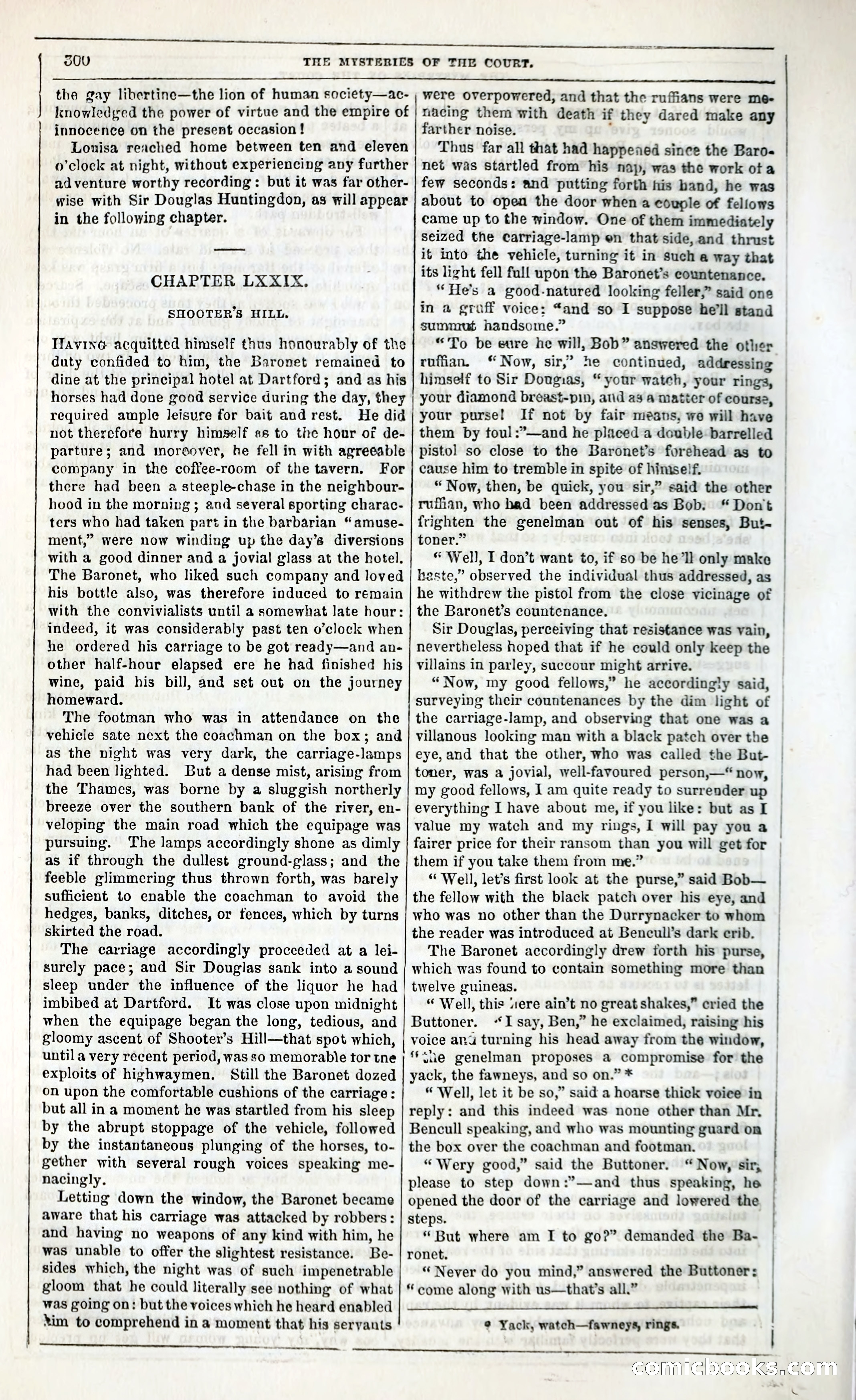
A restored page from Penny Dreadfuls, 1849. Page through the whole issue in the reader above.
📄 Transcribed text from this page (OCR, searchable)
Machine-transcribed from the original scan — historical spelling and the odd misread are preserved.
a Ne ee eS THE MYSTERIES OF THE COURT, oO0U the gay libertine—the lion of human society—ac- knowledyred the power of virtue and the empire of innocence on the present occasion! Louisa reached home between ten and eleven o’clock at night, without experiencing any further adventure worthy recording: but it was far other- wise with Sir Douglas Huntingdon, as will appear in the following chapter. CHAPTER LXXIX, SHOOTER’S HILL. Havine acquitted himself thus honourably of the duty confided to him, the Baronet remained to dine at the principal hotel at Dartford; and as his horses had done good service during the day, they required ample leisure for bait and rest. He did not therefore hurry himself ss to the hour of de- parture; and moreover, he fell in with agreeable company in the coffee-room of the tavern. For there had been a steeple-chase in the neighbour- hood in the morning; and several sporting charac- ters who had taken part in the barbarian “amuse- ment,” were now winding up the day’s diversions with a good dinner and a jovial glass at the hotel. The Baronet, who liked such company and loved his bottle also, was therefore induced to remain with the convivialists until a somewhat late hour: indeed, it was considerably past ten o’clock when he ordered his carriage to be got ready—and an- other half-hour elapsed ere he had finished his wine, paid his bill, and set out on the journey homeward. The footman who was in attendance on the vehicle sate next the coachman on the box; and as the night was very dark, the carriage-lamps had been lighted. But a dense mist, arising from the Thames, was borne by a sluggish northerly breeze over the southern bank of the river, en- veloping the main road which the equipage was pursuing. The lamps accordingly shone as dimly as if through the dullest ground-glass; and the feeble glimmering thus thrown forth, was barely sufficient to enable the coachman to avoid the hedges, banks, ditches, or fences, which by turns skirted the road. The carriage accordingly proceeded at a lei- surely pace; and Sir Douglas sank into a sound sleep under the influence of the liquor he had imbibed at Dartford. It was close upon midnight when the equipage began the long, tedious, and gloomy ascent of Shooter’s Hill—that spot which, until a very recent period, was so memorable tor tne exploits of highwaymen. Still the Baronet dozed on upon the comfortable cushions of the carriage: but all in a moment he was startled from his sleep by the abrupt stoppage of the vehicle, followed by the instantaneous plunging of the horses, to- gether with several rough voices speaking me- nacingly. Letting down the window, the Baronet became aware that his carriage was attacked by robbers: and having no weapons of any kind with him, he was unable to offer the slightest resistance. Be- sides which, the night was of such impenetrable gloom that he could literally see nothing of what was going on: but the voices which he heard enabled sim to comprehend in a moment that his seryants were . - - ewe is ~ were overpowered, and that the ruffians were me- nacing them with death if they dared make any farther noise. Thus far all that had happened since the Baro« net was startled from his nap, was the work ota few seconds: and putting forth his hand, he was about to open the door when a couple of fellows came up to the window. One of them immediately | seized the carriage-lamp en that side, and thrust it into the vehicle, turning it in such a way that its light fell full upon the Baronet’s countenance, “He’s a good-natured looking feller” said one in a graff voice: “and so I suppose he'll stand summut handsome.” “To be sure he will, Bob” answered the other rufian. “Now, sir,’ he continued, addressing himself to Sir Dougias, “ your watch, your rings, your diamond breast-pin, atid as a matter of course, your purse! If not by fair means, we will have them by toul:”—and he placed a double barrelled — pistol so close to the Baronet’s forehead as to cause him to tremble in spite of himself. “ Now, then, be quick, you sir,” said the other rufian, who had been addressed as Bob: “ Don't frighten the genelman out of his senses, But- toner.” “Well, I don’t want to, if so be hell only make baste,” observed the individual thus addressed, as he withdrew the pistol from the close vicinage of the Baronet’s countenance. Sir Douglas, perceiving that resistance was yain, nevertheless hoped that if he could only keep the villains in parley, succour might arrive. “Now, my good fellows,” he accordingly said, surveying their countenances by the dim light of the carriage-lamp, and observing that one was a villanous looking man with a black patch over the eye, and that the other, who was called the But- toner, was a jovial, well-favoured person,—* now, my good fellows, | am quite ready to surrender up everything I have about me, if you like: but as I value my watch and my rings, I will pay you a fairer price for their ransom than you will get for them if you take them from me.” “ Well, let’s first look at the purse,” said Bob— the fellow with the black patch over his eye, and who was no other than the Durrynacker to whom the reader was introduced at Bencull’s dark erib. The Baronet accordingly drew forth his purse, which was found to contain something more than twelve guineas. “ Well, this ere ain’t no great shakes,” cried the Buttoner. ‘I say, Ben,” he exclaimed, raising his voice ang turning his head away from the window, ‘sue genelman proposes a compromise for the yack, the fawneys, and so on.” * “ Well, let it be so,” said a hoarse thick voice in reply: and this indeed was none other than Mr, Bencull speaking, and who was mounting guard on the box over the coachman and footman. “ Wery good,” said the Buttoner. “ Now, sir, please to step down:’—and thus speaking, he opened the door of the carriage and lowered the steps. * But where am I to go?” demanded the Ba- ronet. “ Never do you mind,” answered the Buttoner: * come along with us—that’s all.” @ Yack, watch—fawneys, rings. —_-— ee ge — CONMNICLOOO (E() S