
Penny Dreadfuls, 1849 · page 326 of 394
The Mysteries of the Court of London — page 326: what you’re looking at
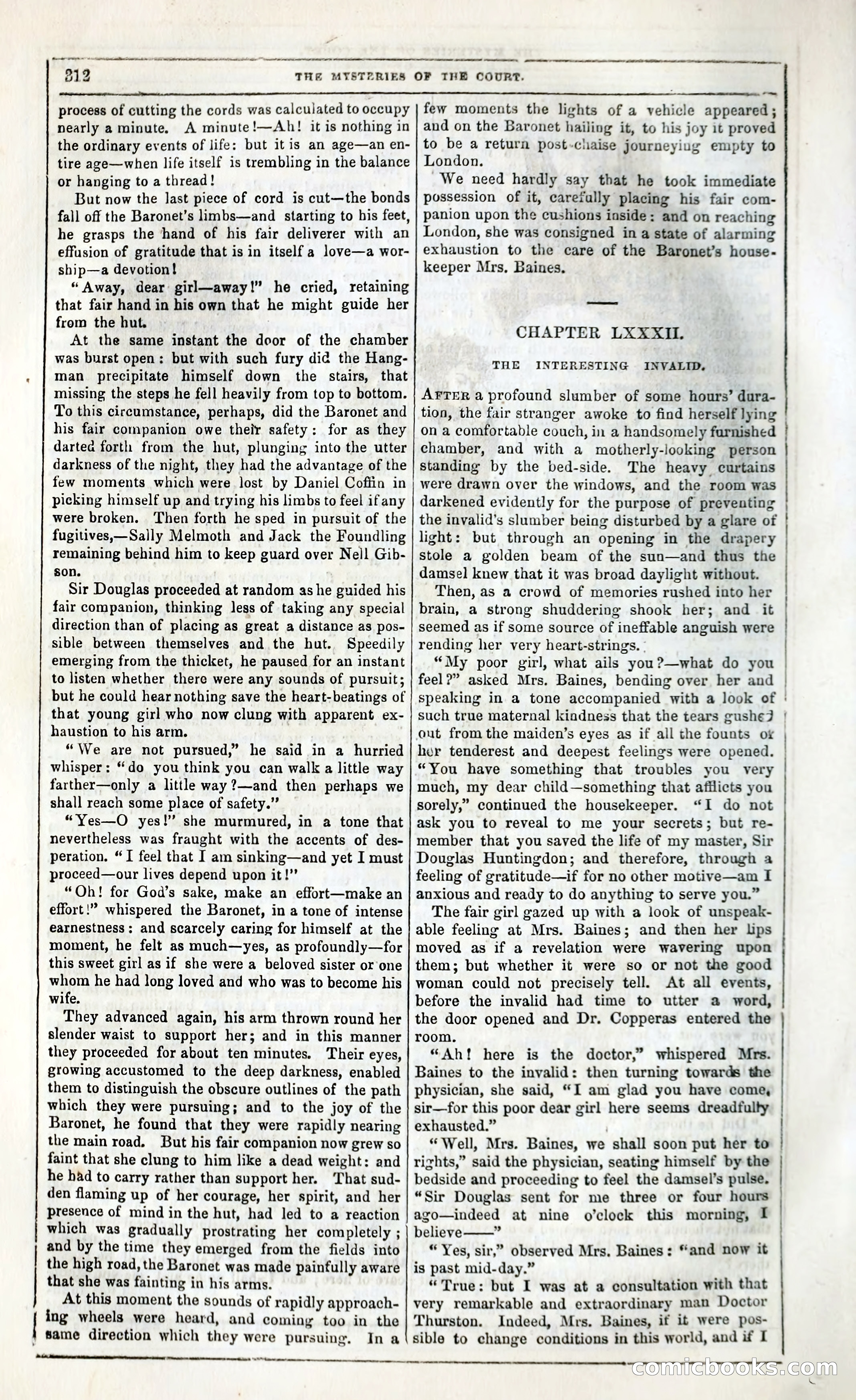
A restored page from Penny Dreadfuls, 1849. Page through the whole issue in the reader above.
📄 Transcribed text from this page (OCR, searchable)
Machine-transcribed from the original scan — historical spelling and the odd misread are preserved.
| tl A A kT Ct A A RT process of cutting the cords was calculated to occupy nearly a minute. A minute!—Ah! it is nothing in the ordinary events of life: but itis an age—an en- tire age—when life itself is trembling in the balance or hanging to a thread! But now the last piece of cord is cut—the bonds fall off the Baronet’s limbs—and starting to his feet, he grasps the hand of his fair deliverer with an effusion of gratitude that is in itself a love—a wor- ship—a devotion! “ Away, dear girl—away!” he cried, retaining that fair hand in his own that he might guide her from the hut. At the same instant the door of the chamber was burst open: but with such fury dic the Hang- man precipitate himself down the stairs, that missing the steps he fell heavily from top to bottom. To this circumstance, perhaps, did the Baronet and his fair companion owe their safety: for as they darted forth from the hut, plunging into the utter darkness of the night, they had the advantage of the few moments which were lost by Daniel Coffin in picking himself up and trying his limbs to feel ifany were broken. Then forth he sped in pursuit of the fugitives,—Sally Melmoth and Jack the Foundling remaining behind him to keep guard over Nell Gib- son. Sir Douglas proceeded at random as he guided his fair companion, thinking less of taking any special direction than of placing as great a distance as pos- sible between themselves and the hut. Speedily emerging from the thicket, he paused for an instant to listen whether there were any sounds of pursuit; but he could hear nothing save the heart-beatings of that young girl who now clung with apparent ex- haustion to his arm. “We are not pursued,” he said in a hurried whisper: “do you think you can walk a little way farther—only a little way ?—and then perhaps we shall reach some place of safety.” “Yes—O yes!” she murmured, in a tone that nevertheless was fraught with the accents of des- peration. “I feel that I am sinking—and yet I must proceed—our lives depend upon it!” “Oh! for God’s sake, make an effort—make an effort!” whispered the Baronet, in a tone of intense earnestness; and scarcely caring for himself at the moment, he felt as much—yes, as profoundly—for this sweet girl as if she were a beloved sister or one whom he had long loved and who was to become his wife. They advanced again, his arm thrown round her slender waist to support her; and in this manner they proceeded for about ten minutes. Their eyes, growing accustomed to the deep darkness, enabled them to distinguish the obscure outlines of the path which they were pursuing; and to the joy of the Baronet, he found that they were rapidly nearing the main road. But his fair companion now grew so faint that she clung to him like a dead weight: and he had to carry rather than support her. That sud- den flaming up of her courage, her spirit, and her presence of mind in the hut, had led to a reaction which was gradually prostrating her completely ; and by the time they emerged from the fields into the high road, the Baronet was made painfully aware that she was fainting in his arms. At this moment the sounds of rapidly approach- ing wheels were heard, and coming too in the same direction which they were pursuing. Ina oS tee eee THE MYSTZRIES OF THE COURT. few moments the lights of a vehicle appeared; and on the Baronet hailing it, to his joy it proved to be a return post-cliaise journeyiug empty to London. We need hardly say that he took immediate possession of it, carefully placing his fair com- panion upon the cushions inside: and on reaching London, she was consigned in a state of alarming exhaustion to the care of the Baronet’s house- keeper Mrs, Baines, CHAPTER LXXXII. THE INTERESTING INVALID, AFTER a profound slumber of some hours’ dura- tion, the fair stranger awoke to find herself lying on a comfortable couch, in a handsomely farnished chamber, and with a motherly-looking person standing by the bed-side. The heavy curtains were drawn over the windows, and the room was darkened evidently for the purpose of preventing the invalid’s slumber being disturbed by a glare of light: but through an opening in the drapery stole a golden beam of the sun—and thus the damsel knew that it was broad daylight without. Then, as a crowd of memories rushed into her brain, a strong shuddering shook her; and it seemed as if some source of ineffable anguish were rending her very heart-strings. “My poor girl, what ails you?—what do you feel?” asked Mrs. Baines, bending over her and - SO ED SD speaking in a tone accompanied with a look of | such true maternal kindness that the tears gushe? | out from the maiden’s eyes as if all the founts of hur tenderest and deepest feelings were opened. “You have something that troubles you very much, my dear child—something that afflicts you sorely,” continued the housekeeper. “I do not ask you to reveal to me your secrets; but re- member that you saved the life of my master, Sir Douglas Huntingdon; and therefore, through a feeling of gratitude—if for no other motive—am I anxious and ready to do anything to serve you.” The fair girl gazed up with a look of unspeak- able feeling at Mrs. Baines; and then her Ups moved as if a revelation were wavering upon them; but whether it were so or not the good woman could not precisely tell. At all events, before the invalid had time to utter a word, the door opened and Dr. Copperas entered the room. “Ah! here is the doctor,” whispered Mrs. Baines to the invalid: then turning towards the physician, she said, “I am glad you have come, sir—for this poor dear girl here seems dreadfulty exhausted.” ) “Well, Mrs. Baines, we shall soon put her to rizhts,” said the physician, seating himself by the bedside and proceeding to feel the damsel’s pulse. “Sir Douglas sent for me three or four hours ago—indeed at nine o’clock this morning, I believe ——” “Yes, sir,” observed Mrs, Baines: “and now it is past mid-day.” “True: but I was at a consultation with that very remarkable and extraordinary man Doctor so oe - + SS lt ee eee ee Thurston. Indeed, Mrs. Baines, if it were pos- sible to change conditions in this world, and if I ik 20 IGOMULGDOOKSEGOM