
Penny Dreadfuls, 1849 · page 330 of 394
The Mysteries of the Court of London — page 330: what you’re looking at
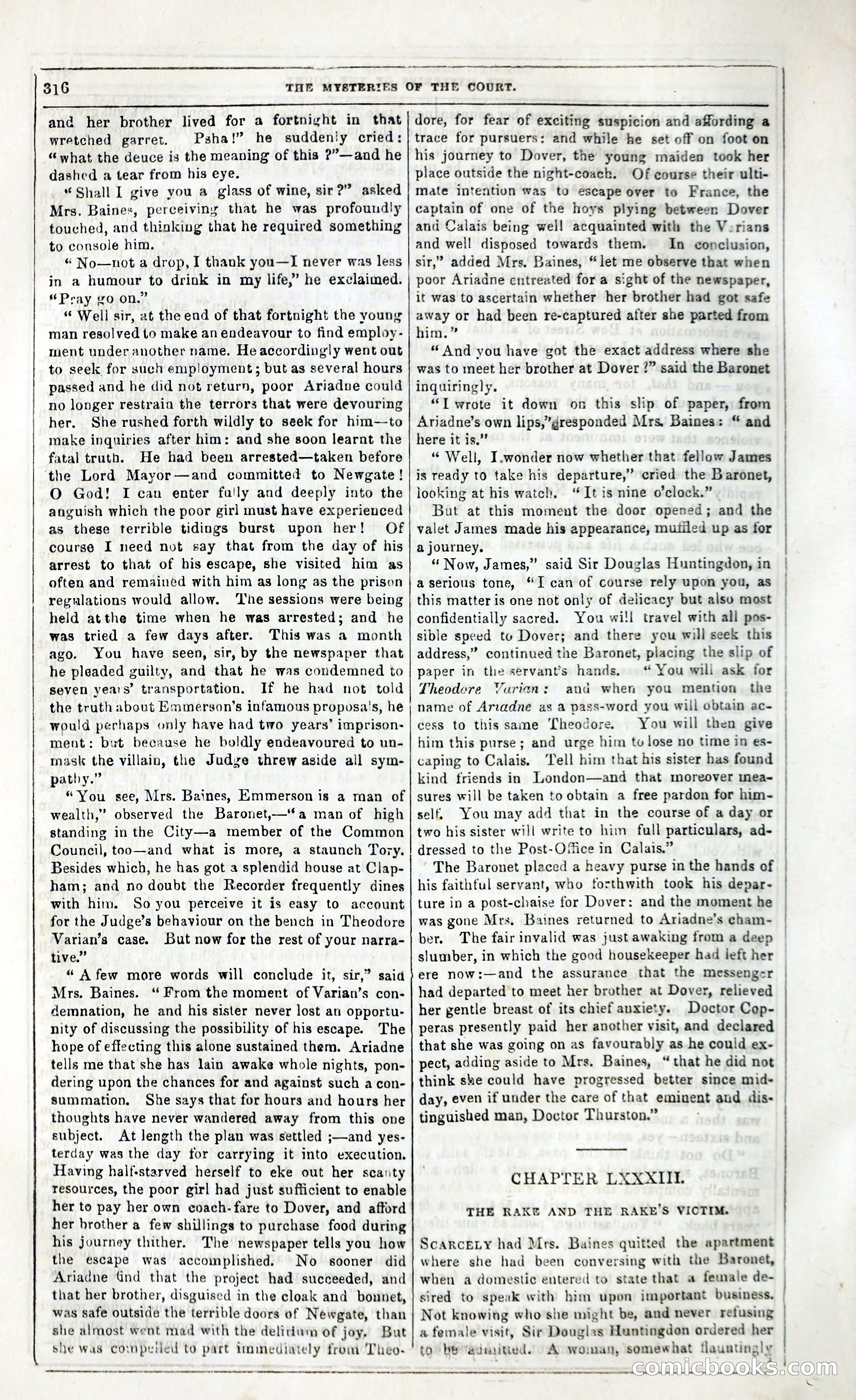
A restored page from Penny Dreadfuls, 1849. Page through the whole issue in the reader above.
📄 Transcribed text from this page (OCR, searchable)
Machine-transcribed from the original scan — historical spelling and the odd misread are preserved.
—-_ omeemeea_ 316 and her brother lived for a fortnight in that wretched garret. Psha!” he suddeniy cried: “what the deuce is the meaning of this ?”—and he dashed a tear from his eye. “Shall 1 give you a glass of wine, sir?” asked Mrs. Baines, perceiving that he was profoundly touched, and thinking that he required something to console him. “ No—not a drop, I thank you—I never was less in a humour to drink in my life,’ he exclaimed. Pray go on.” *“ Well sir, at the end of that fortnight the young man resolved to make an endeavour to find employ- ment under another name. He accordingly went out to seek for such employment; but as several hours passed and he did not return, poor Ariadne could no longer restrain the terrors that were devouring her. She rushed forth wildly to seek for him—to make inquiries after him: and she soon learnt the fatal truth. He had been arrested—taken before the Lord Mayor—and committed to Newgate! O God! I can enter fully and deeply into the anguish which the poor girl must have experienced as these terrible tidings burst upon her! Of course I need not say that from the day of his arrest to that of his escape, she visited him as often and remained with him as long as the prison regulations would allow. The sessions were being held atthe time when he was arrested; and he was tried a few days after. This was a month ago. You have seen, sir, by the newspaper that he pleaded guilty, and that he was coudemned to seven years’ transportation. If he had not told the truth about Emmerson’s infamous proposa's, he would perhaps only have had two years’ imprison- ment: but because he boldly endeavoured to un- mask the villain, the Judge threw aside all sym- pathy.” “You see, Mrs. Baines, Emmerson is a man of wealth,” observed the Baronet,—‘fa man of high standing in the City—a member of the Common Council, too—and what is more, a staunch Tory. Besides which, he has got a splendid house at Clap- ham; and no doubt the Recorder frequently dines with him. So you perceive it is easy to account for the Judge’s behaviour on the bench in Theodore Varian’s case. But now for the rest of your narra- tive.” “ A few more words will conclude it, sir,” said Mrs. Baines. ‘“ From the momert of Varian’s con- demnation, he and his sister never lost an opportu- nity of discussing the possibility of his escape. The hope of effecting this alone sustained them. Ariadne tells me that she has lain awake whole nights, pon- dering upon the chances for and against such a con- summation. She says that for hours and hours her thoughts have never wandered away from this one subject. At length the plan was settled ;—and yes- terday was the day for carrying it into execution. Having halfsstarved herself to eke out her scanty resources, the poor girl had just sufficient to enable her to pay her own eoach- fare to Dover, and afford her brother a few shillings to purchase food during his journey thither. The newspaper tells you how the escape was accomplished. No sooner did Ariadne find that the project had succeeded, and that her brother, disguised in the cloak and bonnet, was safe outside the terrible doors of Newgate, than she almost went mad with the delirium of joy, But she was competed to part immediately from Theo- Oe mr er a me ee THE MYSTERIES OF THE COURT. dore, for fear of exciting suspicion and affording a trace for pursuers: and while he set off on foot on his journey to Dover, the young maiden took her place outside the night-coachk. Of course their ulti- mate intention was to escape over to France, the captain of one of the hoys plying between Dover and Calais being well acquainted with the V-rians and well disposed towards them. In conclusion, sir,” added Mrs. Baines, “let me observe that when poor Ariadne entreated for a sight of the newspaper, it was to ascertain whether her brother had got safe away or had been re-captured after she parted from him,” “ And you have got the exact address where she was to ineet her brother at Dover ?” said the Baronet inqturingly. “T wrote it down on this slip of paper, from Ariadne’s own lips,”gresponded Mrs, Baines: “ and here it is.” “ Well, I.wonder now whether that fellow James is ready to take his departure,” cried the Baronet, looking at his watch. “It is nine o’clock.” But at this moment the door opened; and the valet James made his appearance, muiiled up as for a journey. “ Now, James,” said Sir Douglas Huntingdon, in a serious tone, “I can of course rely upon you, as this matter is one not only of delicacy but also most confidentially sacred. You will travel with all pos- sible speed to Dover; and there you will seek this address,” continued the Baronet, placing the slip of paper in the servant’s hands. “ You will ask for Theodere Vurien: and when you mention the name of Arvadne as a pass-word you will obtain ac- cess to this same Theodore. You will then give him this purse; and urge him to lose no time in es- caping to Calais. ‘Tell him that his sister has found kind friends in London—and that moreover mnea- sures will be taken to obtain a free pardon for him- self, You may add that in the course of a day or two his sister will write to him full particulars, ad- dressed to the Post-O‘fice in Calais.” The Baronet placed a heavy purse in the hands of his faithful servant, who forthwith took his depar- ture in a post-chaise for Dover: and the moment he was gone Mrs. Baines returned to Ariadne’s cham- ber. The fair invalid was just awaking from a deep slumber, in which the good housekeeper had left her ere now:—and the assurance that the messenger had departed to meet her brother at Dover, relieved her gentle breast of its chief anxiety. Doctor Cop- peras presently paid her another visit, and declared that she was going on as favourably as he could ex- pect, adding aside to Mrs. Baines, “that he did not think she could have progressed better since mid- day, even if under the care of that eminent aud dis- tinguished man, Doctor Thurston.” CHAPTER LXXXIII THE RAKE AND THE RAKE’S VICTIM. ScARCELY had Mrs. Buines quitted the apartment where she had been conversing with the Baronet, when a domestic entered to state that a female de- sired to speak with him upon important business. Not knowing who she might be, and never refusing a female visit, Sir Douglas Huntingdon ordered her to Htfadmitied. A woman, somewhat flauntingly ———— —— — (CORMNIKE OOO _— <<... (€©)