
Penny Dreadfuls, 1849 · page 349 of 394
The Mysteries of the Court of London — page 349: what you’re looking at
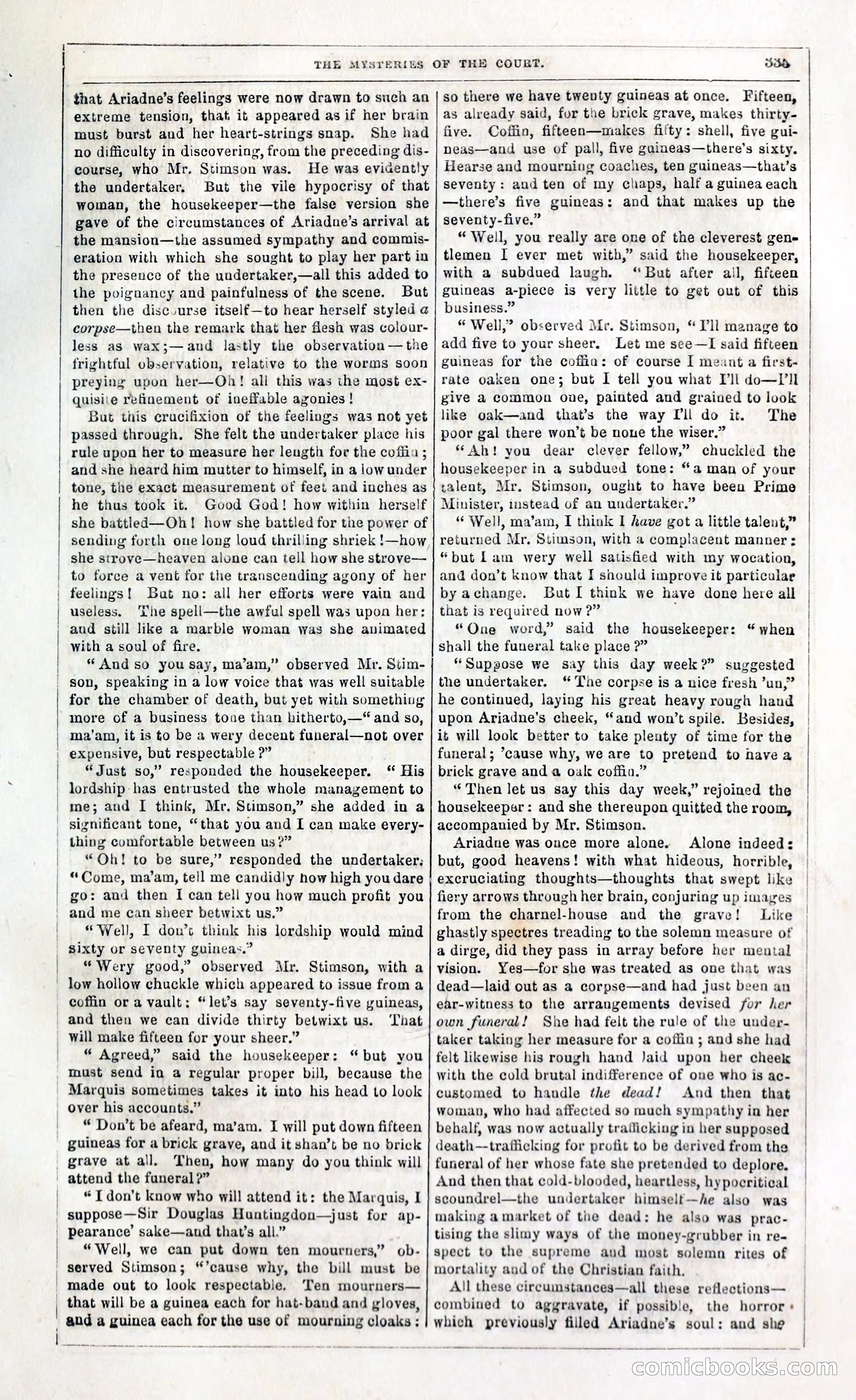
A restored page from Penny Dreadfuls, 1849. Page through the whole issue in the reader above.
📄 Transcribed text from this page (OCR, searchable)
Machine-transcribed from the original scan — historical spelling and the odd misread are preserved.
SS SSS esas THE MYSTERIES OF THE COURT. that Ariadne’s feelings were now drawn to such an extreme tension, that it appeared as if her brain must burst and her heart-strings snap. She had no difficulty in discovering, from the preceding dis- course, who Mr. Stimson was. He was evidently the undertaker. But the vile hypocrisy of that woman, the housekeeper—the false version she gave of the circumstances of Ariadne’s arrival at the mansion—the assumed sympathy and commis- eration with which she sought to play her part in the presence of the undertaker,—all this added to the poiguancy and painfulness of the scene. But then the disccurse itself—to hear herself styled a corpse—then the remark that her flesh was colour- less as wax;—and lastly the observation—the frightful observation, relative to the worms soon preying upon her—QOh! all this was the most ex- quisi‘e refinement of ineffable agonies! But this crucifixion of the feelings was not yet passed through. She felt the undertaker place his rule upon her to measure her length for the coffia ; and she heard him mutter to himself, in a low under tone, the exact measurement of feet and inches as he thus took it. Good God! how within herself she battled—Oh! how she battled for the power of sending forth oue long loud thrilling shriek !—how she strove—heaven alone can tell how she strove— to force a vent for the transcending agony of her feelings! But no: all her efforts were vain and useless, ‘The spell—the awful spell was upon her: aud still like a marble woman was she animated with a soul of fire. * And so you say, ma’am,” observed Mr. Stim- son, speaking in a low voice that was well suitable for the chamber of death, but yet with something more of a business tone than hitherto,—“ and so, ma'am, it is to be a wery decent funeral—not over expensive, but respectable ?” * Just so,” responded the housekeeper. “ His lordship has entrusted the whole management to me; and I think, Mr. Stimson,” she added in a siznificant tone, “that you and I can make every- thing comfortable between us ?” “Oh! to be sure,” responded the undertaker, “ Come, ma’am, tell me candidly how high you dare go: and then I can tell you how much profit you and me can sheer betwixt us.” * Well, I dou’c think his lordship would mind sixty or seventy guineas.” * Wery good,” observed Mr. Stimson, with a low hollow chuckle which appeared to issue from a coffin or a vault: “let’s say seventy-five guineas, and then we can divide thirty betwixt us. ‘That will make fifteen for your sheer.” “ Agreed,” said the housekeeper: “but you must send in a regular proper bill, because the _ Marquis sometimes takes it into his head to look over his accounts.” “ Don’t be afeard, ma’am. I will put down fifteen guineas for a brick grave, and it shan’t be no brick _ grave at all. Then, how many do you think will | attend the funeral ?” “ T don’t know who will attend it: the Marquis, I suppose—Sir Douglas Huntingdon—just for ap- pearance’ sake—and that’s all.” * Well, we can put down ten mourners,” ob- served Stimson; “’cause why, the bill must be ' made out to look respectable. Ten mourners— that will be a guinea each for hat-band and gloves, and a guinea each for the use of mourning cloaks: - wee ee — we eee oe 2 we oe ee = es seventy-five.” * Well, you really are one of the cleverest gen- tlemen I ever met with,” said the housekeeper, with a subdued laugh. “But after all, fifteen guineas a-piece is very little to get out of this business.” * Well,” observed Mr. Stimson, “ ll manage to add five to your sheer. Let me see—I said fifteen guineas for the coflia: of course I meant a first- rate oaken one; but I tell you what I'll do—lll give a common one, painted and grained to look The 53S like oak—and that’s the way Ill do it. poor gal there won’t be noue the wiser.” “Ah! vou dear clever fellow,” chuckled the housekeeper in a subdued tone: “a man of your talent, Mr. Stimson, ought to have been Prime Minister, instead of an undertaker.” “ Well, ma’am, I think I have got a little talent,” returned Mr, Stimson, with a complacent manner: “but Lam wery well satisfied with my wocation, and don’t know that I should improve it particular by achange. But I think we have done here all that is required now ?” “One word,” said the housekeeper: “when shall the funeral take place ?” “Suppose we say this day week?” suggested the undertaker. “ The corpse is a nice fresh ’un,” he continued, laying his great heavy rough hand upon Ariadne’s cheek, “and won’t spile. Besides, it will look better to take plenty of time for the funeral; cause why, we are to pretend to nave a brick grave and a oalk coffin.” “ Then let us say this day week,” rejoined the housekeeper: and she thereupon quitted the room, accompanied by Mr. Stimson. Ariadne was once more alone. Alone indeed: but, good heavens! with what hideous, horrible, so there we have twenty guineas at once. Fifteen, as already said, for the brick grave, makes thirty- five. Coffin, fifteen—makes fifty: shell, five gui- neas—and use of pall, five guineas—there’s sixty. Hearse and mourning coaches, ten guineas—that’s seventy: aud ten of my claps, half a guinea each —there’s five guineas: and that makes up the SSS i TCE excruciating thoughts—thoughts that swept like fiery arrows through her brain, conjuring up images from the charnel-house and the grave! ghastly spectres treading to the solemn measure of a dirge, did they pass in array before her mental vision. Yes—for she was treated as one that was dead—laid out as a corpse—and had just been an ear-witness to the arrangements devised for her own funeral! She had felt the rule of the under- Like | taker taking her measure for a coffin ; and she had felt likewise his rough hand Jaid upon her cheek with the cold brutal indifference of one who is ac- customed to handle the dead! And then that woman, who had affected so much sympathy in her behalf, was now actually traflicking in her supposed death—traflicking for profit to be derived from the funeral of her whose fate she pretended to deplore. And then that cold-blooded, heartless, hypocritical scoundrel—the undertaker himself—Ae also was making a market of the dead: he also was prac- tising the slimy ways of the money-grubber in re- spect to the supreme and most solemn rites of mortality and of the Christian faith. All these circumstances—all these reflections— combined to aggravate, if possible, the horror+ | which previously filled Ariadne’s soul: and she COMMUC JOO | S (CO)