
Penny Dreadfuls, 1849 · page 374 of 394
The Mysteries of the Court of London — page 374: what you’re looking at
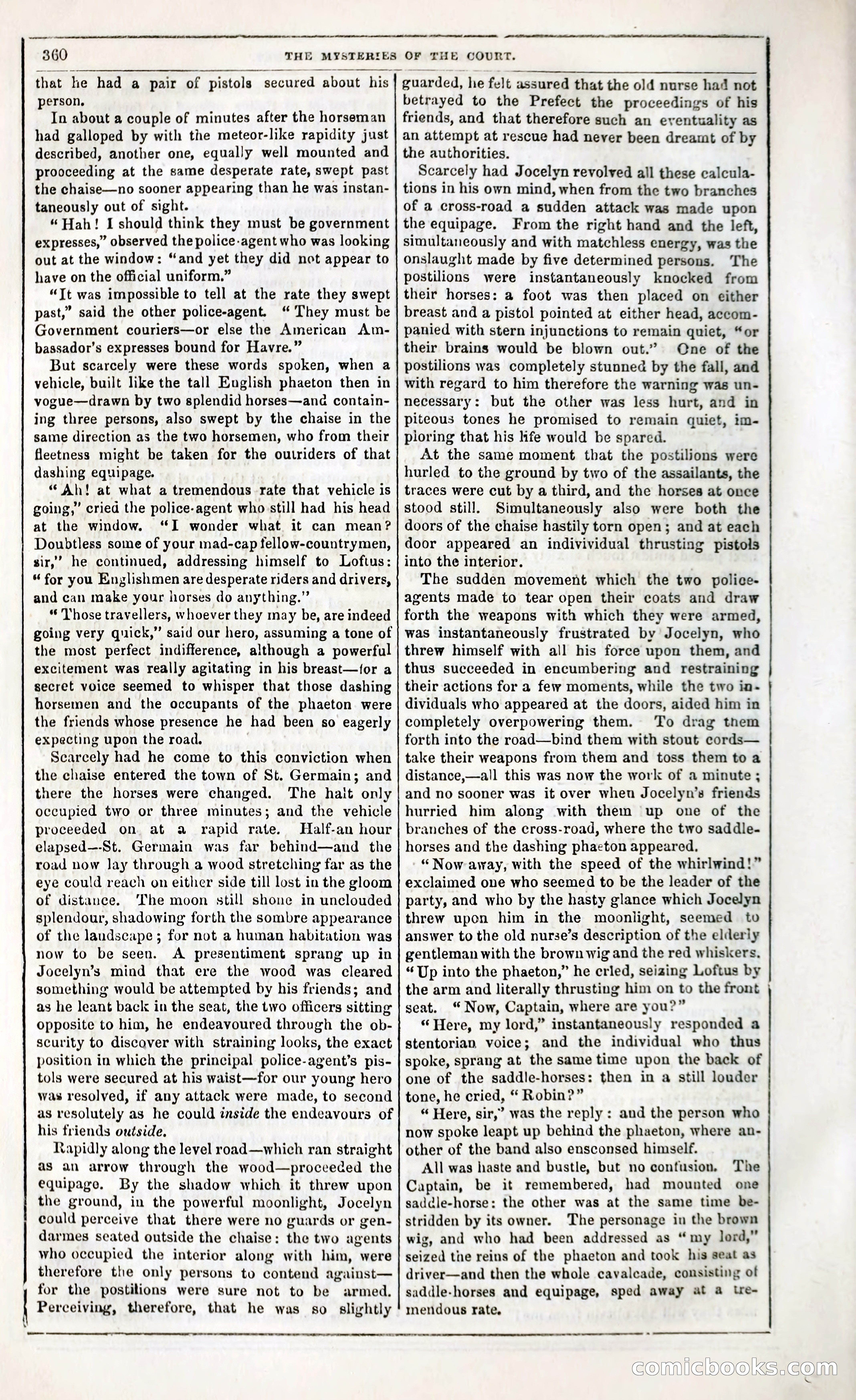
A restored page from Penny Dreadfuls, 1849. Page through the whole issue in the reader above.
📄 Transcribed text from this page (OCR, searchable)
Machine-transcribed from the original scan — historical spelling and the odd misread are preserved.
= ——— —_—_— — 360 THE that he had a pair of pistols secured about his person. In about a couple of minutes after the horseman had galloped by with the meteor-like rapidity just described, another one, equally well mounted and prooceeding at the same desperate rate, swept past the chaise—no sooner appearing than he was instan- taneously out of sight. “Hah! I should think they must be government expresses,” observed the police-agent who was looking out at the window: “and yet they did not appear to have on the official uniform.” “Tt was impossible to tell at the rate they swept past,” said the other police-agent. “ They must be Government courlers—or else the American Am- bassador’s expresses bound for Havre.” But scarcely were these words spoken, when a vehicle, built like the tall Euglish phaeton then in vogue—drawn by two splendid horses—ana contain- ing three persons, also swept by the chaise in the same direction as the two horsemen, who from their fleetness might be taken for the outriders of that dashing equipage. “Ah! at what a tremendous rate that vehicle is going,” cried the police-agent who still had his head at the window. “I wonder what it can mean? Doubtless some of your mad-cap fellow-countrymen, sir,’ he continued, addressing himself to Loftus: “ for you Englishmen are desperate riders and drivers, and can make your horses do anything.” * hose travellers, whoever they may be, are indeed going very quick,” said our hero, assuming a tone of the most perfect indifference, although a powerful excitement was really agitating in his breast—for a secret voice seemed to whisper that those dashing horsemen and the occupants of the phaeton were the friends whose presence he had been so eagerly expecting upon the road, Secarcely had he come to this conviction when the chaise entered the town of St. Germain; and there the horses were changed. The hait only occupied two or three minutes; and the vehicle proceeded on at a rapid rate. Half-an hour elapsed—-St. Germain was far behind—and the road now lay through a wood stretching far as the eye could reach on either side till lost in the gloom of distance. ‘The moon still shone in unclouded splendour, shadowing forth the sombre appearance of the landscape ; for not a human habitation was now to be seen. A presentiment sprang up in Jocelyn’s mind that ere the wood was cleared something would be attempted by his friends; and as he leant back in the seat, the two officers sitting opposite to him, he endeavoured through the ob- scurity to discaver with straining looks, the exact position in which the principal police-agent’s pis- tols were secured at his waist—for our young hero was resolved, if any attack were made, to second as resolutely as he could znside the endeavours of his friends outside. Rapidly along the level road—which ran straight as an arrow through the wood—proceeced the equipage, By the shadow which it threw upon the ground, in the powerful moonlight, Jocelyn could perceive that there were no guards or gen- darmes seated outside the chaise: the two agents who occupied the interior along with him, were therefore the only persons to contend against— for the postitions were sure not to be armed. Perceiving, therefore, that he was so slightly SE ee ee MYSTERIES OF THE COURT. guarded, he felt assured that the old nurse had not betrayed to the Prefect the proceedings of his friends, and that therefore such an eventuality as an attempt at rescue had never been dreamt of by the authorities. Scarcely had Jocelyn revolved all these calcula- tions in his own mind, when from the two branches of a cross-road a sudden attack was made upon the equipage. From the right hand and the left, simultaneously and with matchless energy, was the onslaught made by five determined persons. The postilions were instantaneously knocked from their horses: a foot was then placed on either breast and a pistol pointed at either head, accom- panied with stern injunctions to remain quiet, “or their brains would be blown out.” Qne of the postilions was completely stunned by the fall, and with regard to him therefore the warning was un- necessary: but the other was less hurt, and in piteous tones he promised to remain quiet, im- pioring that his life would be spared. At the same moment that the postilions were hurled to the ground by two of the assailants, the traces were cut by a third, and the horses at once stood still. Simultaneously also were both the doors of the chaise hastily torn open; and at each door appeared an indivividual thrusting pistols into the interior. The sudden movement which the two police- agents made to tear open their coats and draw forth the weapons with which they were armed, was instantaneously frustrated by Jocelyn, who threw himself with all his force upon them, and thus succeeded in encumbering and restraining their actions for a few moments, while the two in- dividuals who appeared at the doors, aided him in | completely overpowering them. To drag them forth into the road—bind them with stout cords— take their weapons from them and toss them to a distance,—all this was now the work of a minute ; and no sooner was it over when Jocelyn’s friends hurried him along with them up one of the branches of the cross-road, where the two saddle- horses and the dashing phaeton appeared. “ Now away, with the speed of the whirlwind!” exclaimed one who seemed to be the leader of the party, and who by the hasty glance which Jocelyn threw upon him in the moonlight, seemed to answer to the old nurse’s description of the elderly gentleman with the brown wig and the red whiskers, “Up into the phaeton,” he erled, seizing Loftus by the arm and literally thrusting him on to the front | seat. “ Now, Captain, where are you?” “Here, my lord,” instantaneously responded a stentoriapn voice; and the individual who thus spoke, sprang at the same time upon the back of one of the saddle-horses: then in a still louder tone, he cried, “ Robin?” “ Here, sir,’ was the reply: and the person who now spoke leapt up behind the phaeton, where an- other of the band also ensconsed himself. All was haste and bustle, but no confusion. The Captain, be it remembered, had mounted one saddle-horse: the other was at the same time be- stridden by its owner. The personage in the brown wig, and who had been addressed as “ my lord,” seized the reins of the phaeton and took his seat as driver—and then the whole cavalcade, consisting of saddle-horses and equipage, sped away at a tre- mendous rate. — Go 0)(0)©) (C S Eo