
Penny Dreadfuls, 1849 · page 40 of 394
The Mysteries of the Court of London — page 40: what you’re looking at
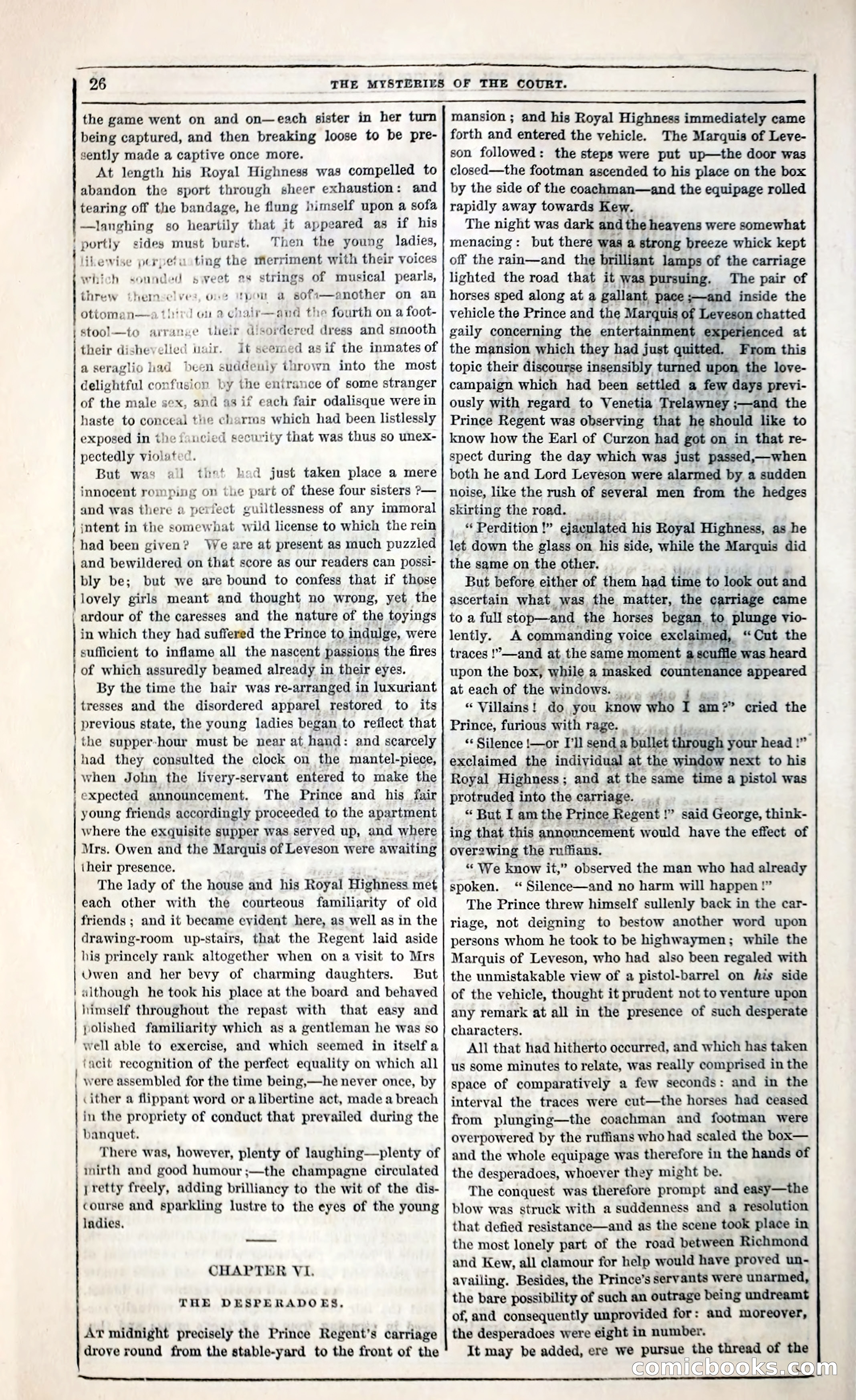
A restored page from Penny Dreadfuls, 1849. Page through the whole issue in the reader above.
📄 Transcribed text from this page (OCR, searchable)
Machine-transcribed from the original scan — historical spelling and the odd misread are preserved.
$$ SL 26 THE MYSTERIES OF THE COURT. the game went on and on—each sister in her turn being captured, and then breaking loose to be pre- sently made a captive once more. At length his Royal Highness was compelled to abandon the sport through sheer exhaustion: and tearing off the bandage, he flung himself upon a sofa —langhing go heartily that it appeared as if his portly sides must burst. Then the young ladies, liLewise perpetu ting the merriment with their voices which sounded sweet 2s strings of musical pearls, threw themeeclves, oe “pou a sofa—another on an ottoman—a third ou a chair—and the fourth on a foot- stool—to arranse tleir disordered dress and stnooth their dishevelied Uair. It seemed asif the inmates of aseraglio had been suddenly ihrown into the most delightful confusion by the entrance of some stranger of the male sex, and as if each fair odalisque were in haste to conceal the charrmas which had been listlessly exposed in the fancied security that was thus so unex- pectedly violated. But was all thet had just taken place a mere innocent romping on the part of these four sisters P— ee re Le re ee Ce Ee le and was there a perfect guiltlessness of any immoral intent in the somewhat wild license to which the rein had been given? We are at present as much puzzled and bewildered on that score as our readers can possi- bly be; but we are bound to confess that if those lovely girls meant and thought no wrong, yet the ardour of the caresses and the nature of the toyings in which they had suffered the Prince to indulge, were sufficient to inflame all the nascent passions the fires of which assuredly beamed already in their eyes. By the time the hair was re-arranged in luxuriant tresses and the disordered apparel restored to its previous state, the young ladies began to reflect that the supper-hour must be near at hand: and scarcely had they consulted the clock on the mantel-piece, when John the livery-servant entered to make the expected announcement. The Prince and his fair young friends accordingly proceeded to the apartment where the exquisite supper was served up, and where Mrs. Owen and the Marquis of Leveson were awaiting (heir presence. The lady of the house and his Royal Highness met each other with the courteous familiarity of old friends ; and it became evident here, as well as in the drawing-room up-stairs, that the Regent laid aside his princely rank altogether when on a visit to Mrs Owen and her bevy of charming daughters. But although he took his place at the board and behaved | himself throughout the repast with that easy and | polished familiarity which as a gentleman he was so well able to exercise, and which seemed in itself a ‘acit recognition of the perfect equality on which all , were assembled for the time being,—he never once, by \ither a flippant word or alibertine act, made a breach in the propriety of conduct that prevailed during the banquet. There was, however, plenty of laughing—plenty of mirth and good humour ;—the champagne circulated j retty freely, adding brilliancy to the wit of the dis- course and sparkling lustre to the eyes of the young ladies, ——EEE 2 = -: — —_ —— - ao~ ~~ CHAPTER VI. THE DESPERADOES. Ar midnight precisely the Prince Regent’s carriage drove round from the stable-yard to the front of the -™-——_—-_-+_ —- mansion ; and his Royal Highness immediately came forth and entered the vehicle. The Marquis of Leve- son followed: the steps were put up—the door was closed—the footman ascended to his place on the box by the side of the coachman—and the equipage rolled rapidly away towards Kew. The night was dark and the heayens were somewhat menacing: but there was a strong breeze whick kept off the rain—and the brilliant lamps of the carriage lighted the road that it was pursuing. The pair of horses sped along at a gallant, pace ;—and inside the vehicle the Prince and the Marquis of Leveson chatted gaily concerning the entertainment experienced at the mansion which they had just quitted. From this topic their discourse insensibly turned upon 1 the love- campaign which had been settled a few days previ- ously with regard to Venetia Trelawney ;—and the Prince Regent was observing that he should like to know how the Earl of Curzon had got on in that re- spect during the day which was just passed,—when both he and Lord Leveson were alarmed by a sudden noise, like the rush of several men from the hedges skirting the road. ** Perdition !” ejaculated his Royal Highness, as he let down the glass on his side, while the Marquis did the same on the other. But before either of them had time to look out and ascertain what was the matter, the carriage came to a full stop—and_ the horses began. to plunge vio- lently. A commanding voice exclaimed, “Cut the traces !”—and at the same moment a scuffle was heard upon the box, while a masked countenance appeared at each of the windows. __ “ Villains! do you know who i am” cried the Prince, furious with rage... “ Silence !—or I'll senda bullet through your head!” exclaimed the individual at the window next to his Royal Highness ; and at the same time a pistol was protruded into the carriage. __, “ But I am the Prince Regent !” said George, think- ing that this announcement would have the effect of overewing the ruffians. “ We know it,” observed the man who had already spoken. ‘ Silence—and no harm will happen!” The Prince threw himself sullenly back in the car- riage, not deigning to bestow another word upon persons whom he took to be highwaymen; while the Marquis of Leveson, who had also been regaled with the unmistakable view of a pistol-barrel on his side of the vehicle, thought it prudent not to venture upon any remark at all in the presence of such desperate characters. All that had hitherto occurred, and which has taken us some minutes to relate, was really comprised in the space of comparatively a few seconds: and in the interval the traces were cut—the horses had ceased from plunging—the coachman and footman were overpowered by the ruffians who had scaled the box— and the whole equipage was therefore in the hands of the desperadoes, whoever they might be. The conquest was therefore prompt and easy—the blow was struck with a suddenness and a resolution that defied resistance—and as the scene took place in the most lonely part of the road between Richmond and Kew, all clamour for help would have proved un- availing. Besides, the Prince’s servants were unarmed, the bare possibility of such an outrage being undreamt of, and consequently unprovided for: and moreover, the desperadoes were eight in number. It may be added, ere we pursue the thread of the (E@ONMIELOOWOLKS