
Penny Dreadfuls, 1849 · page 42 of 394
The Mysteries of the Court of London — page 42: what you’re looking at
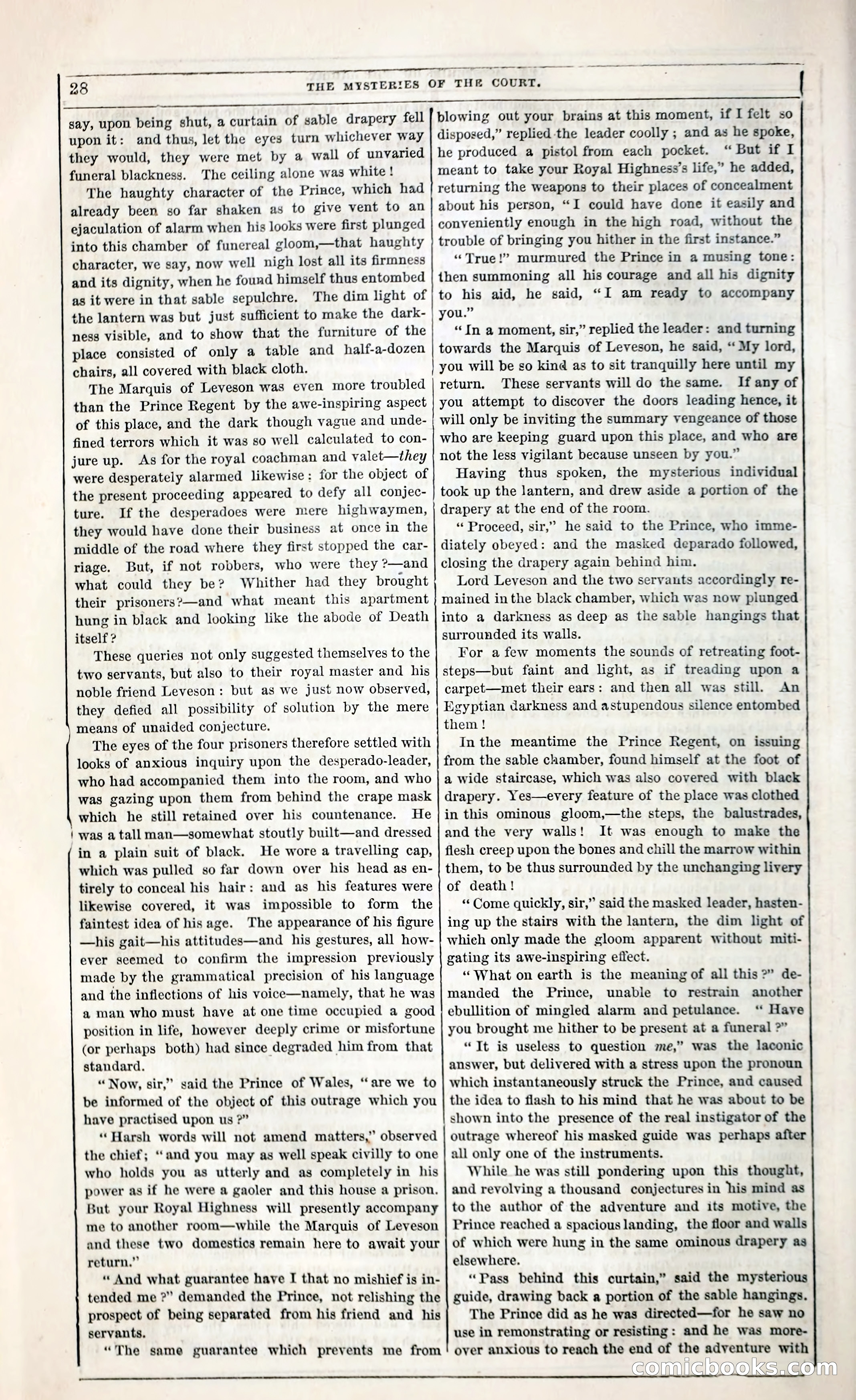
A restored page from Penny Dreadfuls, 1849. Page through the whole issue in the reader above.
📄 Transcribed text from this page (OCR, searchable)
Machine-transcribed from the original scan — historical spelling and the odd misread are preserved.
TT eT ee THE MYSTERIES OF THE COURT. ieee neg AA a a a me 28 say, upon being shut, a curtain of sable drapery fell upon it: and thus, let the eyes turn whichever way they would, they were met by a wall of unvaried funeral blackness. The ceiling alone was white! The haughty character of the Prince, which had already been so far shaken as to give vent to an ejaculation of alarm when his looks were first plunged into this chamber of funereal gloom,—that haughty character, we say, now well nigh lost all its firmness and its dignity, when he found himself thus entombed as it were in that sable sepulchre. The dim light of the lantern was but just sufficient to make the dark- ness visible, and to show that the furniture of the place consisted of only a table and half-a-dozen chairs, all covered with black cloth. The Marquis of Leveson was even more troubled than the Prince Regent by the awe-inspiring aspect of this place, and the dark though vague and unde- fined terrors which it was so well calculated to con- jure up. As for the royal coachman and valet—they were desperately alarmed likewise: for the object of the present proceeding appeared to defy all conjec- ture. If the desperadoes were mere highwaymen, they would have done their business at once in the middle of the road where they first stopped the car- riage. But, if not robbers, who were they ?—and what could they be? Whither had they brought their prisoners?—and what meant this apartment hung in black and looking like the abode of Death itself ? These queries not only suggested themselves to the two servants, but also to their royal master and his noble friend Leveson: but as we just now observed, they defied all possibility of solution by the mere means of unaided conjecture. The eyes of the four prisoners therefore settled with looks of anxious inquiry upon the desperado-leader, who had accompanied them into the room, and who was gazing upon them from behind the crape mask which he still retained over his countenance. He was a tall man—somewhat stoutly built—and dressed in a plain suit of black. He wore a travelling cap, which was pulled so far down over his head as en- tirely to conceal his hair: and as his features were likewise covered, it was impossible to form the faintest idea of his age. The appearance of his figure —his gait—his attitudes—and his gestures, all how- ever seemed to confirm the impression previously made by the grammatical precision of his language and the inflections of his voice—namely, that he was a man who must have at one time occupied a good position in life, however deeply crime or misfortune (or perhaps both) had since degraded him from that standard. “Now, sir,” said the Prince of Wales, “are we to be informed of the object of this outrage which you have practised upon us ?” “Harsh words will not amend matters,” observed the chief; ‘“‘and you may as well speak civilly to one who holds you as utterly and as completely in his power as if he were a gaoler and this house a prison. But your Royal Highness will presently accompany me to another room—while the Marquis of Leveson and these two domestics remain here to await your return,” “ And what guarantee have I that no mishief is in- tended me ?” demanded the Prince, not relishing the prospect of being separated from his friend and _ his servants, “The same guarantee which prevents me from -_——— blowing out your brains at this moment, if I felt so disposed,” replied the leader coolly ; and as he spoke, he produced a pistol from each pocket. “ But if I meant to take your Royal Highness’s life,” he added, returning the weapons to their places of concealment about his person, “I could have done it easily and conveniently enough in the high road, without the trouble of bringing you hither in the first instance.” “True!” murmured the Prince in a musing tone: then summoning all his courage and all his dignity to his aid, he said, “I am ready to accompany you.” “In a moment, sir,” replied the leader: and turning towards the Marquis of Leveson, he said, “‘ My lord, you will be so kind as to sit tranquilly here until my return. These servants will do the same. If any of you attempt to discover the doors leading hence, it will only be inviting the summary vengeance of those who are keeping guard upon this place, and who are not the less vigilant because unseen by you.” Having thus spoken, the mysterious individual took up the lantern, and drew aside a portion of the drapery at the end of the room. “Proceed, sir,” he said to the Prince, who imme- diately obeyed: and the masked deparado followed, closing the drapery again behind him. Lord Leveson and the two servauts accordingly re- mained inthe black chamber, which was now plunged into a darkness as deep as the sable hangings that surrounded its walls. For afew moments the sounds of retreating foot- steps—but faint and light, as if treading upon a carpet—met their ears: and then all was still. An Egyptian darkness and astupendous silence entombed them ! In the meantime the Prince Regent, on issuing from the sable chamber, found himself at the foot of a wide staircase, which was also covered with black drapery. Yes—every feature of the place was clothed in this ominous gloom,—the steps, the balustrades, and the very walls! It was enough to make the flesh creep upon the bones and chill the marrow within them, to be thus surrounded by the unchanging livery of death! “Come quickly, sir,” said the masked leader, hasten- ing up the stairs with the lantern, the dim light of which only made the gloom apparent without miti- gating its awe-inspiring effect. ‘What on earth is the meaning of all this ?” de- manded the Prince, unable to restrain another ebullition of mingled alarm and petulance. “ Have you brought me hither to be present at a funeral ?” “Tt is useless to question me,” was the laconic answer, but delivered with a stress upon the pronoun which instantaneously struck the Prince, and caused the idea to flash to his mind that he was about to be shown into the presence of the real instigator of the outrage whereof his masked guide was perhaps after all only one of the instruments. While he was still pondering upon this thought, and revolving a thousand conjectures in his mind as to the author of the adventure and its motive, the Prince reached a spacious landing, the floor and walls of which were hung in the same ominous drapery as elsewhere. “Pass behind this curtain,” said the mysterious guide, drawing back a portion of the sable hangings. The Prince did as he was directed—for he saw no use in remonstrating or resisting: and he was more- over anxious to reach the end of the adventure with ——— ad | GOMmIGvooOkK 0