
Penny Dreadfuls, 1849 · page 50 of 394
The Mysteries of the Court of London — page 50: what you’re looking at
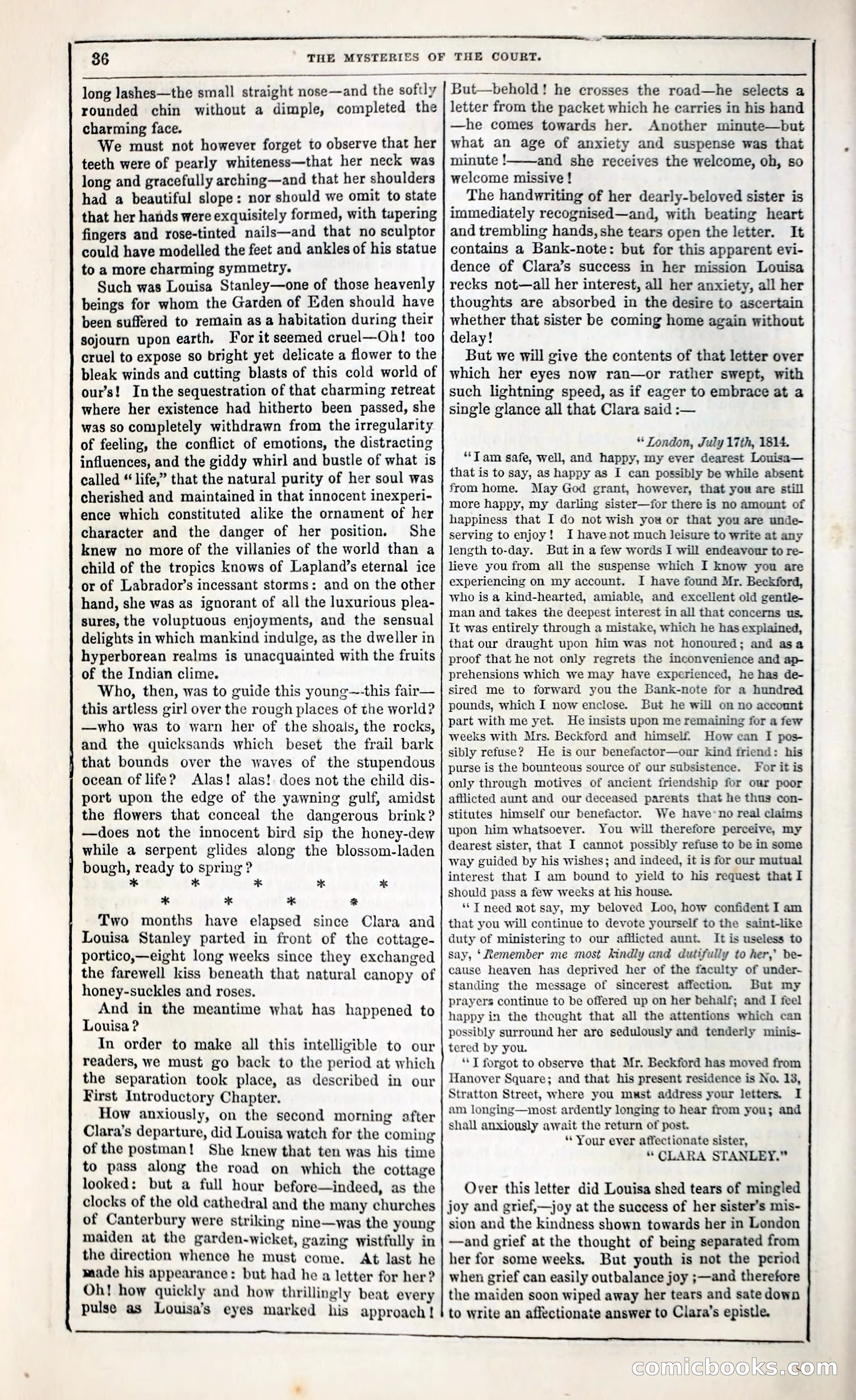
A restored page from Penny Dreadfuls, 1849. Page through the whole issue in the reader above.
📄 Transcribed text from this page (OCR, searchable)
Machine-transcribed from the original scan — historical spelling and the odd misread are preserved.
Neen eee a acca - THE MYSTERIES OF THE COURT. 36 long lashes—the small straight nose—and the softly rounded chin without a dimple, completed the charming face. We must not however forget to observe that her teeth were of pearly whiteness—that her neck was long and gracefully arching—and that her shoulders had a beautiful slope: nor should we omit to state that her hands were exquisitely formed, with tapering fingers and rose-tinted nails—and that no sculptor could have modelled the feet and ankles of his statue to a more charming symmetry. Such was Louisa Stanley—one of those heavenly beings for whom the Garden of Eden should have been suffered to remain as a habitation during their sojourn upon earth. For it seemed cruel—Oh! too cruel to expose so bright yet delicate a flower to the bleak winds and cutting blasts of this cold world of our’s! Inthe sequestration of that charming retreat where her existence had hitherto been passed, she was so completely withdrawn from the irregularity of feeling, the conflict of emotions, the distracting influences, and the giddy whirl and bustle of what is called “ life,” that the natural purity of her soul was cherished and maintained in that innocent inexperi- ence which constituted alike the ornament of her character and the danger of her position. She knew no more of the villanies of the world than a child of the tropics knows of Lapland’s eternal ice or of Labrador’s incessant storms: and on the other hand, she was as ignorant of all the luxurious plea- sures, the voluptuous enjoyments, and the sensual delights in which mankind indulge, as the dweller in hyperborean realms is unacquainted with the fruits of the Indian clime. Who, then, was to guide this young—-this fair— this artless girl over the rough places of the world? —who was to warn her of the shoals, the rocks, and the guicksands which beset the frail bark that bounds over the waves of the stupendous ocean of life? Alas! alas! does not the child dis- port upon the edge of the yawning gulf, amidst the flowers that conceal the dangerous brink? —does not the innocent bird sip the honey-dew while a serpent glides along the blossom-laden bough, ready to spring ? * * * *K * * * * * Two months have elapsed since Clara and Louisa Stanley parted in front of the cottage- portico,—eight long weeks since they exchanged the farewell kiss beneath that natural canopy of honey-suckles and roses. And in the meantime what has happened to Louisa ? In order to make all this intelligible to our readers, we must go back to the period at which the separation took place, as described in our First Introductory Chapter. How anxiously, on the second morning after Clara's departure, did Louisa watch for the coming of the postman! She knew that ten was his time to pass along the road on which the cottage looked: but a full hour before—indeed, as the clocks of the old cathedral and the many churches of Canterbury were striking nine—was the young maiden at the garden-wicket, gazing wistfully in the direction whence he must come. At last he made his appearance: but had he a letter for her? Oh! how quickly and how thrillingly beat every pulse as Louisa’s eyes marked his approach! SUE REEEEAn EEL a (Go) But—behold! he crosses the road—he selects a letter from the packet which he carries in his hand —he comes towards her. Another minute—but what an age of anxiety and suspense was that minute !——and she receives the welcome, ob, so welcome missive ! The handwriting of her dearly-beloved sister is immediately recognised—and, with beating heart and trembling hands, she tears open the letter. It contains a Bank-note: but for this apparent evi- dence of Clara’s success in her mission Louisa recks not—all her interest, all her anxiety, all her thoughts are absorbed in the desire to ascertain whether that sister be coming home again without delay! But we will give the contents of that letter over which her eyes now ran—or rather swept, with such lightning speed, as if eager to embrace at a single glance all that Clara said :— * London, July 17th, 1814. ‘*Tam safe, well, and happy, my ever dearest Louisa— that is to say, as happy as I can possibly be while absent from home. May God grant, however, that you are still more happy, my darling sister—for there is no amount of happiness that I do not wish you or that you are unde- serving to enjoy! I hayvenot much leisure to write at any length to-day. But in a few words I will endeavour to re- lieve you from all the suspense which I know you are experiencing on my account. I have found Mr. Beckford, who is a kind-hearted, amiable, and excellent old gentle- man and takes the deepest interest in all that concerns us. It was entirely through a mistake, which he has explained, that our draught upon him was not honoured; and asa proof that he not only regrets the inconvenience and ap- prehensions which we may have experienced, he has de- sired me to forward you the Bank-note for a hundred pounds, which I now enclose. But he will on no account part with me yet. He insists upon me remaining for a few weeks with Mrs. Beckford and himself. How can I pos- sibly refuse? He is our benefactor—our kind friend: his purse is the bounteous source of our subsistence. For itis only through motives of ancient friendship for our poor afflicted aunt and our deceased parents that he thus con- stitutes himself our benefactor. We have~no real claims upon him whatsoever. You will therefore perceive, my dearest sister, that I cannot possibly refuse to be in some way guided by his wishes; and indeed, it is for our mutual interest that I am bound to yield to his request that I should pass a few weeks at his house. ‘‘T need not say, my beloved Loo, how confident I am that you will continue to devote yourself to the saint-like duty of ministering to our afflicted aunt. It is useless to say, ‘Remember me most kindly and dutifully to her,’ be- cause heaven has deprived her of the faculty of under- standing the message of sincerest affection. But my prayers continue to be offered up on her behalf; and I feel happy in the thought that all the attentions which can possibly surround her are sedulously and tenderly minis- tered by you. ‘*T forgot to observe that Mr. Beckford has moved from Hanover Square; and that his present residence is No. 13, Stratton Street, where you must address your letters. I am longing—most ardently longing to hear from you; and shall anxiously await the return of post. ‘* Your ever affectionate sister, “ CLARA STANLEY.” Over this letter did Louisa shed tears of mingled joy and grief,—joy at the success of her sister’s mis- sion and the kindness shown towards her in London —and grief at the thought of being separated from her for some weeks. But youth is not the period when grief can easily outbalance joy ;—and therefore the maiden soon wiped away her tears and sate down to write an affectionate answer to Clara’s epistle. CONnNIELOOOKS