
Penny Dreadfuls, 1849 · page 52 of 394
The Mysteries of the Court of London — page 52: what you’re looking at
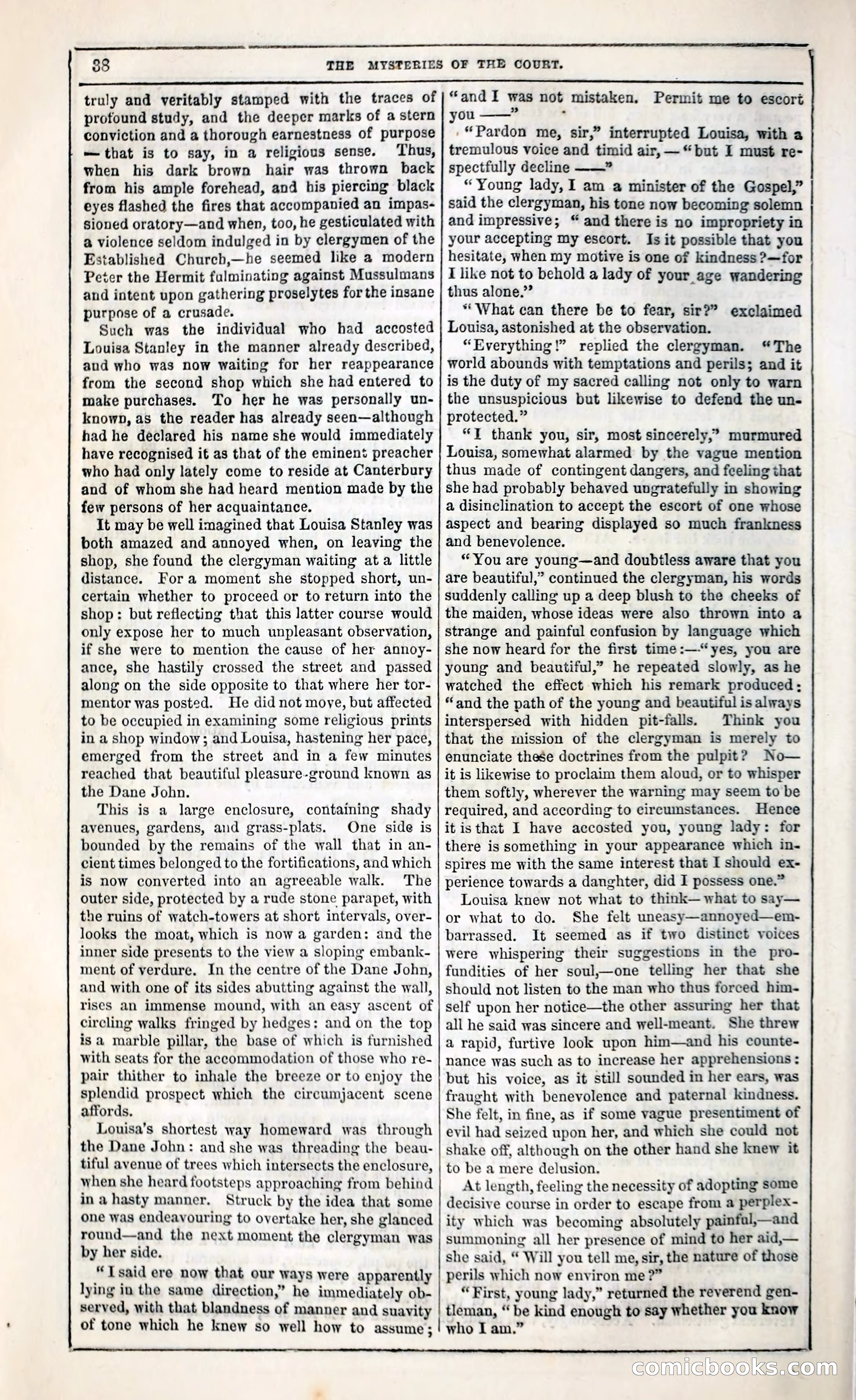
A restored page from Penny Dreadfuls, 1849. Page through the whole issue in the reader above.
📄 Transcribed text from this page (OCR, searchable)
Machine-transcribed from the original scan — historical spelling and the odd misread are preserved.
ET PRE Le 38 THE MYSTERIES OF THE COURT. truly and veritably stamped with the traces of profound study, and the deeper marks of a stern conviction and a thorough earnestness of purpose — that is to say, in a religious sense. Thus, when his dark brown hair was thrown back from his ample forehead, and his piercing black eyes flashed the fires that accompanied an impas- sioned oratory—and when, too, he gesticulated with a violence seldom indulged in by clergymen of the Established Church,—he seemed like a modern Peter the Hermit fulminating against Mussulmans and intent upon gathering proselytes for the insane purpose of a crusade. Such was the individual who had accosted Louisa Stanley in the manner already described, and who was now waiting for her reappearance from the second shop which she had entered to make purchases. To her he was personally un- known, as the reader has already seen—although had he declared his name she would immediately have recognised it as that of the eminent preacher who had only lately come to reside at Canterbury and of whom she had heard mention made by the few persons of her acquaintance. It may be well imagined that Louisa Stanley was both amazed and annoyed when, on leaving the shop, she found the clergyman waiting at a little distance. Fora moment she stopped short, un- certain whether to proceed or to return into the shop: but reflecting that this latter course would only expose her to much unpleasant observation, if she were to mention the cause of her annoy- ance, she hastily crossed the street and passed along on the side opposite to that where her tor- mentor was posted. He did not moye, but affected to be occupied in examining some religious prints in a shop window; and Louisa, hastening her pace, emerged from the street and in a few minutes reached that beautiful pleasure-ground known as the Dane John. This is a large enclosure, containing shady avenues, gardens, and grass-plats. One side is bounded by the remains of the wall that in an- cient times belonged to the fortifications, and which is now converted into an agreeable walk. The outer side, protected by a rude stone parapet, with the ruins of watch-towers at short intervals, over- looks the moat, which is now a garden: and the inner side presents to the view a sloping embank- ment of verdure. In the centre of the Dane John, and with one of its sides abutting against the wall, rises an immense mound, with an easy ascent of circling walks fringed by hedges: and on the top isa marble pillar, the base of which is furnished with seats for the accommodation of those who re- pair thither to inhale the breeze or to enjoy the splendid prospect which the circumjacent scene affords. Louisa’s shortest way homeward was through the Dane John: and she was threading the beau- tiful avenue of trees which intersects the enclosure, when she heard footsteps approaching from behind ina hasty manner. Struck by the idea that some one was endeavouring to overtake her, she glanced round—and the next moment the clergyman was by her side. “Tsaid ere now that our ways were apparently lying in the same direction,” he immediately ob- served, with that blandness of manner and suavity of tone which he knew so well how to assume 3 “and I was not mistaken. Permit me to escort ou ta - .“Pardon me, sir,” interrupted Louisa, with a tremulous voice and timid air, —“ but I must re- spectfully decline —_—” “Young lady, I am a minister of the Gospel,” said the clergyman, his tone now becoming solemn and impressive; “ and there is no impropriety in your accepting my escort. Is it possible that you hesitate, when my motive is one of kindness ?—for I like not to behold a lady of your age wandering thus alone.”’ ** What can there be to fear, sir?” exclaimed Louisa, astonished at the observation. “Everything!” replied the clergyman. “The world abounds with temptations and perils; and it is the duty of my sacred calling not only to warn the unsuspicious but likewise to defend the un- protected.” “¥ thank you, sir, most sincerely,? murmured Louisa, somewhat alarmed by the vague mention thus made of contingent dangers, and feeling that she had probably behaved ungratefully in showing a disinclination to accept the escort of one whose aspect and bearing displayed so much frankness and benevolence. “You are young—and doubtless aware that you are beautiful,” continued the clergyman, his words suddenly calling up a deep blush to the cheeks of the maiden, whose ideas were also thrown into a strange and painful confusion by language which she now heard for the first time:—-“ yes, you are young and beautiful,” he repeated slowly, as he watched the effect which his remark produced; “and the path of the young and beautiful is always interspersed with hidden pit-falls. Think you that the mission of the clergyman is merely to enunciate these doctrines from the pulpit? No— it is likewise to proclaim them aloud, or to whisper them softly, wherever the warning may seem to be required, and according to circumstances. Hence it isthat I have accosted you, young lady: for there is something in your appearance which in- spires me with the same interest that I should ex- perience towards a danghter, did I possess one.” Louisa knew not what to think— what to say— or what to do. She felt uneasy—annoyed—em- barrassed. It seemed as if two distinet voices were whispering their suggestions in the pro- fundities of her soul,—one telling her that she should not listen to the man who thus forced him- self upon her notice—the other assuring her that all he said was sincere and well-meant. She threw a rapid, furtive look upon him—and his counte- nance was such as to increase her apprehensions : but his voice, as it still sounded im her ears, was fraught with benevolence and paternal kindness. She felt, in fine, as if some vague presentiment of evil had seized upon her, and which she could not shake off, although on the other hand she knew it to be a mere delusion, At length, feeling the necessity of adopting some decisive course in order to escape from a perplex- ity which was becoming absolutely painful,—and summoning all her presence of mind to her aid,— she said, “ Will you tell me, sir, the nature of those perils which now environ me ?” “First, young lady,” returned the reverend gen- tleman, “ be kind enough to say whether you know who I am.” MICLOOKS (E(0) (C©)