
Penny Dreadfuls, 1849 · page 57 of 394
The Mysteries of the Court of London — page 57: what you’re looking at
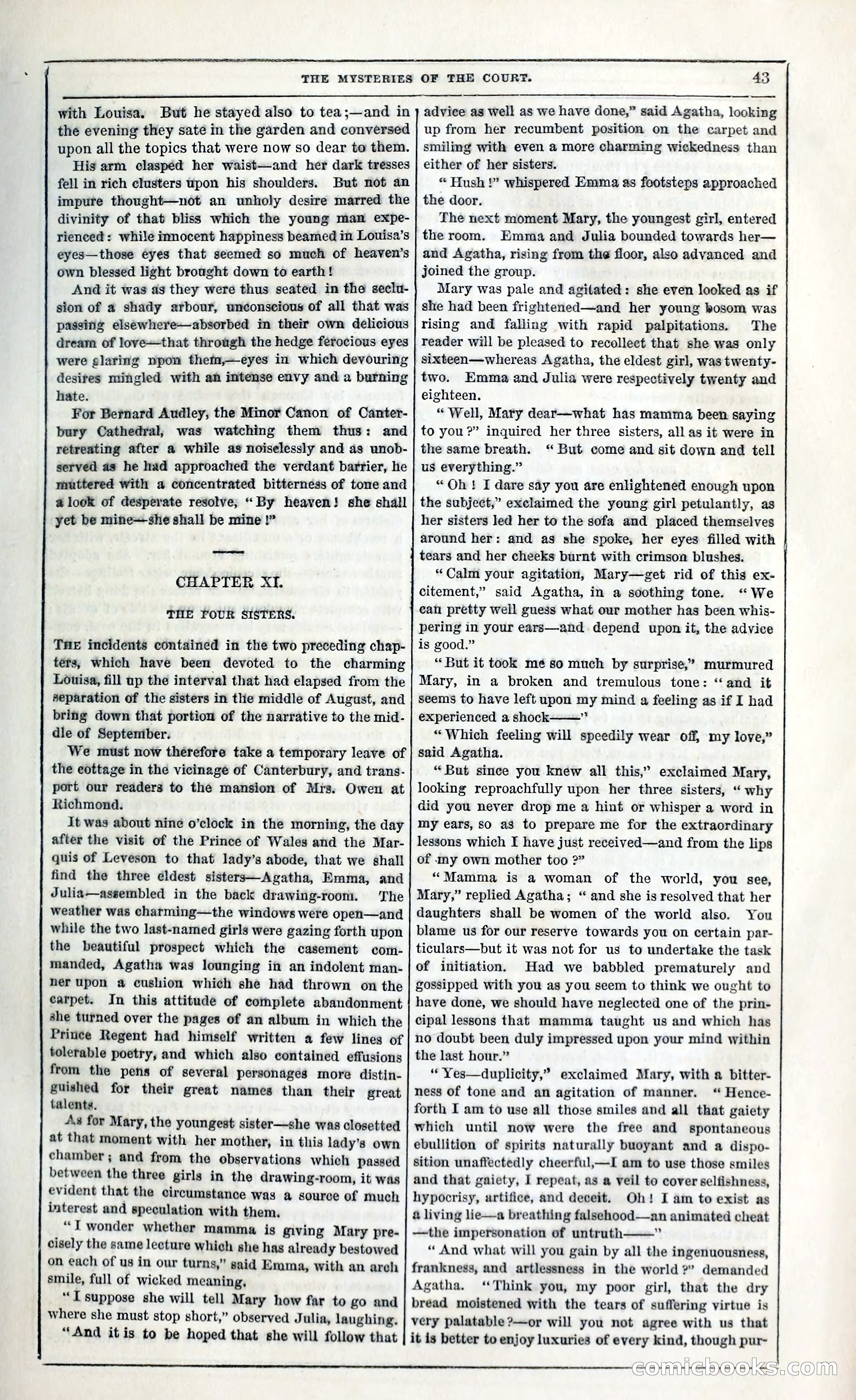
A restored page from Penny Dreadfuls, 1849. Page through the whole issue in the reader above.
📄 Transcribed text from this page (OCR, searchable)
Machine-transcribed from the original scan — historical spelling and the odd misread are preserved.
THE MYSTERIES OF THE COURT. with Louisa. But he stayed also to tea;—and in the evening they sate in the garden and conversed upon all the topics that were now so dear to them. His arm clasped her waist—and her dark tresses fell in rich clusters upon his shoulders. own blessed light brought down to earth! And it was as they were thus seated in the seclu- sion of a shady arbour, unconscious of all that was passing elsewhere—absorbed im their own delicious dream of love—that through the hedge ferocious eyes were glaring npon them,—eyes in which devouring desires mingled with an mtense envy and a burning hate. For Bernard Audley, the Mimor Canon of Canter- bury Cathedral, was watching them thus: and retreating after a while as noiselessly and as unob- served as he had approached the verdant barrier, he muttered with a concentrated bitterness of tone and a look of desperate resolve, “By heaven! she shall yet be mineshe shall be mine !” CHAPTER XI. THE FOUR SISTERS. THE incidents contained in the two preceding chap- ters, which have been devoted to the charming Louisa, fill up the interval that had elapsed from the separation of the sisters in the middle of August, and bring down that portion of the narrative to the mid- dle of September. We must now therefore take a temporary leave of the eottage in the vicinage of Canterbury, and trans- port our readers to the mansion of Mrs. Owen at Richmond. It was about nine o’clock in the morning, the day after the visit of the Prince of Wales and the Mar- quis of Leveson to that lady’s abode, that we shall find the three eldest sisters—Agatha, Emma, and Julia—assembled in the back drawing-room. the beautiful prospect which the casement com- manded, Agatha was lounging in an indolent man- hnerupon a cushion which she had thrown on the carpet. In this attitude of complete abandonment she turned over the pages of an album in which the Prince Regent had himself written a few lines of tolerable poetry, and which also contained effusions from the pens of several personages more distin- guished for their great names than their great talents. As for Mary, the youngest sister—she was closetted at that moment with her mother, in this lady’s own chamber; and from the observations which passed between the three girls in the drawing-room, it was evident that the circumstance was a source of much interest and speculation with them, ““T wonder whether mamma is giving Mary pre- cisely the same lecture which she has alread y bestowed on each of us in our turns,” gaid Emma, with an arch smile, full of wicked meaning, “I suppose she will tell Mary how far to go and where she must stop short,” observed J ulia, laughing. “And itis to be hoped that she will follow that DA eR ence 8) HAHKA SK EXE But not an impure thought—not an wnholy desire marred the divinity of that bliss which the young man expe- rienced: while innocent happiness beamed in Louisa’s eyes—those eyes that seemed so much of heaven’s The weather was charming—the windows were open—and while the two last-named girls were gazing forth upon 43 advice as well as we have done,” said Agatha, looking up from her recumbent position on the carpet and smiling with even a more charming wickedness than either of her sisters. “ Hush !” whispered Emma as footsteps approached the door. The next moment Mary, the youngest girl, entered the room. Emma and Julia bounded towards her— and Agatha, rising from the floor, also advanced and joined the group. Mary was pale and agitated: she even looked as if she had been frightened—and her young bosom was rising and falling with rapid palpitations. The reader will be pleased to recolleet that she was only sixteen—whereas Agatha, the eldest girl, was twenty- two. Emma and Julia were respectively twenty and eighteen. “ Well, Mary dear—what has mamma been saying to you >” inquired her three sisters, all as it were in the same breath. ‘“ But come and sit down and tell us everything.” “Oh ! I dare say you are enlightened enough upon the subject,” exclaimed the young girl petulantly, as her sisters led her to the sofa and placed themselves around her: and as she spoke, her eyes filled with tears and her cheeks burnt with crimson blushes. “Calm your agitation, Mary—get rid of this ex- citement,” said Agatha, in a soothing tone. “We can pretty well guess what our mother has been whis- pering in your ears—and depend upon it, the advice is good.” “But it took meé so much by surprise,” murmured Mary, in a broken and tremulous tone: ‘and it seems to have left upon my mind a feeling as if I had experienced a shock——” “Which feeling will speedily wear off, my love,” said Agatha. “But since you knew all this,” exclaimed Mary, looking reproachfully upon her three sisters, “ why did you never drop me a hint or whisper a word in my ears, so as to prepare me for the extraordinary lessons which I have just received—and from the lips of my own mother too 2” “Mamma is a woman of the world, you see, Mary,” replied Agatha; “ and she is resolved that her daughters shall be women of the world also. You blame us for our reserve towards you on certain par- ticulars—but it was not for us to undertake the task of initiation. Had we babbled prematurely and gossipped with you as you seem to think we ought to have done, we should have neglected one of the prin- cipal lessons that mamma taught us and which has no doubt been duly impressed upon your mind within the last hour.” “* Yes—duplicity,” exclaimed Mary, with a bitter- ness of tone and an agitation of manner. “ Hence- forth I am to use all those smiles and all that gaiety which until now were the free and spontaneous ebullition of spirits naturally buoyant and a dispo- sition unafifectedly cheerful,—I am to use those smiles and that gaiety, I repeat, as a veil to cover selfishness, hypocrisy, artifice, and deceit. Oh! I am to exist as a living lie—a breathing falsehood—an animated cheat —the impersonation of untruth——” “And what will you gain by all the ingenuousness, frankness, and artlessness in the world ?” demanded Agatha. ‘Think you, my poor girl, that the dry bread moistened with the tears of suffering virtue is very palatable ?—or will you not agree with us that it is better to enjoy luxuries of every kind, though pur- <S) (©)