
Penny Dreadfuls, 1849 · page 62 of 394
The Mysteries of the Court of London — page 62: what you’re looking at
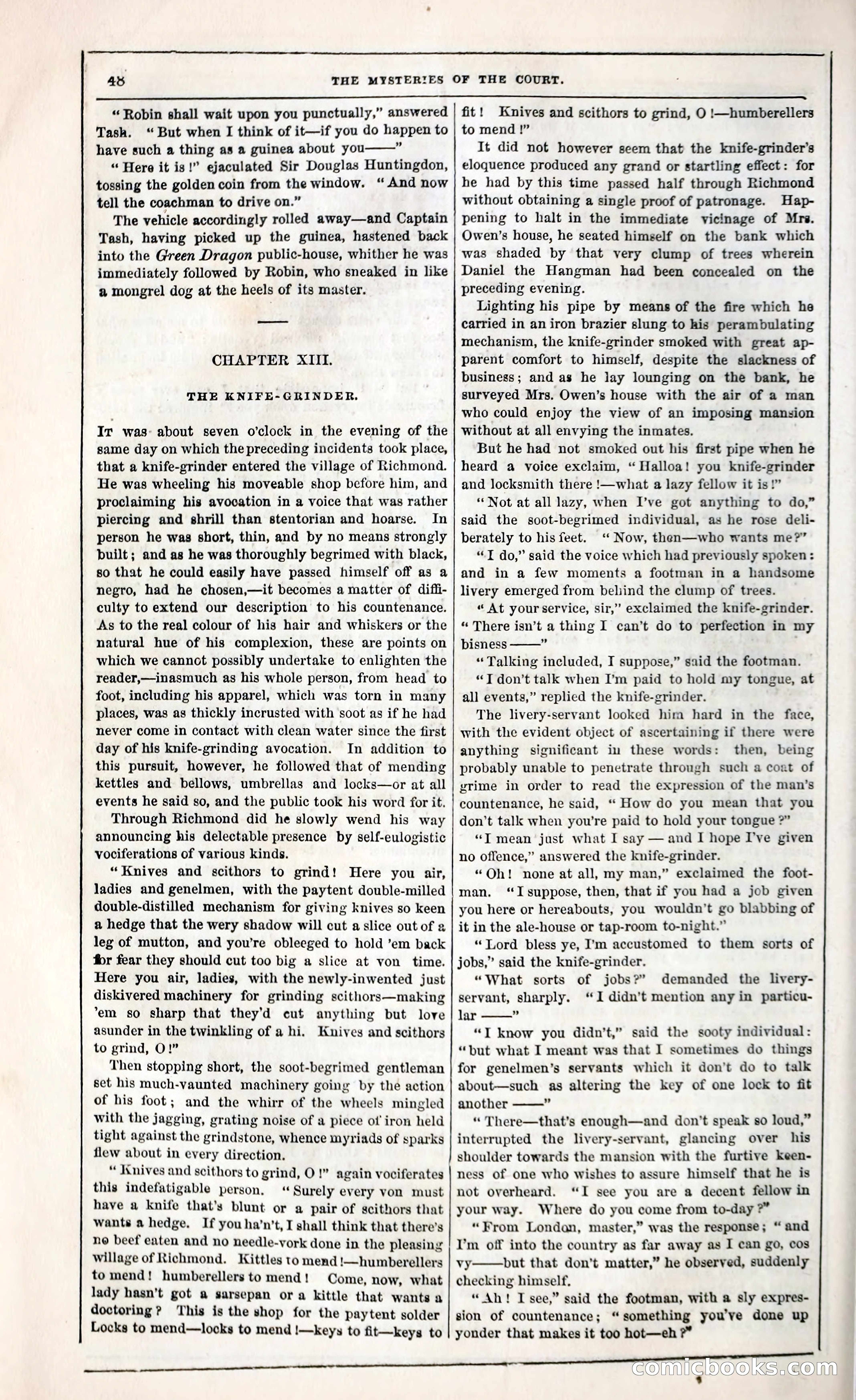
A restored page from Penny Dreadfuls, 1849. Page through the whole issue in the reader above.
📄 Transcribed text from this page (OCR, searchable)
Machine-transcribed from the original scan — historical spelling and the odd misread are preserved.
AB THE MYSTERIES OF THE COURT. “ Robin shall wait upon you punctually,” answered Tash. ‘“ But when I think of it—if you do happen to have such a thing as a guinea about you 4 “ Here it is!” ejaculated Sir Douglas Huntingdon, tossing the golden coin from the window. “And now tell the coachman to drive on.” The vehicle accordingly rolled away—and Captain Tash, having picked up the guinea, hastened back into the Green Dragon public-house, whither he was immediately followed by Robin, who sneaked in like a mongrel dog at the heels of its master. — CHAPTER XIII. THE KNIFE-GRINDER. Ir was- about seven o’clock in the evening of the same day on which the preceding incidents took place, that a knife-grinder entered the village of Richmond. He was wheeling his moveable shop before him, and proclaiming his avocation in a voice that was rather piercing and shrill than stentorian and hoarse. In person he was short, thin, and by no means strongly built; and as he was thoroughly begrimed with black, so that he could easily have passed himself off as a negro, had he chosen,—it becomes a matter of diffi- culty to extend our description to his countenance. As to the real colour of his hair and whiskers or the natural hue of his complexion, these are points on which we cannot possibly undertake to enlighten the reader,—inasmuch as his whole person, from head to foot, including his apparel, which was torn in many places, was as thickly incrusted with soot as if he had never come in contact with clean water since the first day of his knife-grinding avocation. In addition to this pursuit, however, he followed that of mending kettles and bellows, umbrellas and locks—or at all events he said so, and the public took his word for it. Through Richmond did he slowly wend his way announcing his delectable presence by self-eulogistic vociferations of various kinds. “Knives and scithors to grind! Here you air, ladies and genelmen, with the paytent double-milled double-distilled mechanism for giving knives so keen a hedge that the wery shadow will cut a slice out of 2 leg of mutton, and you're obleeged to hold ’em back for fear they should cut too big a slice at von time. Here you air, ladies, with the newly-inwented just diskivered machinery for grinding scithors—making "em so sharp that they’d cut anything but love asunder in the twinkling of a hi. Knives and scithors to grind, O!” Then stopping short, the soot-begrimed gentleman set his much-vaunted machinery going by the action of his foot; and the whirr of the wheels mingled with the jagging, grating noise of a piece of’ iron held tight against the grindstone, whence myriads of sparks flew about in every direction. “ Knives and scithors to grind, O!” again vociferates this indefatigable person. “ Surely every von must have a knife that’s blunt or a pair of scithors that wants a hedge. If you ha’n’t, I shall think that there’s no beef eaten and no needle-vork done in the pleasing willage of Richmond. Kittles to mend !—humberellers to mend! humberellers to mend! Come, now, what lady hasn’t got a sarsepan ora kittle that wants a doctoring ? This is the shop for the paytent solder Locks to mend—locks to mend !—keys to fit—keys to fit! Knives and scithors to grind, O !—humberellers to mend !” It did not however seem that the knife-grinder’s eloquence produced any grand or startling effect: for he had by this time passed half through Richmond without obtaining a single proof of patronage. Hap- pening to halt in the immediate vicinage of Mrs. Owen’s house, he seated himself on the bank which was shaded by that very clump of trees wherein Daniel the Hangman had been concealed on the preceding evening. Lighting his pipe by means of the fire which he carried in an iron brazier slung to his perambulating mechanism, the knife-grinder smoked with great ap- parent comfort to himself, despite the slackness of business; and as he lay lounging on the bank, he surveyed Mrs. Owen’s house with the air of a man who could enjoy the view of an imposing mansion without at all envying the inmates. But he had not smoked out his first pipe when he heard a voice exclaim, “ Halloa! you knife-grinder and locksmith there !—what a lazy fellow it is!” ‘Not at all lazy, when I’ve got anything to do,” said the soot-begrimed individual, as he rose deli- berately to his feet. ‘‘ Now, then—who wants me?” “T do,” said the voice which had previously spoken: and in a few moments a footman in a handsome livery emerged from beliind the clump of trees. « At your service, sir,” exclaimed the knife-grinder. “ There isn’t a thing I can’t do to perfection in my bisness ; “Talking included, I suppose,” said the footman. “T don’t talk when I’m paid to hold my tongue, at all events,” replied the knife-grinder. The livery-servant looked him hard in the face, with the evident object of ascertaining if there were anything significant in these words: then, being probably unable to penetrate through such a coat of vrime in order to read the expression of the man’s countenance, he said, “How do you mean that you don’t talk when you’re paid to hold your tongue ?” “T mean just what I say — and I hope I’ve given no offence,” answered the knife-grinder. “Oh! none at all, my man,” exclaimed the foot- man. “Isuppose, then, that if you had a job given you here or hereabouts, you wouldn’t go blabbing of it in the ale-house or tap-room to-night.” “Lord bless ye, I’m accustomed to them sorts of jobs,” said the knife-grinder. “What sorts of jobs?” demanded the livery- servant, sharply. ‘1 didn’t mention any in particu- lar , “T know you didn’t,” said the sooty individual: “but what I meant was that I sometimes do things for genelmen’s servants which it don’t do to talk about—such as altering the key of one lock to fit another rs “ There—that’s enough—and don’t speak so loud,” interrupted the livery-servant, glancing over his shoulder towards the mansion with the furtive keen- ness of one who wishes to assure himself that he is not overheard. “I see you are a decent fellow in your way. Where do you come from to-day ?” “From Londan, master,” was the response; “ and I’m off into the country as far away as I can go, cos vy but that don’t matter,” he observed, suddenly checking himself, “Ah! I see,” said the footman, with a sly expres- sion of countenance; “something you've done up yonder that makes it too hot—eh ?” COMMUC MOOK 5(E@) |