
Penny Dreadfuls, 1849 · page 68 of 394
The Mysteries of the Court of London — page 68: what you’re looking at
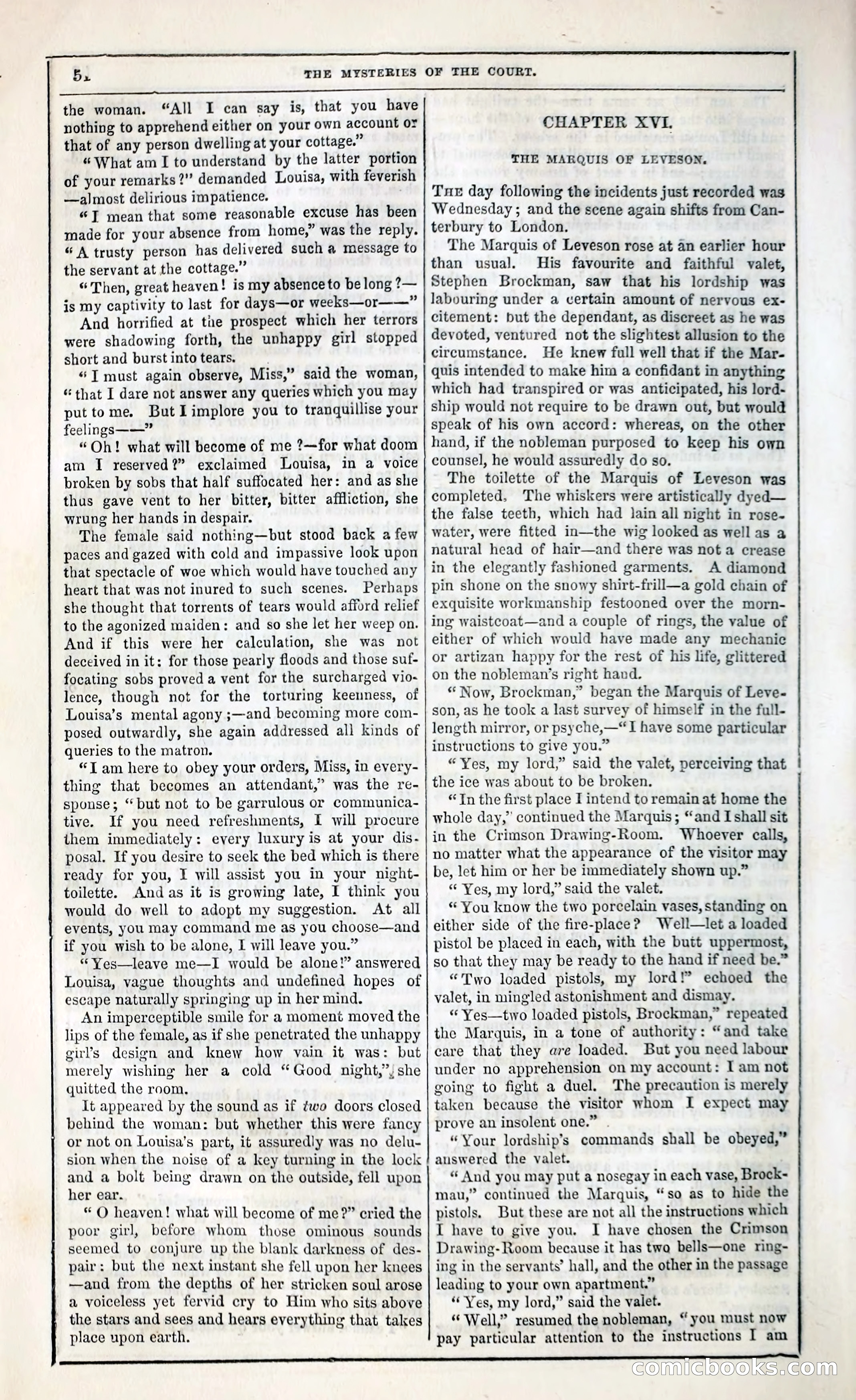
A restored page from Penny Dreadfuls, 1849. Page through the whole issue in the reader above.
📄 Transcribed text from this page (OCR, searchable)
Machine-transcribed from the original scan — historical spelling and the odd misread are preserved.
——— ied 5s THE MYSTERIES OF THE COURT. Tee ee Ee ee the woman. “All I can say is, that you have nothing to apprehend either on your own account or that of any person dwelling at your cottage.” “ What am I to understand by the latter portion of your remarks?” demanded Louisa, with feverish —al]most delirious impatience. “J mean that some reasonable excuse has been made for your absence from home,” was the reply. “ A trusty person has delivered such a message to the servant at the cottage.” “Then, great heaven! is my absenceto be long ?— is my captivity to last for days—or weeks—or——” And horrified at tue prospect which her terrors were shadowing forth, the unhappy girl stopped short and burst into tears. , «TJ must again observe, Miss,” said the woman, ¢ that I dare not answer any queries which you may put tome. ButLimplore you to tranquillise your feelings——” “Oh! what will become of me ?—for what doom am I reserved?” exclaimed Louisa, in a voice broken by sobs that half suffocated her: and as she thus gave vent to her bitter, bitter affliction, she wrung her hands in despair. The female said nothing—but stood back a few paces and gazed with cold and impassive look upon that spectacle of woe which would have touched any heart that was not inured to such scenes. Perhaps she thought that torrents of tears would afford relief to the agonized maiden: and so she let her weep on. And if this were her calculation, she was not deceived in it: for those pearly floods and those suf- focating sobs proved a vent for the surcharged vio- lence, though not for the torturing keenness, of Louisa’s mental agony ;—and becoming more com- posed outwardly, she again addressed all kinds of queries to the matron. “Tam here to obey your orders, Miss, in every- thing that becomes an attendant,” was the re- sponse; “ but not to be garrulous or communica- tive. If you need refreshments, I will procure them immediately: every luxury is at your dis- posal. If you desire to seek the bed which is there ready for you, I will assist you in your night- toilette. Andas it is growing late, I think you would do well to adopt my suggestion. At all events, you may command me as you choose—and if you wish to be alone, I will leave you.” “Yes—leave me—I would be alone!” answered Louisa, vague thoughts and undefined hopes of escape naturally springing up in her mind. An imperceptible smile for a moment moved the lips of the female, as if she penetrated the unhappy girl’s design and knew how vain it was: but merely wishing her a cold “Good night,”’, she quitted the room, It appeared by the sound as if two doors closed behind the woman: but whether this were fancy or not on Louisa’s part, it assuredly was no delu- sion when the noise of a key turning in the lock and a bolt being drawn on the outside, fell upon her ear. * O heaven! what will become of me?” cried the poor girl, before whom those ominous sounds seemed to conjure up the blank darkness of des- pair: but the next instant she fell upon her knees —and from the depths of her stricken soul arose a voiceless yet fervyid ery to Him who sits above _ the stars and sees and hears everything that takes place upon earth. CHAPTER XVI. THE MARQUIS OF LEVESON. Tne day following the incidents just recorded was Wednesday; and the scene again shifts from Can- terbury to London. The Marquis of Leveson rose at an earlier hour than usual. His favourite and faithful valet, Stephen Brockman, saw that his lordship was labouring under a certain amount of nervous ex- citement: but the dependant, as discreet as he was devoted, ventured not the slightest allusion to the circumstance. He knew full well that if the Mar- quis intended to make him a confidant in anything which had transpired or was anticipated, his lord- ship would not require to be drawn out, but would speak of his own accord: whereas, on the other hand, if the nobleman purposed to keep his own counsel, he would assuredly do so. The toilette of the Marquis of Leveson was completed, The whiskers were artistically dyed— the false teeth, which had jain all night in rose- water, were fitted in—the wig looked as well as a natural head of hair—and there was not a crease in the elegantly fashioned garments. A diamond pin shone on the snowy shirt-frill—a gold chain of exquisite workmanship festooned over the morn- ing waistcoat—and a couple of rings, the value of either of which would have made any mechanic or artizan happy for the rest of his life, glittered on the nobleman’s right hand. “ Now, Brockman,” began the Marquis of Leve- son, as he took a last survey of himself in the full- length mirror, or psyche,—“ I have some particular instructions to give you.” “Yes, my lord,” said the valet, perceiving that the ice was about to be broken. “Tn the first place I intend to remain at home the whole day,” continued the Marquis; “and I shall sit in the Crimson Drawing-Room. Whoever calls, no matter what the appearance of the visitor may be, let him or her be immediately shown up.” “ Yes, my lord,” said the valet. * You know the two porcelain vases, standing on either side of the fire-place? Well—let a loaded pistol be placed in each, with the butt uppermost, so that they may be ready to the hand if need be.” “Two loaded pistols, my lord!” echoed the valet, in mingled astonishment and dismay. « Yes—two loaded pistols, Brockman,” repeated the Marquis, in a tone of authority: “and take care that they are loaded. But you need labour under no apprehension on my account: I am not going to fight a duel. The precaution is merely taken because the visitor whom I expect may prove an insolent one.” . “Your lordship’s commands shall be obeyed,” auswered the valet. “ And you may put a nosegay in each vase, Brock- mau,” continued the Marquis, “so as to hide the pistols. But these are not all the instructions which I have to give you. I have chosen the Crimson Drawing- Room because it has two bells—one ring- ing in the servants’ hall, and the other in the passage leading to your own apartment.” “Yes, my lord,” said the valet. « Well,” resumed the nobleman, “ you must now pay particular attention to the instructions I am CONMUCIOOMKS (E(0)