
Penny Dreadfuls, 1849 · page 70 of 394
The Mysteries of the Court of London — page 70: what you’re looking at
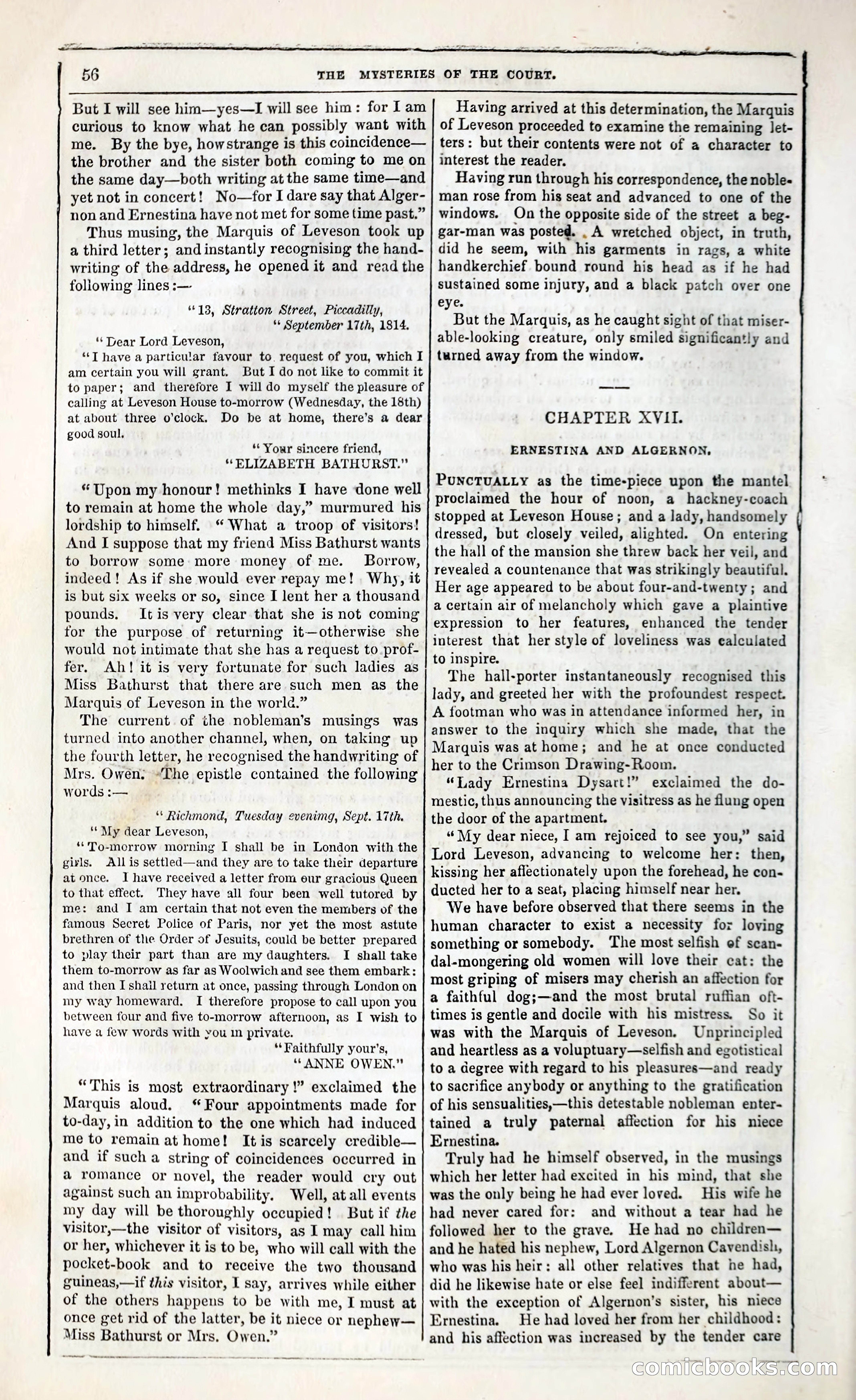
A restored page from Penny Dreadfuls, 1849. Page through the whole issue in the reader above.
📄 Transcribed text from this page (OCR, searchable)
Machine-transcribed from the original scan — historical spelling and the odd misread are preserved.
56 THE MYSTERIES OF THE COURT. But I will see him—yes—I will see him: for I am curious to know what he can possibly want with me. By the bye, howstrange is this coincidence— the brother and the sister both coming to me on the same day—both writing at the same time—and yet not in concert! No—for I dare say that Alger- non and Ernestina have not met for some time past.” Thus musing, the Marquis of Leveson took up a third letter; andinstantly recognising the hand- writing of the address, he opened it and read the following lines :—- 13, Stratton Street, Piccadilly, ** September 17th, 1814. ‘‘ Dear Lord Leveson, ‘‘T have a particular favour to. request of you, which I am certain you will grant. But I do not like to commit it to paper; and therefore I willdo myself the pleasure of calling at Leveson House to-morrow (Wednesday, the 18th) at about three o'clock. Do be at home, there’s a dear good soul. ‘Your sincere friend, * ELIZABETH BATHURST.” * Upon my honour! methinks I have done well to remain at home the whole day,” murmured his lordship to himself. “ What a troop of visitors! And I suppose that my friend Miss Bathurst wants to borrow some: more money of me. Borrow, indeed! As if she would ever repay me! Why, it is but six weeks or so, since I lent her a thousand pounds. Itis very clear that she is not coming for the purpose of returning it—otherwise she would not intimate that she has a request to prof- fer. Ah! it is very fortunate for such ladies as Miss Bathurst that there are such men as the Marquis of Leveson in the world.” The current of the nobleman’s musings was turned into another channel, when, on taking up the fourth letter, he recognised the handwriting of Mrs. Owen: The epistle contained the following words :— ‘** Richmond, Tuesday evenimg, Sept. 17th. ‘* My dear Leveson, “To-morrow morning I shall be in London with the girls. Allis settled—and they are to take their departure at once. I have received a letter from eur gracious Queen to that effect. They have all four been well tutored by me: and I am certain that not even the members of the famous Secret Police of Paris, nor yet the most astute brethren of the Order of Jesuits, could be better prepared to play their part than are my daughters. I shall take them to-morrow as far as Woolwich and see them embark: and then I shail return at once, passing through London on my way homeward. I therefore propose to call upon you between four and five to-morrow afternoon, as I wish to have a few words with you 1m private. “Faithfully your's, ‘*ANNE OWEN.” “This is most extraordinary !” exclaimed the Marquis aloud. Four appointments made for to-day, in addition to the one which had induced me to remain at home! Itis scarcely credible— and if such a string of coincidences occurred in a romance or novel, the reader would cry out against such an improbability. Well, at all events my day will be thoroughly occupied! But if the visitor,—the visitor of visitors, as I may call him or her, whichever it is to be, who will call with the pocket-book and to receive the two thousand guineas,—if this visitor, I say, arrives while either of the others happens to be with me, I must at once get rid of the latter, be it niece or nephew— Miss Bathurst or Mrs, Owen.” Se ee eee. oe - — - Having arrived at this determination, the Marquis of Leveson proceeded to examine the remaining let- ters: but their contents were not of a character to interest the reader. Having run through his correspondence, the noble- man rose from his seat and advanced to one of the windows. On the opposite side of the street a beg- gar-man was posted. . A wretched object, in truth, did he seem, with his garments in rags, a white handkerchief bound round his head as if he had sustained some injury, and a black patch over one eye. But the Marquis, as he caught sight of that miser- able-looking creature, only smiled significantly and turned away from the window. CHAPTER XVII. ERNESTINA AND ALGERNON, PUNCTUALLY as the time-piece upon the mantel proclaimed the hour of noon, a hackney-coach stopped at Leveson House; and a lady, handsomely dressed, but closely veiled, alighted. On entering the hall of the mansion she threw back her veil, and revealed a countenance that was strikingly beautiful. Her age appeared to be about four-and-twenty; and a certain air of melancholy which gave a plaintive expression to her features, enhanced the tender interest that her style of loveliness was calculated to inspire. The hall-porter instantaneously recognised this lady, and greeted her with the profoundest respect. A footman who was in attendance informed her, in answer to the inquiry which she made, that the Marquis was at home; and he at once conducted her to the Crimson Drawing-Room. “Lady Ernestina Dysart!” exclaimed the do- mestic, thus announcing the visitress as he flung open the door of the apartment. “My dear niece, I am rejoiced to see you,” said Lord Leveson, advancing to welcome her: then, kissing her aflectionately upon the forehead, he con- ducted her to a seat, placing himself near her, We have before observed that there seems in the human character to exist a necessity for loving something or somebody. ‘The most selfish ef scan- dal-mongering old women will love their cat: the most griping of misers may cherish an affection for a faithful dog;—and the most brutal ruffian oft- times is gentle and docile with his mistress. So it was with the Marquis of Leveson. Unprincipled and heartless as a voluptuary—selfish and egotistical to a degree with regard to his pleasures—and ready to sacrifice anybody or anything to the gratification of his sensualities,—this detestable nobleman enter- tained a truly paternal affection for his niece Ernestina. Truly had he himself observed, in the musings which her letter had excited in his mind, that she was the only being he had ever loved. His wife he had never cared for: and without a tear had he followed her to the grave. He had no children— and he hated his nephew, Lord Algernon Cavendish, who was his heir: all other relatives that he had, did he likewise hate or else feel indifferent about— with the exception of Algernon’s sister, his niece Ernestina. He had loved her from her childhood: and his affection was increased by the tender care COMM§|CEDOOKSSCOM