
Penny Dreadfuls, 1849 · page 75 of 394
The Mysteries of the Court of London — page 75: what you’re looking at
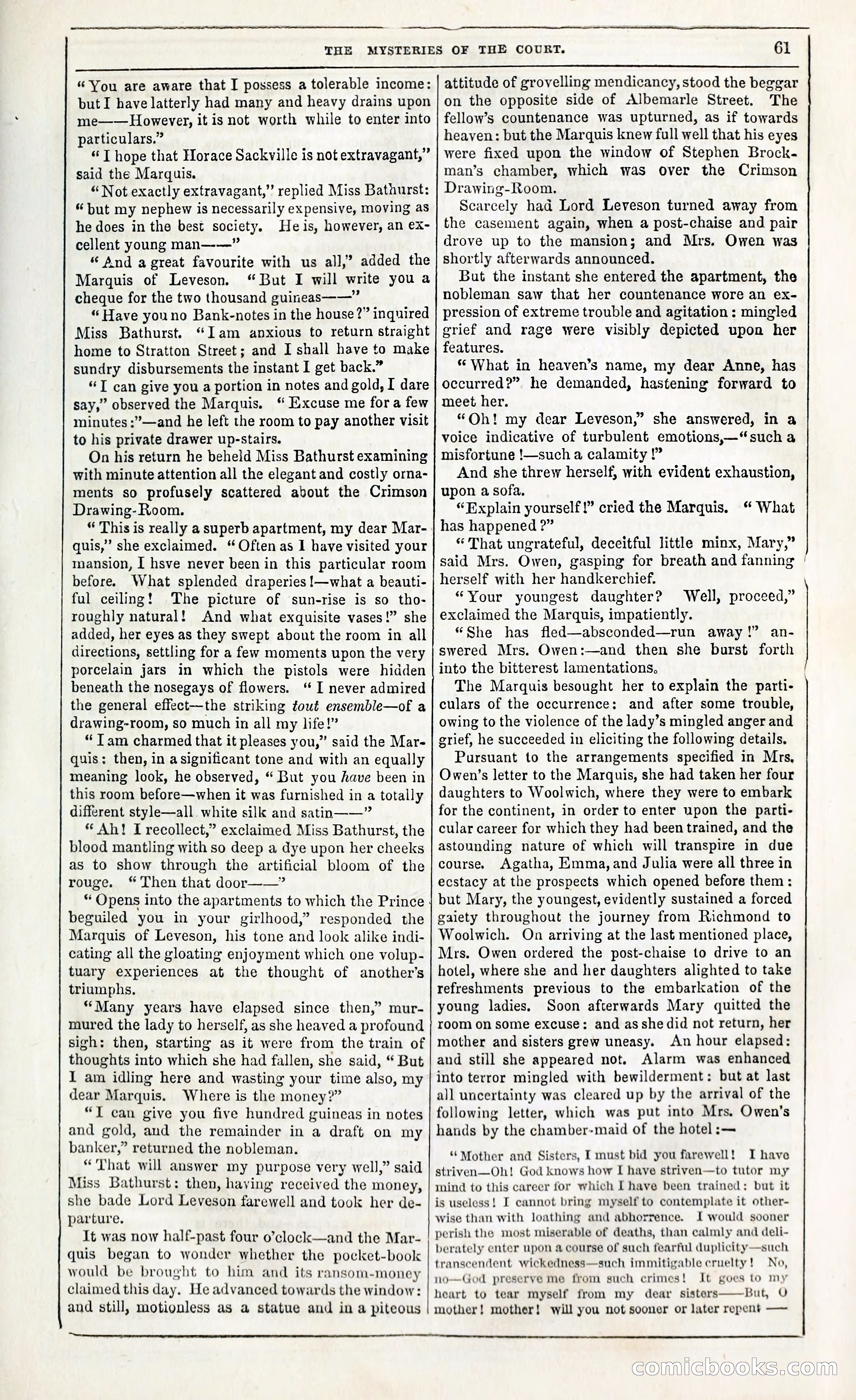
A restored page from Penny Dreadfuls, 1849. Page through the whole issue in the reader above.
📄 Transcribed text from this page (OCR, searchable)
Machine-transcribed from the original scan — historical spelling and the odd misread are preserved.
THE MYSTERIES OF THE COURT. 61 “You are aware that I possess a tolerable income: but I have latterly had many and heavy drains upon me—— However, it is not worth while to enter into particulars.” “T hope that Horace Sackville is not extravagant,” said the Marquis. “ Not exactly extravagant,” replied Miss Bathurst: “ but my nephew is necessarily expensive, moving as he does in the best society. Heis, however, an ex- cellent young man——” “ And a great favourite with us all,’ added the Marquis of Leveson. “But I will write you a cheque for the two thousand guineas——” “ Have youno Bank-notes in the house?” inquired Miss Bathurst. “Iam anxious to return straight home to Stratton Street; and I shall have to make sundry disbursements the instant I get back.” “T can give you a portion in notes and gold, I dare say,” observed the Marquis. “ Excuse me fora few minutes :’—and he left the room to pay another visit to his private drawer up-stairs. On his return he beheld Miss Bathurst examining with minute attention all the elegant and costly orna- ments so profusely scattered about the Crimson Drawing-Room. “ This is really a superb apartment, my dear Mar- quis,’ she exclaimed. “Often as I have visited your mansion, I hsve never been in this particular room before. What splended draperies !—what a beauti- ful ceiling! The picture of sun-rise is so tho- roughly natural! And what exquisite vases!” she added, her eyes as they swept about the room in all directions, settling for a few moments upon the very porcelain jars in which the pistols were hidden beneath the nosegays of flowers. ‘“ I never admired the general effect—the striking tout ensemble—of a drawing-room, so much in all my life!” “Tam charmed that it pleases you,” said the Mar- quis: then, in asignificant tone and with an equally meaning look, he observed, “ But you have been in this room before—when it was furnished in a totally different style—all white silk and satin——” * Ah! I recollect,” exclaimed Miss Bathurst, the blood mantling with so deep a dye upon her cheeks as to show through the artificial bloom of the rouge. “Then that door——” “ Opens into the apartments to which the Prince beguiled you in your girlhood,” responded the Marquis of Leveson, his tone and look alike indi- cating all the gloating enjoyment which one volup- tuary experiences at the thought of another’s triumphs. “Many years have elapsed since then,” mur- mured the lady to herself, as she heaved a profound sigh: then, starting as it were from the train of thoughts into which she had fallen, she said, “ But I am idling here and wasting your time also, my dear Marquis. Where is the money?” “J can give you five hundred guineas in notes and gold, and the remainder in a draft on my banker,” returned the nobleman. “That will answer my purpose very well,” said Miss Bathurst: then, having received the money, she bade Lord Leveson farewell and took her de- parture, It was now half-past four o’clock—and the Mar- quis began to wonder whether the pocket-book would be brought to him and its ransom-money claimed this day. He advanced towards the window: aud still, motionless as a statue and in a piteous OO rw es ee ee a attitude of grovelling mendicancy, stood the beggar on the opposite side of Albemarle Street. The fellow’s countenance was upturned, as if towards heaven: but the Marquis knew full well that his eyes were fixed upon the window of Stephen Brock. man’s chamber, which was over the Crimson Drawing-Room. Scarcely had Lord Leveson turned away from the casement again, when a post-chaise and pair drove up to the mansion; and Mrs. Owen was shortly afterwards announced. But the instant she entered the apartment, the nobleman saw that her countenance wore an ex- pression of extreme trouble and agitation : mingled grief and rage were visibly depicted upon her features. * What in heaven’s name, my dear Anne, has occurred?” he demanded, hastening forward to meet her. “Oh! my dear Leveson,’ she answered, in a voice indicative of turbulent emotions,—“such a misfortune !—such a calamity !” And she threw herself, with evident exhaustion, upon a sofa. “Explain yourself!” cried the Marquis. “ What has happened ?” “That ungrateful, deceitful little minx, Mary,” said Mrs. Owen, gasping for breath and fanning herself with her handkerchief. “Your youngest daughter? Well, proceed,” exclaimed the Marquis, impatiently. “She has fled—absconded—run away!” an- swered Mrs. Owen:—and then she burst forth into the bitterest lamentations, The Marquis besought her to explain the parti- | culars of the occurrence: and after some trouble, owing to the violence of the lady’s mingled anger and grief, he succeeded in eliciting the following details. Pursuant to the arrangements specified in Mrs, Owen’s letter to the Marquis, she had taken her four daughters to Woolwich, where they were to embark for the continent, in order to enter upon the parti- cular career for which they had been trained, and the astounding nature of which will transpire in due course. Agatha, Emma, and Julia were all three in ecstacy at the prospects which opened before them : but Mary, the youngest, evidently sustained a forced galety throughout the journey from Richmond to Woolwich. On arriving at the last mentioned place, Mrs. Owen ordered the post-chaise to drive to an hotel, where she and her daughters alighted to take refreshments previous to the embarkation of the young ladies, Soon afterwards Mary quitted the room on some excuse: and as she did not return, her mother and sisters grew uneasy. An hour elapsed: and still she appeared not. Alarm was enhanced into terror mingled with bewilderment: but at last all uncertainty was cleared up by the arrival of the following letter, which was put into Mrs. Owen’s hands by the chamber-maid of the hotel :— ‘¢ Mother and Sisters, I must bid you farewell! I have striven—Oh! God knows how I have striven—to tutor my mind to this career for which I have been trained: but it is useless! I cannot bring myself to contemplate it other- wise than with loathing and abhorrence. I would sooner perish the most miserable of deaths, than calmly and deli- berately enter upon a course of such fearful duplicity—such transcendent wickedness—such immitigable cruelty! No, no—God preserve me from such crimes! It goes to my heart to tear myself from my dear sisters But, O mother! mother! will you not sooner or later repent —— GomiGcsvooksrteo