
Penny Dreadfuls, 1849 · page 102 of 394
The Mysteries of the Court of London — page 102: what you’re looking at
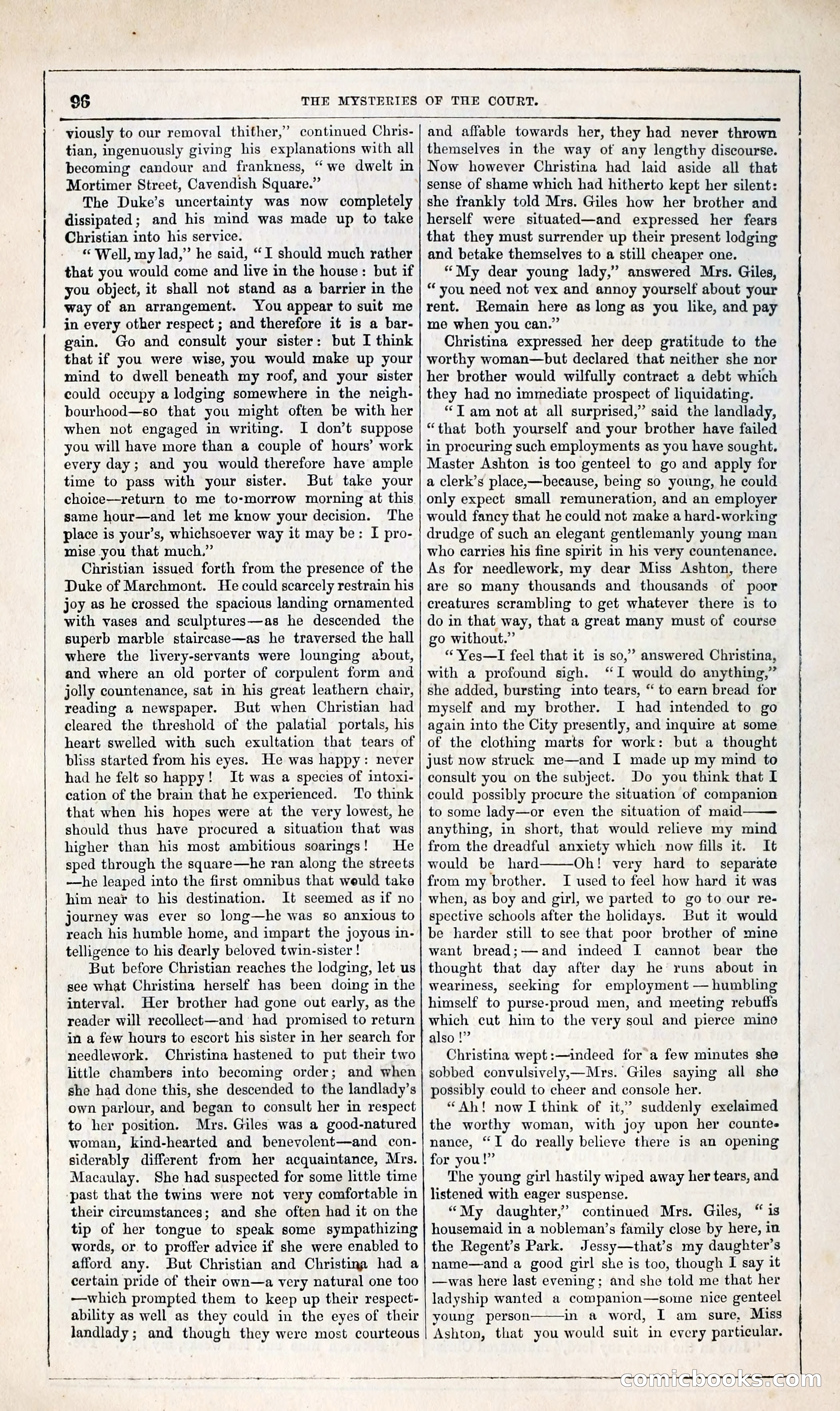
A restored page from Penny Dreadfuls, 1849. Page through the whole issue in the reader above.
📄 Transcribed text from this page (OCR, searchable)
Machine-transcribed from the original scan — historical spelling and the odd misread are preserved.
96 viously to our removal thither,” continued Chris- tian, ingenuously giving his explanations with all becoming candour and frankness, “we dwelt in Mortimer Street, Cavendish Square.” The Duke’s uncertainty was now completely dissipated; and his mind was made up to take Christian into his service. « Well, my lad,” he said, “I should much rather that you would come and live in the house: but if you object, it shall not stand as a barrier in the way of an arrangement. You appear to suit me in every other respect ; and therefore it is a bar- gain. Go and consult your sister: but I think that if you were wise, you would make up your mind to dwell beneath my roof, and your sister could occupy a lodging somewhere in the neigh- bourhood—so that you might often be with her when not engaged in writing. I don’t suppose you will have more than a couple of hours’ work every day; and you would therefore have ample time to pass with your sister. But take your choice—return to me to-morrow morning at this same hour—and let me know your decision. The place is your’s, whichsoever way it may be: I pro- mise you that much.” Christian issued forth from the presence of the Duke of Marchmont. He could scarcely restrain his joy as he crossed the spacious landing ornamented with vases and sculptures—as he descended the superb marble staircase—as he traversed the hall where the livery-servants were lounging about, and where an old porter of corpulent form and jolly countenance, sat in his great leathern chair, reading a newspaper. But when Christian had cleared the threshold of the palatial portals, his heart swelled with such exultation that tears of bliss started from his eyes. He was happy: never had he felt so happy! It was a species of intoxi- cation of the brain that he experienced. ‘To think that when his hopes were at the very lowest, he should thus have procured a situation that was higher than his most ambitious soarings! He sped through the square—he ran along the streets —he leaped into the first omnibus that weuld take him near to his destination. It seemed as if no journey was ever so long—he was £0 anxious to reach his humble home, and impart the joyous in- telligence to his dearly beloved twin-sister ! But before Christian reaches the lodging, let us see what Christina herself has been doing in the interval. Her brother had gone out early, as the reader will recollect—and had promised to return in a few hours to escort his sister in her search for needlework. Christina hastened to put their two little chambers into becoming order; and when she had done this, she descended to the landlady’s own parlour, and began to consult her in respect to her position. Mrs. Giles was a good-natured woman, kind-hearted and benevolent—and con- siderably different from her acquaintance, Mrs. Macaulay. She had suspected for some little time ‘past that the twins were not very comfortable in their circumstances; and she often had it on the tip of her tongue to speak some sympathizing words, or to proffer advice if she were enabled to afford any. But Christian and Christina had a certain pride of their own—a very natural one too —which prompted them to keep up their respect- ability as well as they could in the eyes of their landlady; and though they were most courteous ) A A THE MYSTERIES OF THE COURT. and affable towards her, they had never thrown themselves in the way of any lengthy discourse. Now however Christina had laid aside all that sense of shame which had hitherto kept her silent: she frankly told Mrs. Giles how her brother and herself were situated—and expressed her fears that they must surrender up their present lodging and betake themselves to a still cheaper one. “My dear young lady,” answered Mrs. Giles, “ you need not vex and annoy yourself about your rent. Remain here as long as you like, and pay me when you can.” Christina expressed her deep gratitude to the worthy woman—but declared that neither she nor her brother would wilfully contract a debt which they had no immediate prospect of liquidating. “T am not at all surprised,” said the landlady, “that both yourself and your brother have failed in procuring such employments as you have sought. Master Ashton is too genteel to go and apply for a clerk’s place,—because, being so young, he could only expect small remuneration, and an employer would fancy that he could not make a hard-working drudge of such an elegant gentlemanly young man who carries his fine spirit in his very countenance. As for needlework, my dear Miss Ashton, there are so many thousands and thousands of poor creatures scrambling to get whatever there is to do in that way, that a great many must of course go without.” “ Yes—lI feel that it is so,” answered Christina, with a profound sigh. “I would do anything,” she added, bursting into tears, “ to earn bread for myself and my brother. I had intended to go again into the City presently, and inquire at some of the clothing marts for work: but a thought just now struck me—and I made up my mind to consult you on the subject. Do you think that I could possibly procure the situation of companion to some lady—or even the situation of maid anything, in short, that would relieve my mind from the dreadful anxiety which now fills it. It would be hard Oh! very hard to separate from my brother. I used to feel how hard it was when, as boy and girl, we parted to go to our re- spective schools after the holidays. But it would be harder still to see that poor brother of mine want bread;—and indeed I cannot bear the thought that day after day he runs about in weariness, seeking for employment — humbling himself to purse-proud men, and meeting rebuffs which cut him to the very soul and pierce mine also !” Christina wept:—indeed for a few minutes she sobbed convulsively,—Mrs. Giles saying all she possibly could to cheer and console her. “Ah! now I think of it,’ suddenly exelaimed the worthy woman, with joy upon her countes nance, “I do really believe there is an opening for you!” The young girl hastily wiped away her tears, and listened with eager suspense. “My daughter,” continued Mrs. Giles, “ is housemaid in a nobleman’s family close by here, in the Regent’s Park. Jessy—that’s my daughter’s name—and a good girl she is too, though I say it —was here last evening; and she told me that her ladyship wanted a companion—some nice genteel young person in a word, I am sure, Miss Ashton, that you would suit in every particular. —COMAKE COOLEST