
Penny Dreadfuls, 1849 · page 114 of 394
The Mysteries of the Court of London — page 114: what you’re looking at
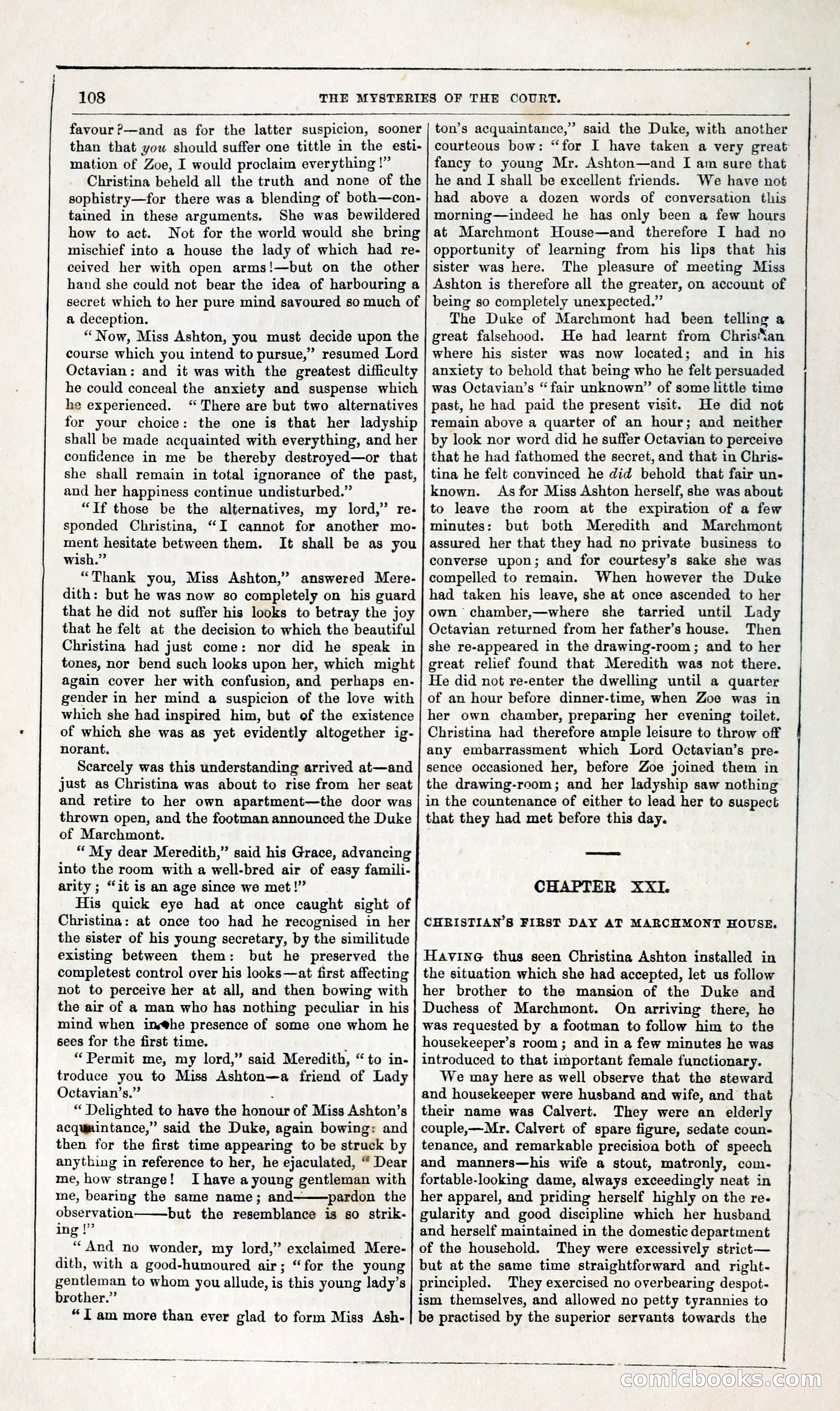
A restored page from Penny Dreadfuls, 1849. Page through the whole issue in the reader above.
📄 Transcribed text from this page (OCR, searchable)
Machine-transcribed from the original scan — historical spelling and the odd misread are preserved.
108 favour ?—and as for the latter suspicion, sooner than that you should suffer one tittle in the esti- mation of Zoe, I would proclaim everything !”’ Christina beheld all the truth and none of the sophistry—for there was a blending of both—con- tained in these arguments. She was bewildered how to act. mischief into a house the lady of which had re- ceived her with open arms!—but on the other hand she could not bear the idea of harbouring a secret which to her pure mind savoured so much of a deception. “Now, Miss Ashton, you must decide upon the course which you intend to pursue,’ resumed Lord Octavian: and it was with the greatest difficulty he could conceal the anxiety and suspense which he experienced. ‘“ There are but two alternatives for your choice: the one is that her ladyship shall be made acquainted with everything, and her confidence in me be thereby destroyed—or that she shall remain in total ignorance of the past, and her happiness continue undisturbed.” “Tf those be the alternatives, my lord,” re- sponded Christina, “I cannot for another mo- ment hesitate between them. It shall be as you wish.” “Thank you, Miss Ashton,” answered Mere- dith: but he was now so completely on his guard that he did not suffer his looks to betray the joy that he felt at the decision to which the beautiful Christina had just come: nor did he speak in tones, nor bend such looks upon her, which might again cover her with confusion, and perhaps en- gender in her mind a suspicion of the love with which she had inspired him, but of the existence of which she was as yet evidently altogether ig- norant. Scarcely was this understanding arrived at—and just as Christina was about to rise from her seat and retire to her own apartment—the door was thrown open, and the footman announced the Duke of Marchmont. “* My dear Meredith,” said his Grace, advancing into the room with a well-bred air of easy famili- arity ; “it is an age since we met!” His quick eye had at once caught sight of Christina: at once too had he recognised in her the sister of his young secretary, by the similitude existing between them: but he preserved the completest control over his looks—at first affecting not to perceive her at all, and then bowing with the air of a man who has nothing peculiar in his mind when ing@he presence of some one whom he sees for the first time. “Permit me, my lord,” said Meredith, “ to in- troduce you to Miss Ashton—a friend of Lady Octavian’s.” “‘ Delighted to have the honour of Miss Ashton’s acquaintance,” said the Duke, again bowing: and then for the first time appearing to be struck by anything in reference to her, he ejaculated, “ Dear me, how strange! Ihave a young gentleman with me, bearing the same name; and———pardon the observation but the resemblance is so strik- ing !” ‘“And no wonder, my lord,” exclaimed Mere- dith, with a good-humoured air; “for the young gentleman to whom you allude, is this young lady’s brother.” “IT am more than ever glad to form Miss Ash- Not for the world would she bring THE MYSTERIES OF THE COURT. ton’s acquaintance,” said the Duke, with another courteous bow: “for I have taken a very great fancy to young Mr. Ashton—and I am sure that he and I shall be excellent friends. We have not had above a dozen words of conversation this morning—indeed he has only been a few hours at Marchmont House—and therefore I had no opportunity of learning from his lips that his sister was here. The pleasure of meeting Miss Ashton is therefore all the greater, on account of being so completely unexpected.” The Duke of Marchmont had been telling a great falsehood. He had learnt from Chrisan where his sister was now located; and in his anxiety to behold that being who he felt persuaded was Octavian’s “fair unknown” of some little time past, he had paid the present visit. He did not remain above a quarter of an hour; and neither by look nor word did he suffer Octavian to perceive that he had fathomed the secret, and that in Chris- tina he felt convinced he did behold that fair un- known. As for Miss Ashton herself, she was about to leave the room at the expiration of a few minutes: but both Meredith and Marchmont assured her that they had no private business to converse upon; and for courtesy’s sake she was compelled to remain. When however the Duke had taken his leave, she at once ascended to her own chamber,—where she tarried until Lady Octavian returned from her father’s house. Then she re-appeared in the drawing-room; and to her great relief found that Meredith was not there. He did not re-enter the dwelling until a quarter of an hour before dinner-time, when Zoe was in her own chamber, preparing her evening toilet. Christina had therefore ample leisure to throw off any embarrassment which Lord Octavian’s pre- sence occasioned her, before Zoe joined them in the drawing-room; and her ladyship saw nothing in the countenance of either to lead her to suspect that they had met before this day. CHAPTER XXI. CHRISTIAN’S FIRST DAY AT MARCHMONT HOUSE. Havine thus seen Christina Ashton installed in the situation which she had accepted, let us follow her brother to the mansion of the Duke and Duchess of Marchmont. On arriving there, he was requested by a footman to follow him to the housekeeper’s room; and in a few minutes he was introduced to that important female functionary. We may here as well observe that the steward and housekeeper were husband and wife, and that their name was Calvert. They were an elderly couple,—Mr. Calvert of spare figure, sedate coun- tenance, and remarkable precisioa both of speech and manners—his wife a stout, matronly, com- fortable-looking dame, always exceedingly neat in her apparel, and priding herself highly on the re- gularity and good discipline which her husband and herself maintained in the domestic department of the household. They were excessively strict— but at the same time straightforward and right- principled. They exercised no overbearing despot- ism themselves, and allowed no petty tyrannies to be practised by the superior servants towards the GomiiGdooks co