
Penny Dreadfuls, 1849 · page 123 of 394
The Mysteries of the Court of London — page 123: what you’re looking at
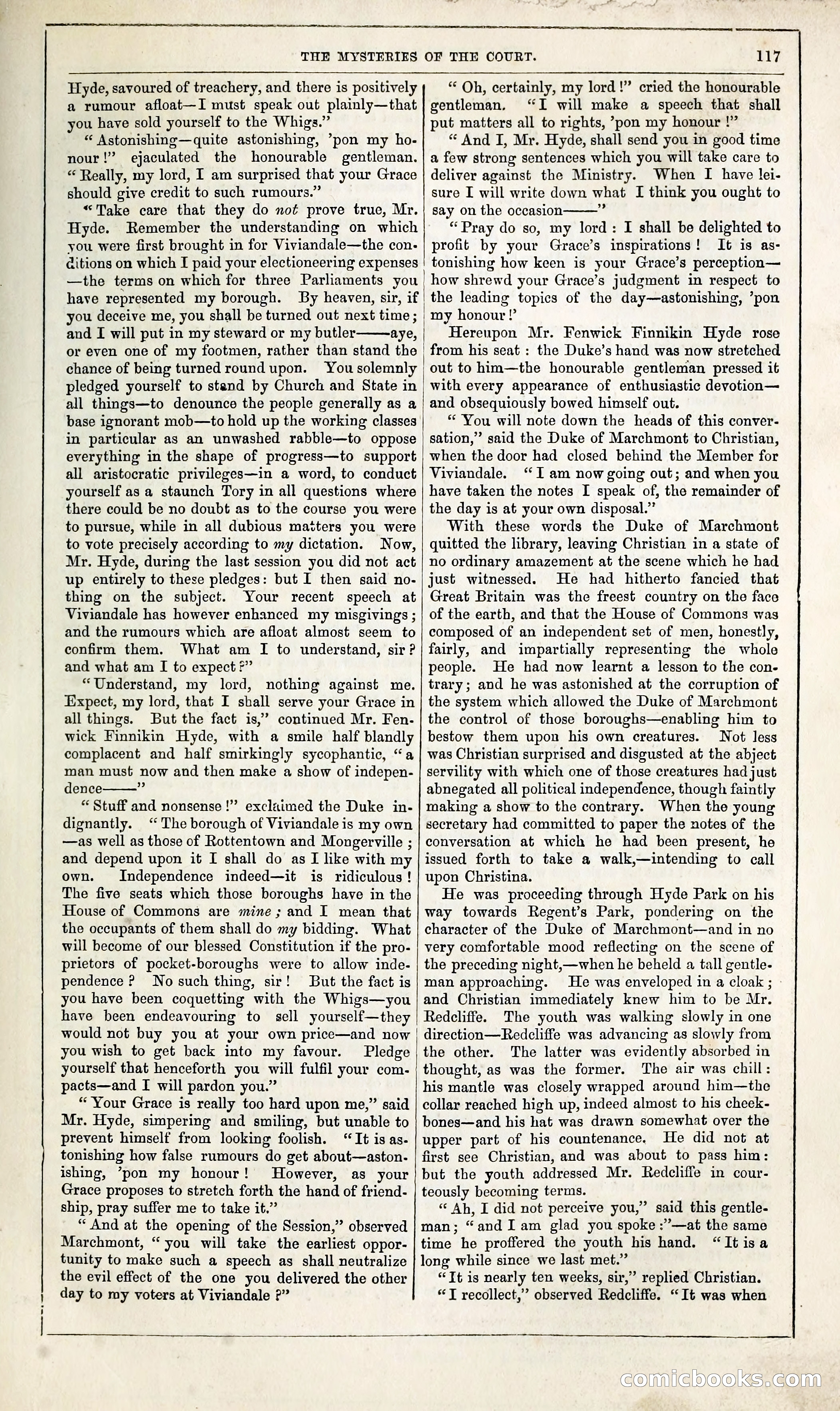
A restored page from Penny Dreadfuls, 1849. Page through the whole issue in the reader above.
📄 Transcribed text from this page (OCR, searchable)
Machine-transcribed from the original scan — historical spelling and the odd misread are preserved.
je ie te THE MYSTERIES OF THE COURT. 117 Hyde, savoured of treachery, and there is positively a rumour afloat—I must speak out plainly—that you have sold yourself to the Whigs.” “ Astonishing—quite astonishing, ’pon my ho- nour!” ejaculated the honourable gentleman. “ Really, my lord, I am surprised that your Grace should give credit to such rumours.” “Take care that they do not prove true, Mr. Hyde. Remember the understanding on which you were first brought in for Viviandale—the con- ditions on which I paid your electioneering expenses —the terms on which for three Parliaments you have represented my borough. By heaven, sir, if you deceive me, you shall be turned out next time ; and I will put in my steward or my butler aye, or even one of my footmen, rather than stand the chance of being turned round upon. You solemnly pledged yourself to stand by Church and State in all things—to denounce the people generally as a base ignorant mob—to hold up the working classes in particular as an unwashed rabble—to oppose everything in the shape of progress—to support all aristocratic privileges—in a word, to conduct yourself as a staunch Tory in all questions where there could be no doubt as to the course you were to pursue, while in all dubious matters you were to vote precisely according to my dictation. Now, Mr. Hyde, during the last session you did not act up entirely to these pledges: but I then said no- thing on the subject. Your recent speech at Viviandale has however enhanced my misgivings ; and the rumours which are afloat almost seem to confirm them. What am I to understand, sir? and what am I to expect ?” “Understand, my lord, nothing against me. Expect, my lord, that I shall serve your Grace in all things. But the fact is,’ continued Mr. Fen- wick Finnikin Hyde, with a smile half blandly complacent and half smirkingly sycophantic, “a man must now and then make a show of indepen- dence ¥ “ Stuff and nonsense !” exclaimed the Duke in- dignantly. “The borough of Viviandale is my own —as well as those of Rottentown and Mongerville ; and depend upon it I shall do as I like with my own. Independence indeed—it is ridiculous! The five seats which those boroughs have in the House of Commons are mine ; and I mean that the occupants of them shall do my bidding. What will become of our blessed Constitution if the pro- prietors of pocket-boroughs were to allow inde- pendence? Nosuch thing, sir! But the fact is you have been coquetting with the Whigs—you have been endeavouring to sell yourself—they would not buy you at your own price—and now you wish to get back into my favour. Pledge yourself that henceforth you will fulfil your com- pacts—and I will pardon you.” “Your Grace is really too hard upon me,” said Mr. Hyde, simpering and smiling, but unable to prevent himself from looking foolish. “It is as. tonishing how false rumours do get about—aston- ishing, *pon my honour! However, as your Grace proposes to stretch forth the hand of friend- ship, pray suffer me to take it,” “And at the opening of the Session,” observed Marchmont, “ you will take the earliest oppor- tunity to make such a speech as shall neutralize the evil effect of the one you delivered the other day to my voters at Viviandale ?” ——$ 1? “ Oh, certainly, my lord!” cried the honourable gentleman, “I will make a speech that shall put matters all to rights, pon my honour !” “ And I, Mr. Hyde, shall send you in good time a few strong sentences which you will take care to deliver against the Ministry. When I have lei- sure I will write down what I think you ought to say on the occasion a “Pray do so, my lord: I shall be delighted to profit by your Grace’s inspirations! It is as- tonishing how keen is your Grace’s perception— how shrewd your Grace’s judgment in respect to the leading topics of the day—astonishing, ’pon my honour!’ Hereupon Mr. Fenwick Finnikin Hyde rose from his seat : the Duke’s hand was now stretched out to him—the honourable gentleman pressed it with every appearance of enthusiastic devotion— and obsequiously bowed himself out. You will note down the heads of this conver- sation,’ said the Duke of Marchmont to Christian, when the door had closed behind the Member for Viviandale. “I am now going out; and when you have taken the notes I speak of, the remainder of the day is at your own disposal.” With these words the Duke of Marchmont quitted the library, leaving Christian in a state of no ordinary amazement at the scene which he had just witnessed. He had hitherto fancied that Great Britain was the freest country on the face of the earth, and that the House of Commons was composed of an independent set of men, honestly, fairly, and impartially representing the whole people. He had now learnt a lesson to the con- trary; and he was astonished at the corruption of the system which allowed the Duke of Marchmont the control of those boroughs—enabling him to bestow them upon his own creatures. Not less was Christian surprised and disgusted at the abject servility with which one of those creatures had just abnegated all political independence, though faintly making a show to the contrary. When the young secretary had committed to paper the notes of the conversation at which he had been present, he issued forth to take a walk,—intending to call upon Christina. He was proceeding through Hyde Park on his way towards Regent’s Park, pondering on the character of the Duke of Marchmont—and in no very comfortable mood reflecting on the scene of the preceding night,—when he beheld a tall gentle- man approaching. and Christian immediately knew him to be Mr. Redcliffe. The youth was walking slowly in one direction—Redcliffe was advancing as slowly from the other. The latter was evidently absorbed in thought, as was the former. The air was chill: his mantle was closely wrapped around him—the collar reached high up, indeed almost to his cheek- bones—and his hat was drawn somewhat over the upper part of his countenance. He did not at first see Christian, and was about to pass him: but the youth addressed Mr. Redcliffe in cour- teously becoming terms. “ Ah, I did not perceive you,” said this gentle- man; “and Iam glad you spoke :’—at the same time he proffered the youth his hand. “Itisa long while since we last met.” “Tt is nearly ten weeks, sir,” replied Christian. *T recollect,’ observed Redcliffe. “It was when He was enveloped in a cloak ; » DOOKS (C(O) (60)