
Penny Dreadfuls, 1849 · page 156 of 394
The Mysteries of the Court of London — page 156: what you’re looking at
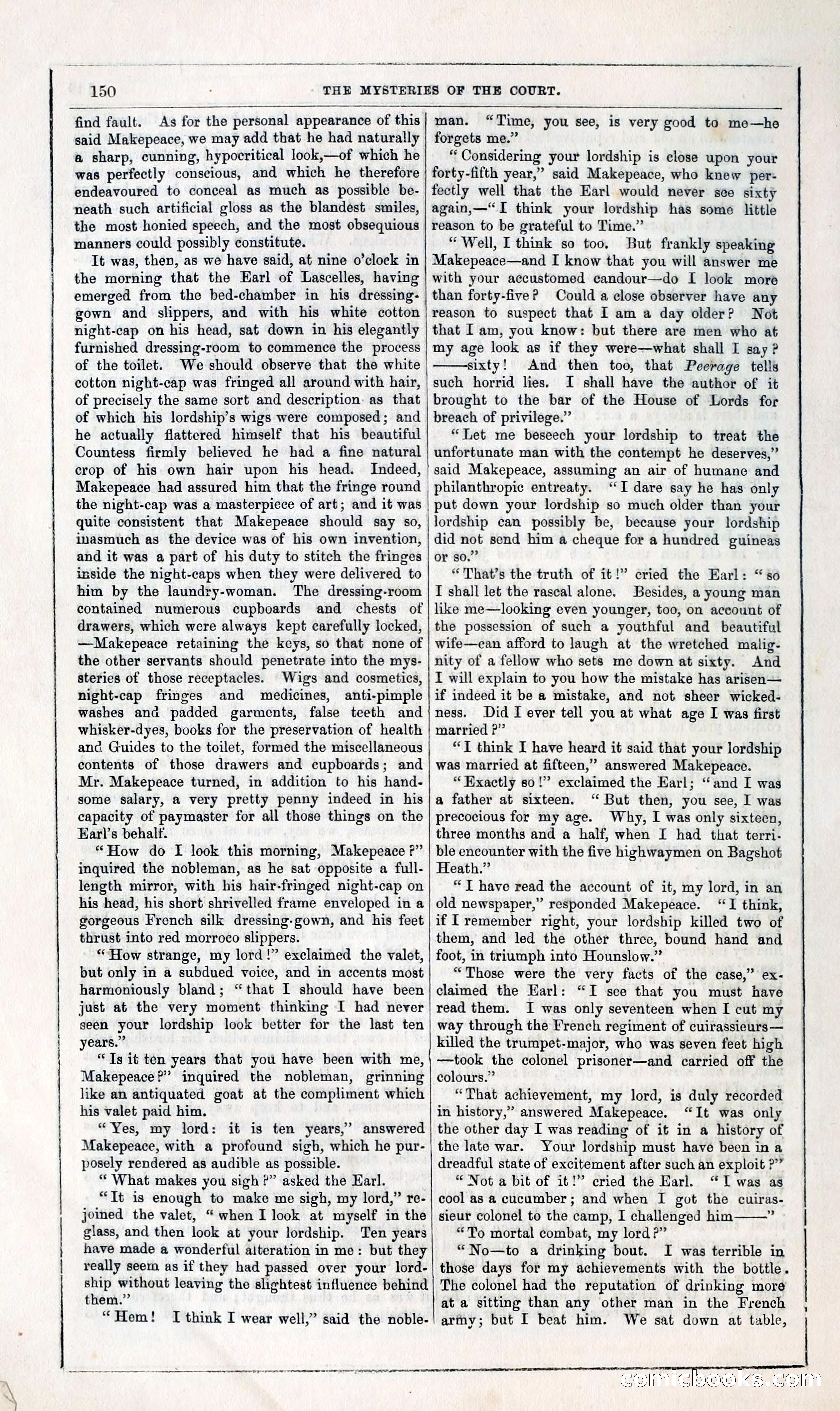
A restored page from Penny Dreadfuls, 1849. Page through the whole issue in the reader above.
📄 Transcribed text from this page (OCR, searchable)
Machine-transcribed from the original scan — historical spelling and the odd misread are preserved.
nel ee 8 THE MYSTERIES OF THE COURT. find fault. As for the personal appearance of this said Makepeace, we may add that he had naturally a sharp, cunning, hypocritical look,—of which he was perfectly conscious, and which he therefore endeavoured to conceal as much as possible be- neath such artificial gloss as the blandest smiles, the most honied speech, and the most obsequious manners could possibly constitute. It was, then, as we have said, at nine o’clock in the morning that the Earl of Lascelles, having emerged from the bed-chamber in his dressing- gown and slippers, and with his white cotton night-cap on his head, sat down in his elegantly furnished dressing-room to commence the process of the toilet. We should observe that the white cotton night-cap was fringed all around with hair, of precisely the same sort and description: as that of which his lordship’s wigs were composed; and he actually flattered himself that his beautiful Countess firmly believed he had a fine natural crop of his own hair upon his head. Indeed, Makepeace had assured him that the fringe round the night-cap was a masterpiece of art; and it was quite consistent that Makepeace should say so, inasmuch as the device was of his own invention, and it was a part of his duty to stitch the fringes inside the night-caps when they were delivered to him by the laundry-woman. The dressing-room contained numerous cupboards and chests of drawers, which were always kept carefully locked, —Makepeace retaining the keys, so that none of the other servants should penetrate into the mys- steries of those receptacles. Wigs and cosmetics, night-cap fringes and medicines, anti-pimple washes ana padded garments, false teeth and whisker-dyes, books for the preservation of health and Guides to the toilet, formed the miscellaneous contents of those drawers and cupboards; and Mr. Makepeace turned, in addition to his hand- some salary, a very pretty penny indeed in his capacity of paymaster for all those things on the Ear\’s behalf. “How do I look this morning, Makepeace P” inquired the nobleman, as he sat opposite a full- length mirror, with his hair-fringed night-cap on his head, his short shrivelled frame enveloped in a gorgeous French silk dressing-gown, and his feet thrust into red morroco slippers. “How strange, my lord!” exclaimed the valet, but only in a subdued voice, and in accents most harmoniously bland; “that 1 should have been just at the very moment thinking I had never seen your lordship look better for the last ten years.” “Is it ten years that you have been with me, Makepeace?” inquired the nobleman, grinning like an antiquated goat at the compliment which his valet paid him. “Yes, my lord: it is ten years,’ answered Makepeace, with a profound sigh, which he pur- posely rendered as audible as possible. “What makes you sigh ?” asked the Earl. “Tt is enough to make me sigh, my lord,” re- joined the valet, “when I look at myself in the glass, and then look at your lordship. Ten years have made a wonderful alteration in me: but they really seem as if they had passed over your lord- ship without leaving the slightest influence behind them.” “Hem! I think I wear well,” said the noble- a ee ee pS en a eee ee LOLLIPOP IO OED man. “Time, you see, is very good to me—he forgets me.” “ Considering your lordship is close upon your forty-fifth year,” said Makepeace, who knew per: fectly well that the Earl would never see sixty again,—“ I think your lordship has some little reason to be grateful to Time.” “Well, I think so too. But frankly speaking Makepeace—and I know that you will answer me with your accustomed candour—do I look more than forty-five? Could a close observer have any reason to suspect that I am a day older? Not that 1 am, you know: but there are men who at my age look as if they were—what shall I say ? ——sixty! And then too, that Peerage tells such horrid lies. I shall have the author of it brought to the bar of the House of Lords for breach of privilege.” “Let me beseech your lordship to treat the unfortunate man with the contempt he deserves,” said Makepeace, assuming an air of humane and philanthropic entreaty. “I dare say he has only put down your lordship so much older than your lordship can possibly be, because your lordship did not send him a cheque for a hundred guineas or 80.” “That’s the truth of it!” cried the Earl: “so I shall let the rascal alone. Besides, a young man like me—looking even younger, too, on account of the possession of such a youthful and beautiful wife—ean afford to laugh at the wretched malig- nity of a fellow who sets me down at sixty. And I will explain to you how the mistake has arisen— if indeed it be a mistake, and not sheer wicked- ness. Did I ever tell you at what age I was first married P” “T think I have heard it said that your lordship was married at fifteen,” answered Makepeace. “Exactly so!’ exclaimed the Earl; “and I was a father at sixteen. “But then, you see, I was precocious for my age. Why, I was only sixteen, three months and a half, when I had that terri- ble encounter with the five highwaymen on Bagshot Heath.” “T have read the account of it, my lord, in an old newspaper,” responded Makepeace. “I think, if [remember right, your lordship killed two of them, and led the other three, bound hand and foot, in triumph into Hounslow.” “Those were the very facts of the case,” ex- claimed the Earl: “I see that you must have read them. I was only seventeen when I cut my way through the French regiment of cuirassieurs— killed the trumpet-major, who was seven feet high —took the colonel prisoner—and carried off the colours.” “That achievement, my lord, is duly recorded in history,” answered Makepeace. “It was only the other day I was reading of it in a history of the late war. Your lordship must have been in a dreadful state of excitement after such an exploit P”’ “Not a bit of it!” cried the Earl. “T was as cool as a cucumber ; and when I got the cuiras- sieur colonel to the camp, I challenged him s “To mortal combat, my lord ?” “No—to a drinking bout. I was terrible in those days for my achievements with the bottle. The colonel had the reputation of drinking moré at a sitting than any other man in the French army; but I beat him. We sat down at table, A mM COOKS (CO) co