
Penny Dreadfuls, 1849 · page 172 of 394
The Mysteries of the Court of London — page 172: what you’re looking at
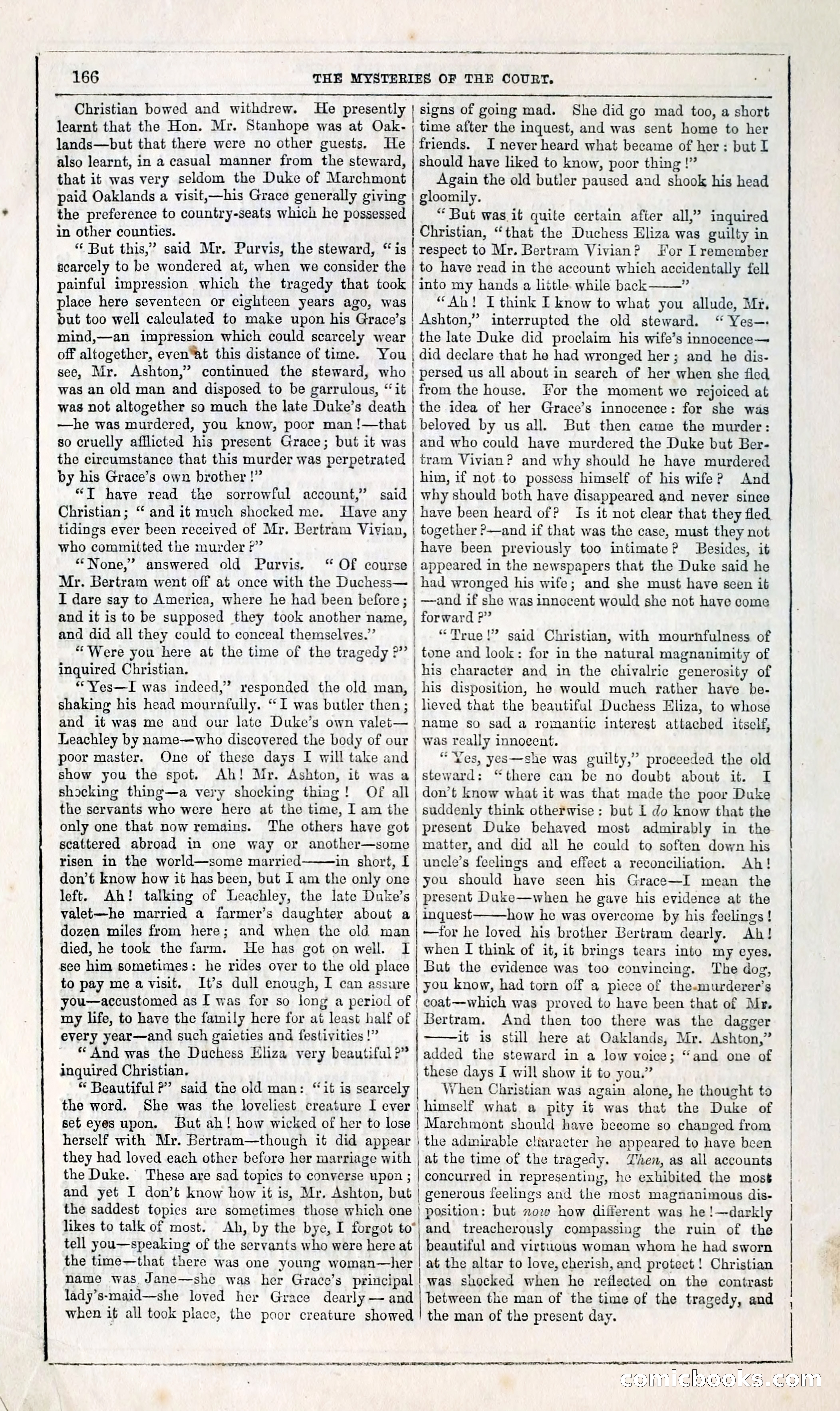
A restored page from Penny Dreadfuls, 1849. Page through the whole issue in the reader above.
📄 Transcribed text from this page (OCR, searchable)
Machine-transcribed from the original scan — historical spelling and the odd misread are preserved.
ET A ee SRE, a ee OE ly A lt NN te tl 166 THE MYSTERIES OF THE COURT, Christian bowed and withdrew. He presently | signs of going mad. She did go mad too, a short learnt that the Hon. Mr. Stanhope was at Oak- | time after the inquest, and was sent home to her lands—but that there were no other guests. Hej friends. I never heard what became of her: but L also learnt, in a casual manner from the steward, | should have liked to know, poor thing !” that it was very seldom the Duke of Marchmont| Again the old butler paused and shook his head paid Oaklands a visit,—his Grace generally giving | gloomily. the preference to country-seats which he possessed| “But was it quite certain after all,” inquired in other counties. Christian, “that the Duchess Eliza was guilty in “ But this,’ said Mr. Purvis, the steward, “is respect to Mr. Bertram Vivian? For I remember gearcely to be wondered at, when we consider the | to have read in the account which accidentally fell painful impression which the tragedy that took | into my hands a little while back Y place here seventeen or eighteen years ago, was “Ah! I think I know to what you allude, Mr, but too well calculated to make upon his Grace’s | Ashton,” interrupted the old steward. “ Yes—. mind,—an impression which could scarcely wear : the late Duke did proclaim his wife’s innocence— off altogether, even“at this distance of time. You | did declare that he had wronged her; and he dis- see, Mr. Ashton,” continued the steward, who : persed us all about in search of her when she fled was an old man and disposed to be garrulous, “it | from the house. For the moment we rejoiced at was not altogether so much the late Duke’s death | the idea of her Grace’s innocence: for she was —he was murdered, you know, poor man!—that | beloved by us all. But then came the murder: so cruelly afflicted his present Grace; but it was | and who could have murdered the Duke but Ber- the circumstance that this murder was perpetrated | tram Vivian? and why should he have murdered by his Grace’s own brother !” him, if not to possess himself of his wife? And “T have read the sorrowful account,” said | why should both have disappeared and never since Christian; “and it much shocked me. Have any | have been heard of? Is it not clear that they fled tidings ever been received of Mr. Bertram Vivian, | together ?—and if that was the case, must they not who committed the murder ?” | have been previously too intimate? Besides, it ““None,” answered old Purvis. ‘“ Of course | appeared in the newspapers that the Duke said he Mr. Bertram went off at once with the Duchess— | had wronged his wife; and she must have seen it I dare say to America, where he had been before ; | —and if she was innocent would she not have come and it is to be supposed they took another name, | forward ?” and did all they could to conceal themselves.” | “True!” said Christian, with mourhfulness of “Were you here at the time of the tragedy ?”? tone and look: for in the natural magnanimity of a i y . . ° y . . * . 5 . J inquired Christian. his character and in the chivalric generosity of *'Yes—I was indeed,’ responded the old man, | his disposition, he would much rather have be- shaking his head mournfully. “I was butler then; | lieved that the beautiful Duchess Eliza, to whose and it was me and our late Duke’s own valet— | name so sad a romantic interest attached itself, Leachley by name—who discovered the body of our | was really innocent. poor master. One of these days I willtakeand| “ Yes, yes—she was guilty,” proceeded the old show you the spot. Ah! Mr. Ashton, it was a| steward: “there can be no doubt about it. I shocking thing—a very shocking thing! Of all | don’t know what it was that made the poor Duke the servants who were here at the time, I am the | suddenly think otherwise: but 1 do know that the only one that now remains. The others have got | present Duke behaved most admirably in the scattered abroad in one way or another—some | matter, and did all he could to soften down his risen in the world—some married in short, I | uncle’s feelings and effect a reconciliation. Ah! don’t know how it has been, but I am the only one | you should have seen his Grace—I mean the left. Ah! talking of Leachley, the late Duke’s | present Duke—when he gave his evidence at the valet—he married a farmer’s daughter about a | inquest how he was overcome by his feelings! dozen miles from here; and when the old man |—for he loved his brother Bertram dearly. Ah! died, he took the farm. He has got on well. Ij} when I think of it, it brings tears into my eyes. see him sometimes: he rides over to the old place | But the evidence was too convincing. The dog, to pay me avisit. It’s dull enough, I can assure | you know, had torn off a piece of the.murderer’s you—accustomed as I was for so long a period of | coat—which was proved to have been that of Mr. my life, to have the family here for at least half of | Bertram. And then too there was the dagger every year—and such gaieties and festivities !” it is still here at Oaklands, Mr. Ashton,” And was the Duchess Eliza very beautiful?” | added the steward in a low yoice; “and one of inquired Christian. these days I will show it to you.” “ Beautiful?’ said the old man: “it is searcely| When Christian was again alone, he thought to the word. She was the loveliest creature I ever | himself what a pity it was that the Duke of set eyes upon. But ah! how wicked of her to lose | Marchmont should have beeome so changed from herself with Mr. Bertram—though it did appear | the adimirable character he appeared to haye been they had loved each other before her marriage with | at the time of the tragedy. When, as all accounts the Duke. These are sad topics to converse upon ; | concurred in representing, he exhibited the most and yet I don’t know how it is, Mr. Ashton, but | generous feelings and the most magnanimous dis- the saddest topics are sometimes those which one | position: but 2ow how different was he !—darkly likes to talk of most. Ah, by the bye, I forgot to’! and treacherously compassing the ruin of the tell you—speaking of the servants who were here at | beautiful and virtuous woman whom he had sworn the time—that there was one young woman—her | at the altar to love, cherish, and protect! Christian name was Jane—she was her Grace’s principal! was shocked when he reflected on the contrast lady’s-maid—she loved her Grace dearly — and | between the man of the time of the tragedy, and when if all took place, the poor creature showed! the man of the present day. et eT EE Le eg ee Ore BREST TS a ee RR SFT NET” 0 a Cr ee ree te, Beas ee SP LOTR, BSS ESE Ne ETT EP | WELT re Ole Fy « -™ Conmicloooks., e@