
Penny Dreadfuls, 1849 · page 18 of 394
The Mysteries of the Court of London — page 18: what you’re looking at
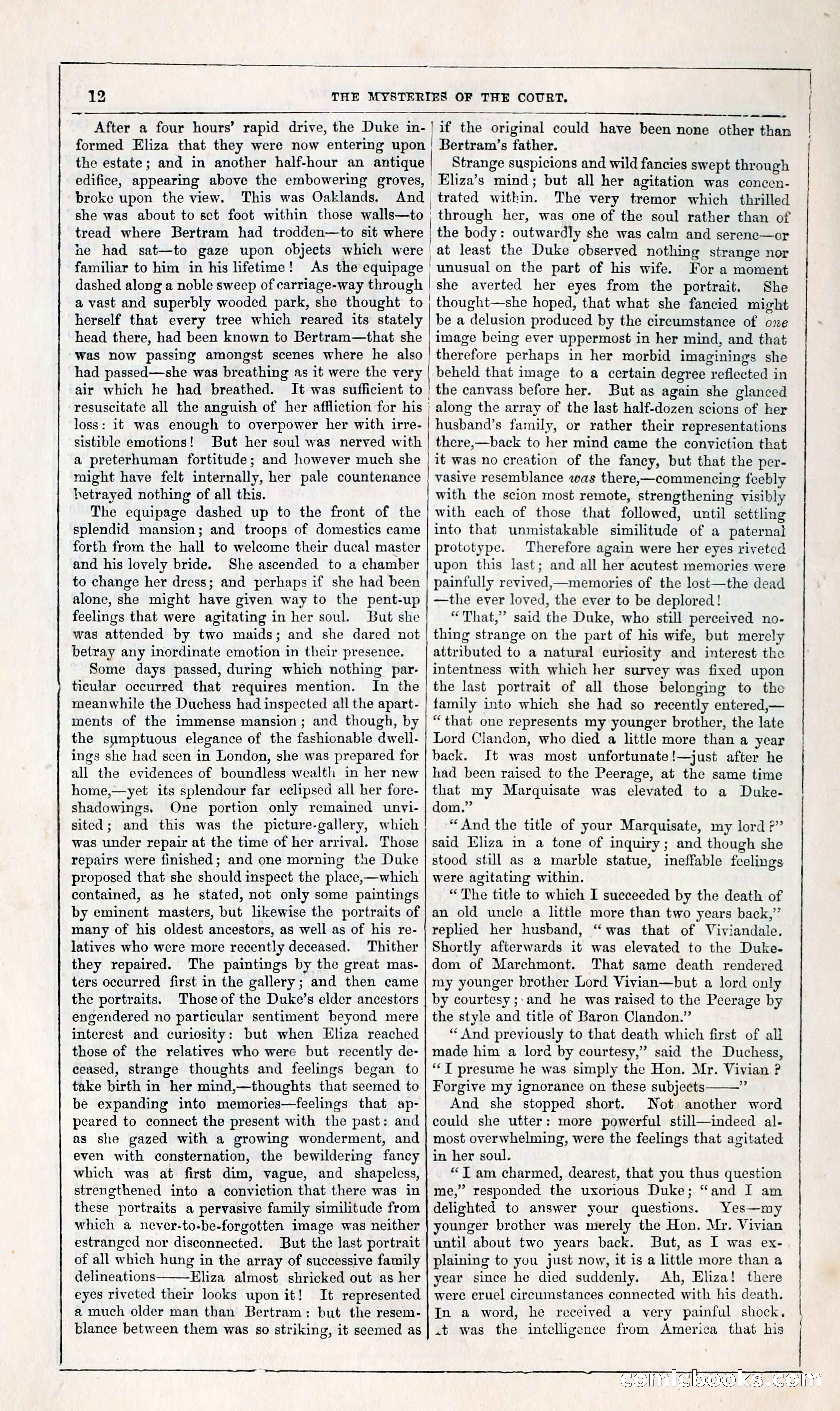
A restored page from Penny Dreadfuls, 1849. Page through the whole issue in the reader above.
📄 Transcribed text from this page (OCR, searchable)
Machine-transcribed from the original scan — historical spelling and the odd misread are preserved.
12 THE MYSTERIES OF THE COURT. After a four hours’ rapid drive, the Duke in-| if the original could have been none other than formed Eliza that they were now entering upon | Bertram’s father. the estate; and in another half-hour an antique! Strange suspicions and wild fancies swept through edifice, appearing above the embowering groves, | Eliza’s mind; but all her agitation was concen- broke upon the view. This was Oaklands. And trated within. The very tremor which thrilled she was about to set foot within those walls—to | through her, was one of the soul rather than of tread where Bertram had trodden—to sit where | the body: outwardly she was calm and serene—or ne had sat—to gaze upon objects which were familiar to him in his lifetime! As the equipage dashed along a noble sweep of carriage-way through a vast and superbly wooded park, she thought to herself that every tree which reared its stately head there, had been known to Bertram—that she was now passing amongst scenes where he also had passed—she was breathing as it were the very air which he had breathed. It was sufficient to resuscitate all the anguish of her affliction for his | loss: it was enough to overpower her with irre- sistible emotions! But her soul was nerved with a preterhuman fortitude; and however much she might have felt internally, her pale countenance hetrayed nothing of all this. The equipage dashed up to the front of the splendid mansion; and troops of domestics came forth from the hall to welcome their ducal master and his lovely bride. She ascended to a chamber to change her dress; and perhaps if she had been alone, she might have given way to the pent-up feelings that were agitating in her soul. But she was attended by two maids; and she dared not betray any inordinate emotion in their presence. Some days passed, during which nothing par- ticular occurred that requires mention. In the meanwhile the Duchess had inspected all the apart- ments of the immense mansion; and though, by the sumptuous elegance of the fashionable dwell- ings she had seen in London, she was prepared for all the evidences of boundless wealth in her new home,—yet its splendour far eclipsed all her fore- shadowings, One portion only remained unvi- sited; and this was the picture-gallery, which was under repair at the time of her arrival. Those repairs were finished; and one morning the Duke proposed that she should inspect the place,—which contained, as he stated, not only some paintings by eminent masters, but likewise the portraits of many of his oldest ancestors, as well as of his re- latives who were more recently deceased. Thither they repaired. The paintings by the great mas- ters occurred first in the gallery; and then came the portraits. Those of the Duke’s elder ancestors engendered no particular sentiment beyond mere interest and curiosity: but when Eliza reached those of the relatives who were but recently de- ceased, strange thoughts and feelings began to take birth in her mind,—thoughts that seemed to be expanding into memories—feelings that sap- peared to connect the present with the past: and as she gazed with a growing wonderment, and even with consternation, the bewildering fancy which was at first dim, vague, and shapeless, strengthened into a conviction that there was in these portraits a pervasive family similitude from which a never-to-be-forgotten image was neither estranged nor disconnected. But the last portrait of all which hung in the array of successive family delineations Eliza almost shrieked out as her eyes riveted their looks upon it! It represented a much older man than Bertram: but the resem- blance between them was so striking, it seemed as at least the Duke observed nothing strange nor unusual on the part of his wife. For a moment she averted her eyes from the portrait. She thought—she hoped, that what she fancied might be a delusion produced by the circumstance of one image being ever uppermost in her mind, and that therefore perhaps in her morbid imaginings she beheld that image to a certain degree reflected in the canvass before her. But as again she glanced along the array of the last half-dozen scions of her husband’s family, or rather their representations there,—back to her mind came the conviction that it was no creation of the fancy, but that the per- vasive resemblance was there,—commencing feebly with the scion most remote, strengthening visibly with each of those that followed, until settling into that unmistakable similitude of a paternal prototype. Therefore again were her eyes riveted upon this last; and all her acutest memories were painfully revived,—memories of the lost—the dead —the ever loved, the ever to be deplored! “That,” said the Duke, who still perceived no- thing strange on the part of his wife, but merely attributed to a natural curiosity and interest the intentness with which her survey was fixed upon the last portrait of all those belonging to the family into which she had so recently entered,— “that one represents my younger brother, the late Lord Clandon, who died a little more than a year back. It was most unfortunate!—just after he had been raised to the Peerage, at the same time that my Marquisate was elevated to a Duke- dom.” “And the title of your Marquisate, my lord ?” said Eliza in a tone of inquiry; and though she stood still as a marble statue, ineffable feelings were agitating within. “The title to which I succeeded by the death of an old uncle a little more than two years back,” replied her husband, “was that of Viviandale. Shortly afterwards it was elevated to the Duke- dom of Marchmont. That same death rendered my younger brother Lord Vivian—but a lord only by courtesy ;-and he was raised to the Peerage by the style and title of Baron Clandon.” “And previously to that death which first of all made him a lord by courtesy,” said the Duchess, “TI presume he was simply the Hon. Mr. Vivian ? Forgive my ignorance on these subjects A And she stopped short. Not another word could she utter: more powerful still—indeed al- most overwhelming, were the feelings that agitated in her soul. “JT am charmed, dearest, that you thus question me,” responded the uxorious Duke; “and I am delighted to answer your questions. Yes—my younger brother was merely the Hon. Mr. Vivian until about two years back. But, as I was ex- plaining to you just now, it is a little more than a year since he died suddenly. Ah, Eliza! there were cruel circumstances connected with his death. In a word, he received a very painful shock. .t was the intelligence from America that his im ClO OOS) (CO) (C© | | |